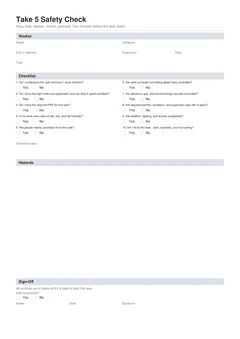
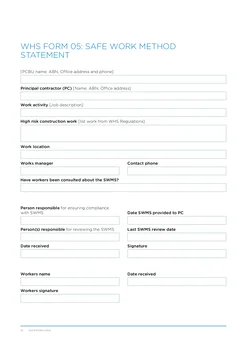
One builder wants a "Take 5". Another wants a "JSA". The high risk step still needs a SWMS whether anyone said the word or not. Choosing the wrong PDF wastes the morning at the gate.
Use the if-then path below. For labels and the full three-way comparison, read SWMS vs JSA vs Take 5. For filling the short form: How to complete a Take 5 on site.
When do you need a SWMS instead of a Take 5?
You need a SWMS whenever high risk construction work is about to start, and a Take 5 never substitutes for it. Under model WHS rules used across most of Australia, a PCBU that carries out high risk construction work must ensure a Safe Work Method Statement is prepared before that work starts. SafeWork NSW publishes clear guidance for NSW sites. Other states and territories apply the same high risk construction work concept through their WHS laws and codes.
A Take 5 does not replace that duty. Treat the SWMS trigger as hard. Treat Take 5 as a useful site habit and pack requirement on top.
High risk examples include fall risk more than two metres, work near energised electrical installations, work near powered mobile plant, and trenches deeper than 1.5 metres. Full lists live on your state regulator site and in the model Construction Work Code of Practice.
If-then decision tree
If the task is high risk construction work and no current SWMS exists for this method and site
then prepare or update a SWMS before that work starts. Do not start on a Take 5 alone. NSW detail: When is a SWMS required in NSW.
If the pack or PO names a document (SWMS, JSA, Take 5, risk assessment, toolbox)
then match that name for the gate file, and still run the SWMS check above.
If the pack requires a JSA for the package
then complete a site-specific JSA with crew sign-on. More: When is a JSA required.
If the pack or employer requires a daily or per-task pre-start
then complete a Take 5 before tools come out, even when a SWMS or JSA already exists.
If conditions change mid-shift (weather, plant, other trades, access, method)
then stop when safe, run a fresh Take 5 for the new conditions. If the high risk method itself changed, review the SWMS before resume.
If the supervisor only said "just send a Take 5" and high risk construction work applies
then prepare the SWMS, send both, and say clearly: SWMS covers the high risk method; Take 5 is the pre-task check.
If none of the high risk triggers apply, the pack only asks for a pre-task card, and the step is routine
then a Take 5 alone is usually enough for that moment.
When is a Take 5 enough on its own?
A Take 5 alone is usually enough when no high risk construction work trigger applies, the pack asks only for a pre-task card, and the step is routine. Common cases:
- Routine second fix or finishing with no high risk construction work activity
- Re-check after lunch when the morning SWMS still matches the method but weather or access shifted
- Personal check when joining a crew that already holds a current SWMS and toolbox for the activity
- Employer process that requires a daily Take 5 for all tasks as a minimum habit
- Small maintenance step on a site where the principal only asks for pre-task cards for low risk work
Even then, if the step grows into high risk construction work mid-job (for example a fall risk appears when edge protection is removed), escalate before that step continues.
When is a Take 5 not enough?
A Take 5 is never enough on its own once a high risk construction work trigger applies, or once the pack, auditor, or contract names a specific method document. Escalate in these cases:
- High risk construction work about to start and no SWMS exists
- Principal filed "SWMS" or "WHS Form 05" in the pack
- Client auditor asked for step-by-step JSA evidence for a multi-day package
- Licence or contract requires a specific method document beyond a personal check
Roof work with fall risk greater than two metres: a signed Take 5 about "being careful on the roof" does not replace a SWMS that names fall controls. Trench deeper than 1.5 metres with an excavator: Take 5 after rain is still useful for ground conditions, but it sits on top of the SWMS.
Stack without triple entry
- SWMS for the high risk method before that work starts (when the duty applies)
- JSA only if the client system still requires that format for the package
- Take 5 each morning or after a redesign so people re-check conditions
- Toolbox talk when the crew needs a group brief and attendance record
You do not need every document on every job. You need the legal SWMS when high risk construction work applies, plus whatever the principal's pack requires, plus enough pre-task discipline that people notice change.
Two worked if-thens
Electrical second fix, empty dwelling, circuits isolated and proven dead, no fall risk above two metres.
If no high risk construction work activity remains: Take 5 or company pre-start; JSA only if your system uses one for every board job. SWMS only if a high risk trigger is still present (for example work near energised services until isolation is complete).
Scaffolded facade, fall risk more than two metres.
If high risk construction work applies: SWMS before start. If the builder's portal asks for JSA: add the JSA. If the site wants morning pre-starts: Take 5 each day confirming scaffold and exclusion. Do not swap Take 5 for SWMS.
What supervisors should put in the induction
Name the documents the gate will ask for by form number or title. State when high risk construction work needs a SWMS before start. Say whether Take 5 is daily, per task, or on change only. Keep one method of work across SWMS, JSA, and Take 5 so rows do not contradict.
Building the habit without it becoming theatre
The risk with a per-task check is that it becomes a form people fill rather than a moment people take.
The signs are familiar. Every card looks the same, the task line never changes, and every answer is Yes. At that point the document exists and the check does not, which is worse than having no card because it produces evidence of a habit that is not real.
What keeps it honest is supervisors treating a No as normal rather than as a problem. A crew that has seen a No written down, acted on, and cause no trouble will write the next one. A crew that has seen a No turn into an argument will stop writing them.
When conditions change mid-shift
The most useful Take 5 is often the second one, done after something changed.
Weather turns, a scaffold bay comes out, another trade starts work overhead, or the method shifts. Each of those makes the morning check partly out of date, and the sensible response is a fresh check for the new conditions rather than an amendment to the old one.
Where the change affects a high risk method, that goes further than a Take 5 and back to the SWMS.
Related reading
- How to complete a Take 5 on site
- 9 Take 5 shortcuts that fail toolbox audits
- Take 5 record keeping and handover
- SWMS vs JSA vs Take 5
- JSA vs SWMS for builders
- Building forms hub
Official sources
- Manage risks (Safe Work Australia)
- Prepare safe work method statement (SafeWork NSW)
- Construction work (SafeWork NSW)
- Model Code of Practice: Construction work
Principal packs can add Take 5 and JSA requirements. They do not remove the SWMS duty for high risk construction work where it applies.