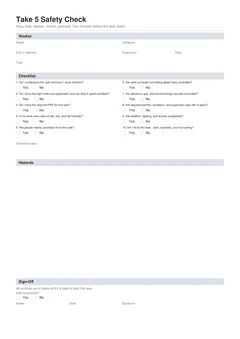
Toolbox audits rarely fail a Take 5 on missing logos. They fail it on timing and honesty: cards filled after the work, ten Yes answers with no notes, safe to proceed while a No is still open, or a short form handed to a gate that asked for a SWMS.
This list is about those shortcuts. It is not the same problem set as generic SWMS rows or empty JSA steps. Take 5 failures usually start when the pause never happened, or when the pause was faked on paper.
Field steps: How to complete a Take 5 on site. Decision path: When to use a Take 5. Document mix: SWMS vs JSA vs Take 5.
1. Writing the card after the tools are packed
A Take 5 is a pre-task check. Writing it at smoko or in the ute on the way home is a diary note. If something goes wrong mid-task, the form that was blank at start does not help the crew or the investigation.
Auditors match dates and times against attendance and photos. A 3pm signature for a 7am start is an easy catch.
Fix: open the form before the first tool comes out. Treat it like gloves and the right blade.
2. Tick and flick every answer to Yes
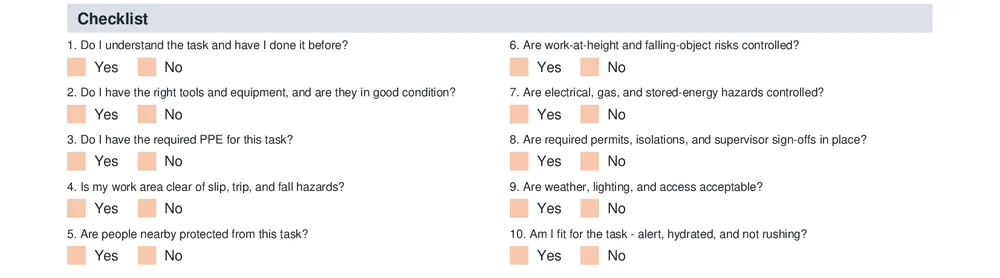
Ten Yes answers with no notes look efficient and often mean nobody looked. Sites with plant, wet floors, incomplete scaffold, or live services should trigger honest No answers or clear hazard rows.
SWMS audits fail on vague task rows. Take 5 audits fail on perfect checklists that never change week to week.
Fix: walk the work face while you answer. If a check is not true yet, mark No, write what is wrong, fix it or escalate, then update before safe to proceed.
3. Safe to proceed while a No is still open
"Safe to proceed" while scaffold is incomplete, isolation is unproven, or a permit is missing is the worst kind of complete form. The signature says go; the site says stop.
This is a Take 5-specific failure. A SWMS can list a control that will be installed later in the sequence. A Take 5 is about this start, now.
Fix: leave the form unsigned or not safe to proceed until the control is real. Escalate early so the crew is not standing around after a false start.

4. Task line that never changes
"Building works", "plumbing", or the client company name does not tell a supervisor which step you checked. Later the file holds a stack of identical tasks that cannot be tied to a moment on site.
Fix: name the step, location on site, and any access detail that matters for that start.
5. Reusing yesterday's PDF with a new date only
Copy-paste Take 5s with the same Yes answers and the same hazards on a different site or after weather change are a common audit complaint. Conditions move. Forms that never move look false.
JSA reuse fails when the address and steps stay from last suburb. Take 5 reuse fails when the checklist never shows a No on a messy morning.
Fix: duplicate only as a draft. Change location, task, checklist answers, and hazards for this start. Re-sign for this day.
6. One form signed by people who never looked
A single Take 5 signed by people who never walked the area is an attendance sheet, not a personal pre-task check. Crew sign-on belongs on a JSA. Take 5 ownership sits with the person starting the task.
Fix: each person who starts the task completes their own check, or your site has a clear group process that still includes a real walk-through. Do not collect signatures for people who left site.
7. Handing Take 5 when the pack asked for a SWMS
Gate checks fail when the pack says "SWMS before high risk work" and the subcontractor emails a Take 5 PDF. Longer hazard text on a Take 5 does not convert it into a SWMS under SafeWork NSW or model WHS rules.
This is the document-name failure. Common SWMS mistakes are about content inside Form 05. This shortcut is about bringing the wrong PDF entirely.
Fix: ask which document name closes the gate. Prepare the SWMS for high risk construction work, the JSA when that is the pack format, and Take 5 when the pre-task check is required as well. See When to use a Take 5.
8. Ignoring fitness, fatigue, and rushing
The last checklist item asks whether you are fit for the task: alert, hydrated, and not rushing. People skip it because it feels soft. Fatigue and time pressure sit behind many bad decisions on tools and plant.
Auditors who sample Take 5s notice when that item is always Yes on a crew working late under pour pressure.
Fix: answer it honestly. If the answer is No, fix rest, water, or programme pressure before you start the hazardous step. That is a valid stop.
9. Treating the form as the control
Writing "isolate board" on a Take 5 does not isolate the board. Controls live in the real world: locks on, prove dead, barriers up, exclusion set.
SWMS and JSA packs fail the same way when controls are paper-only. On a Take 5 the gap is sharper because the form is meant to confirm the control is already in place for this start.
Fix: implement first, then record. The form proves you thought and acted. It does not replace the action.
Quick self-audit before you download
- Date and time match a pre-start, not a post-job diary
- Task and site are specific enough for a stranger to place the work
- Every checklist item is answered
- Every No has a note and a control
- Hazard rows (if any) name real hazards and usable controls
- Safe to proceed matches reality on the ground
- You are not using this PDF to stand in for a missing SWMS or JSA
Open the Take 5 Safety Check and fix anything that fails before signature.
Supervisor habits that teach shortcuts
If supervisors only collect cards at week's end, crews learn that timing does not matter. If every rejected pack is about missing logos instead of missing controls, crews optimise for appearance.
Ask for today's Take 5s on today's work. Praise an honest No that delayed start until a control was fixed. Reject generic task lines the same way you reject missing signatures. Keep SWMS and Take 5 requests clearly named so people do not guess.
What these have in common
Almost every item above is a symptom of the same thing, which is the card being treated as the deliverable rather than the check being the point.
Once a crew believes the form is what matters, filling it faster becomes the rational behaviour and every shortcut on this list follows. Once they believe the two minutes of looking is what matters, most of the list stops happening on its own.
Supervisors set which of those is true, mostly by how they react to a No.
Fixing it without a lecture
The habits above rarely improve because someone was told off in a toolbox meeting.
What tends to work is smaller: a supervisor who reads the cards, asks about a No in a normal tone, and visibly does something about it. A crew that sees a written hazard produce a control will write the next one. That is the whole mechanism, and it is faster than any amount of retraining.
Related reading
- How to complete a Take 5 on site
- When to use a Take 5 pre-task check
- Take 5 record keeping and handover
- Digital vs paper Take 5
- SWMS vs JSA vs Take 5
- Common SWMS mistakes that fail NSW site audits
- Building forms hub
Official sources
- Manage risks (Safe Work Australia)
- Identify, assess and control hazards
- Model Code of Practice: How to manage work health and safety risks
- Prepare safe work method statement (SafeWork NSW)
A clean Take 5 PDF supports site systems. It does not replace legal SWMS duties for high risk construction work where they apply.