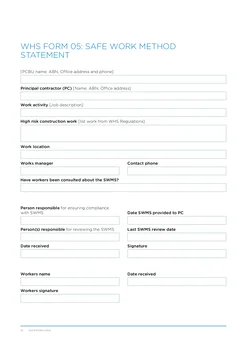
Open the HIISP Form 05 SWMS once you know the work is high risk construction work, and finish it before that task starts.
"Do we need a SWMS for this?" is a site gate question. Get it wrong and you either start high risk work without a plan, or you bury the crew in paperwork for tasks that never needed a SWMS.
SafeWork NSW is clear on the trigger: high risk construction work. This guide maps that duty into plain job language so builders, supervisors, and trade subcontractors can decide before tools come out.
Browse other NSW building forms for the wider HIISP pack. For filling Form 05 on site, use How to complete a NSW SWMS on site.
When is a SWMS required in NSW?
SafeWork NSW says a PCBU is required to have a SWMS prepared for high risk construction work before that work commences.
That sentence has three parts:
- Who: the PCBU carrying out the high risk work (or another person who already prepared the SWMS)
- What: high risk construction work, not every construction task
- When: before the work starts
If the job is not high risk construction work under the WHS rules, you still manage risks, but you do not automatically need a SWMS document for that activity.
What counts as high risk construction work?
SafeWork NSW lists high risk construction work on its construction work page. The list includes:
| High risk construction work | Common site examples |
|---|---|
| Risk of a person falling more than two metres | Roof work, upper-storey framing, scaffold edges, void work |
| Work on a telecommunication tower | Tower maintenance and installation |
| Demolition of load-bearing or structural elements | Structural demolition, load path changes |
| Disturbance of asbestos | Removal or work likely to disturb asbestos materials |
| Structural alterations needing temporary support | Propping during load path changes |
| Work in or near a confined space | Tanks, pits, some roof voids and service ducts |
| Shaft or trench deeper than 1.5 m | Deep drainage, footings, services trenches |
| Work in or near a tunnel | Tunnelled services or civil works |
| Use of explosives | Blasting and explosive work |
| Work on or near pressurised gas mains or piping | Gas service work near live distribution |
| Work on or near chemical, fuel or refrigerant lines | Plant rooms, service corridors |
| Work on or near energised electrical installations or services | Live switchboards, services that remain energised |
| Contaminated or flammable atmosphere | Some remediation and industrial sites |
| Tilt-up or precast concrete | Panel erection and temporary stability work |
| Work on, in or adjacent to roads or traffic corridors in use | Lane work, driveway traffic interfaces |
| Areas with movement of powered mobile plant | Crane, excavator, telehandler zones |
| Artificial extremes of temperature | Controlled hot or cold work environments |
| Work in or near water with drowning risk | Wharf, flood, pool excavation contexts |
| Diving work | Underwater construction tasks |
If your task sits on that list, plan the SWMS before the task starts. If you are unsure, read the SafeWork NSW list and the Construction work Code of Practice rather than guessing from habit.
Who must act: PCBU, subcontractor, principal
PCBU doing the high risk work
SafeWork NSW says the PCBU that carries out high risk construction work must ensure a SWMS is prepared or already prepared by another person.
More than one PCBU
Each PCBU must consult, cooperate, and coordinate. SafeWork NSW gives the example of a subcontractor on a principal contractor site: the subcontractor develops the SWMS for their high risk work, taking into account site conditions and the project WHS management plan, and develops it in consultation with the principal so agreed controls are in place before the activity starts.
Principal contractor
For construction projects where a principal contractor applies, SafeWork NSW says the principal must get a copy of the SWMS relating to high risk construction work. The SWMS must be updated when control measures change.
Do not assume "the builder has a SWMS" covers your trade method. Check the document names the high risk work you will do and the controls your crew will use.
Do you need one SWMS or many?
SafeWork NSW says:
- One SWMS can cover several high risk construction work activities
- Or you can prepare a separate SWMS for each high risk activity
- If you split them, cross-reference activities that affect each other
Example: asbestos roof sheeting removal with a fall risk greater than two metres needs fall controls and asbestos controls to work as one system, whether they sit in one document or two linked documents.
Can you use a generic SWMS template?
A generic SWMS can cover high risk activities you do often. SafeWork NSW still requires a review that takes site-specific hazards and risks into account.
Before you reuse last month's SWMS:
- Confirm the high risk activities still match
- Update location, access, nearby trades, plant, and services
- Change any control that is not available on this site
- Re-consult workers if the method changed
A template that never changes is a risk document, not a living SWMS.
What does not need to be on the SWMS
SafeWork NSW says you do not need to include activities that are not defined as high risk construction work in a SWMS.
That keeps the document short enough for workers to use. Low-risk packing, clean-up, or ordinary tasks can sit in other site systems (inductions, toolbox talks, JSA or Take 5 where your site uses them) without bloating the SWMS.
After the trigger: minimum content
Once a SWMS is required, SafeWork NSW expects it to identify the high risk work, hazards and risks, control measures, and how controls will be implemented, monitored, and reviewed. People using the document must understand it.
Full field walkthrough: How to complete a NSW SWMS on site.
Trade examples: when the trigger usually fires
These are common residential and light commercial situations. Always check the SafeWork NSW list for your exact task.
Electricians
Work on or near energised electrical installations or services is on the high risk list. Isolation and prove-dead methods still need a clear SWMS when the activity meets that description. Roof solar work often also triggers fall risk more than two metres.
Roofers and carpenters
Fall risk more than two metres covers a large share of upper-storey and roof work. Edge protection, temporary work platforms, and access changes should appear in the method before sheets or frames go up.
Plumbers and drainers
Trenches deeper than 1.5 metres, work near pressurised gas, and some confined space pits trigger SWMS duties. Shallow service digs may not. Measure and check before you assume "it is only a house job".
Plant and civil crews
Movement of powered mobile plant, work adjacent to live traffic corridors, and deep excavation often sit on the list even on small housing estates when excavators, cranes, or road interfaces are present.
Asbestos-related work
Work that involves or is likely to involve disturbance of asbestos is high risk construction work. Licensed removal also brings control plan and clearance paperwork beyond the SWMS. Do not treat a SWMS alone as the full asbestos system.
Stop-work rule when the method is ignored
If work is not being conducted in accordance with the SWMS, SafeWork NSW says work must cease immediately or as soon as it is safe to do so. Work must not resume until it can be carried out in accordance with the SWMS, after review if needed.
That is the practical test on site: if the edge protection is not up yet, the SWMS does not green-light starting the high risk step.
Where to keep the SWMS while the answer is "yes"
When a SWMS is required, SafeWork NSW says keep it available at the workplace where the high risk construction work will be carried out until that work is completed. Electronic copies are fine if workers can get to them easily on site.
Principals often want a copy for the project file as well. Update them when control measures change so the site office copy matches what the crew is actually doing.
HIISP Form 05 vs other SWMS templates
SafeWork NSW publishes multiple SWMS resources, including HIISP Form 05 for the housing industry site safety pack, a high risk construction work method statement example, and trade examples such as demolition.
Principals and clients often ask for the HIISP layout on residential work. The legal duty is still the high risk construction work SWMS content, not a particular filename. Use the layout your site pack requires, and make sure the content still meets SafeWork NSW minimums.
Use the NSW WHS Form 05 SWMS when you need the HIISP layout. Related reading:
Quick decision checklist
Use this before you start the next stage:
- Does any planned task match the SafeWork NSW high risk construction work list?
- If yes, is a current SWMS already prepared for that method on this site?
- If you are reusing a template, have you reviewed it for this site today?
- Are controls named in the SWMS actually available before the task starts?
- Do workers know where to find the SWMS and what it says?
- Does the principal need a copy for this project?
If step 1 is yes and step 2 is no, stop the high risk task plan until the SWMS is ready.
Official sources
- Prepare safe work method statement
- Construction work and high risk list
- Safe Work Australia interactive SWMS guidance
- Housing industry site safety pack
Confirm current requirements on the official pages for your job type and project size.