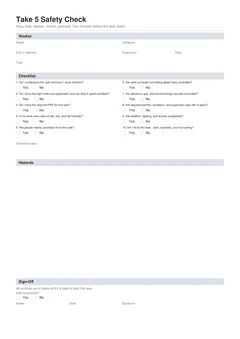
A Take 5 only works before the first tool comes out. Stop, look at the job, assess what can hurt someone, put controls in place, then proceed. Two minutes on the phone before you climb beats a wet pad or a blank card found after the fact.
Open the Take 5 Safety Check when you are ready to fill. Related templates: building forms hub. Labels: SWMS vs JSA vs Take 5.
What is a Take 5 safety check?
A Take 5 is a short pre-task risk check the worker completes themselves, in the minutes before a task starts. Safe Work Australia describes risk management as identify hazards, assess risks, control risks, and review controls; a Take 5 is a personal version of that loop for the task about to start. It is not a full workplace risk assessment and not a Safe Work Method Statement.
Sites also call it Stop Take 5, personal risk assessment, or pre-task check. Principals set the habit. High risk construction work still needs a SWMS under model WHS rules when that duty applies.
Use a Take 5 when the pack or employer requires a pre-task check, when conditions changed after the SWMS or JSA was written, when you want a quick record before a routine or medium-risk step, or when a supervisor asks for pre-start proof. Do not use it alone when high risk construction work applies and no SWMS exists. Decision path: When to use a Take 5.
Who fills out a Take 5?
One worker per Take 5: the person about to start the task. Three people on the same step need three short checks, not one form signed by people who never looked. Supervisors can still walk the ground with the crew. The form records that this worker stopped, checked, and signed. It does not replace a toolbox talk.
Details first
Worker name and site location. Real induction name. Job address or the site identifier the principal already uses, plus stage or lot if they use them.
Task description. The step you are about to start, not the whole project. Weak: "Building works". Usable: "Install first-floor window reveals, east elevation, scaffold in place".
Task date. Today's date for the check you are doing now. Backdating after the work breaks the pre-task purpose.
What are the ten Take 5 checks?
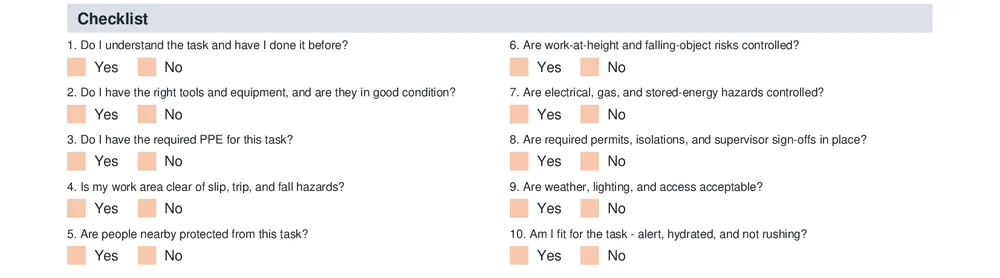
The ten checks cover task understanding, tools and equipment, PPE, work area, people nearby, work at height, stored energy, permits and sign-offs, weather and access, and personal fitness. Answer every item. A No is not a fail of the form. It is a flag that something needs a note and a control before you mark safe to proceed.
- Do I understand the task and have I done it before? If the method is new to you, stop and get a competent person to walk it through before you answer Yes.
- Do I have the right tools and equipment, and are they in good condition? Missing plant, damaged leads, or the wrong ladder is a No until fixed or swapped.
- Do I have the required PPE for this task? Hard hat, eye protection, gloves, harness, hearing protection, or task-specific gear named in the SWMS or site rules.
- Is my work area clear of slip, trip, and fall hazards? Debris, open edges, wet floors, loose sheeting, and poor access all matter.
- Are people nearby protected from this task? Hot works, grinding, plant swing radius, falling objects, and dust that hits other trades.
- Are work-at-height and falling-object risks controlled? Edge protection, platforms, exclusion zones, and tool tethering where needed.
- Are electrical, gas, and stored-energy hazards controlled? Isolation, prove dead, gas isolation, residual energy in plant or systems.
- Are required permits, isolations, and supervisor sign-offs in place? Hot work, confined space, excavation, or site-specific permits before you start.
- Are weather, lighting, and access acceptable? Storms, wind on sheets, night work without lighting, and blocked egress.
- Am I fit for the task - alert, hydrated, and not rushing? Fatigue and time pressure are real site risks.
When the answer is No, write a short note on what is wrong and what you will do before proceeding. "No - scaffold incomplete on west side; waiting on builder edge protection check" is usable. "No - be careful" is not.
Hazard rows that match this task
Use optional hazard rows when a check flagged a risk or the task has a clear hazard even if every check is Yes. Each row needs a plain-language hazard, a risk rating (Low, Medium, High, or Extreme), and a control you will use today.
Prefer a real engineering or isolation control over "use PPE" alone when a stronger control is available.
When can you mark safe to proceed?
Only mark safe to proceed when every checklist item is answered, every No has a note and a control in place or agreed before start, hazard rows (if any) have usable controls, and you are ready to start now. Sign with name and date. If you are not safe to proceed, do not sign Yes. Fix the issue, update the form, or escalate.

Walk-through: second-fix doors on a two-storey reno
Scaffold is up. Painters are downstairs. You will hang doors on the first floor.
- Open Take 5 on the phone before you climb.
- Task: "Hang internal doors first floor, rooms 1 to 3, scaffold access north".
- Work through the ten checks. If the scaffold access is cluttered with paint tins, answer No on work area and clear it or get it cleared.
- Add a hazard if needed: "Other trades below - falling tools". Control: tool lanyards, exclusion under the work face, brief the painters.
- Confirm you are fit and not rushing for a late delivery.
- Sign, download PDF, start the doors.
If mid-morning the builder removes a scaffold bay for deliveries, stop. Re-check height and falling-object items. Update or start a new Take 5 for the changed access. If the work is high risk construction work and the method changed, also review the SWMS under your state rules.
How this fits with JSA and SWMS
- Take 5: short pre-task check for the person starting the work
- JSA: step-by-step job safety analysis when the site wants that format
- SWMS: planning document for high risk construction work before that work starts
A finished Take 5 does not skip the SWMS. A finished SWMS does not remove a fresh eyes check when conditions change. Full comparison: SWMS vs JSA vs Take 5.
Keep the record
Store the PDF against the job. Hand a copy to the principal if they ask. Filing detail: Take 5 record keeping and handover. Paper vs phone: Digital vs paper Take 5.
On multi-trade mornings, name only your step. Flag other trades in the "people nearby" check. If another trade removes a control you relied on, stop and re-check. Do not sign someone else's Take 5 for them.
Common traps
- Filling at smoko after the work
- Tick and flick all Yes without looking
- Task description that names the project only
- Safe to proceed while a No is still open
- Take 5 PDF when the gate asked for a SWMS
Longer list: 9 Take 5 shortcuts that fail toolbox audits.
Related guides and forms
- When to use a Take 5 pre-task check
- 9 Take 5 shortcuts that fail toolbox audits
- Take 5 record keeping and handover
- Digital vs paper Take 5
- SWMS vs JSA vs Take 5
- How to complete a NSW SWMS on site
- National JSA · NSW SWMS Form 05
Official sources
- Manage risks (Safe Work Australia)
- Identify, assess and control hazards
- Model Code of Practice: How to manage work health and safety risks
- Prepare safe work method statement (SafeWork NSW)
Principal packs can require Take 5 records on top of legal duties. They do not remove the SWMS duty for high risk construction work where it applies. You remain responsible for the work, the controls on site, and the downloaded PDF.