Pick the right document for the gate check. Use the NSW SWMS for high risk construction work, plus JSA or Take 5 when the site pack asks for them.
Site offices mix the labels. A principal asks for a "JSA", a builder asks for a "SWMS", and the crew already did a Take 5 in the ute. Handing over the wrong PDF creates rework even when the risk talk was solid.
This guide separates the three documents the way tradies actually meet them on Australian residential and light commercial jobs, with SafeWork NSW rules for SWMS as the hard line.
Browse building forms for the templates behind each of the three, or NSW building forms if you are working to a NSW pack.
Side-by-side comparison
| SWMS | JSA | Take 5 | |
|---|---|---|---|
| Main job | Plan high risk construction work | Break a job into steps, hazards, and controls | Quick check before starting a task |
| NSW legal trigger | Yes for high risk construction work | Not the same as the SWMS duty | Not the SWMS duty |
| Length | Medium; focused on high risk activities | Medium to long; full job steps | Short; minutes |
| Typical asker | Principal, SafeWork focus, site pack Form 05 | Client or company system | Supervisor or crew habit |
| When | Before high risk work starts | Before the job or stage | At the start of a task or shift |
| Template | HIISP Form 05 SWMS | National JSA | National Take 5 |
SWMS: high risk construction work plan
SafeWork NSW defines the SWMS as the document for high risk construction work. It must identify that work, the hazards and risks, the controls, and how controls are implemented, monitored, and reviewed. Workers need to understand it. It must be available on site while the work continues.
Triggers include fall risk more than two metres, work near energised electrical services, work near powered mobile plant, deep trenches, asbestos disturbance, and the rest of the SafeWork NSW high risk list. Details: When is a SWMS required in NSW.
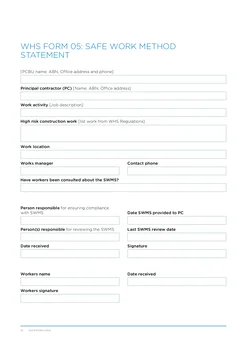
On many housing sites the expected layout is HIISP WHS Form 05. Other projects use a different SWMS template. The content duty is the same: site-specific high risk method, not a generic essay.
JSA: step-by-step job safety analysis
A job safety analysis (sometimes called a job hazard analysis) walks the job in steps: what you do, what can go wrong, how you control it. Companies and clients often ask for a JSA as part of their own WHS system.
A thorough JSA can look similar to a SWMS table. That does not automatically make it a SWMS under SafeWork NSW rules. If the work is high risk construction work, you still need a SWMS that meets SWMS content and timing rules. Some businesses map JSA content into their SWMS template so they are not maintaining two contradictory methods.
Use a national JSA when the site or client asks for that format, or when you want a broader step analysis beyond the high risk-only SWMS focus.
Take 5: short pre-task check
Take 5 (and similar names: Stop Take 5, personal risk assessment) is a short pause before work: look for changes, name a few hazards, confirm controls, start the task. It is useful when conditions change mid-day or when the SWMS covers the method but the crew needs a fresh eyes check.
A Take 5 does not replace a SWMS for high risk construction work. SafeWork NSW still wants the SWMS prepared before that work starts. A completed Take 5 card will not satisfy a principal who asked for Form 05.
Use a national Take 5 for the short check, and keep the SWMS as the high risk planning document.
Which document do you need on site?
Step 1
Check the legal trigger
High risk construction work?
If yes, a SWMS must exist or be updated before that work starts.
Step 2
Match the pack's wording
SWMS, JSA, Take 5, Form 05
Use the name they used so the site file closes cleanly.
Step 3
Add the pre-start
Take 5 or toolbox talk
Extra communication on top of the SWMS, never a substitute.
Step 4
Re-check on change
Stop and review
A new Take 5 catches the change. Update the SWMS if the method changed.
The legal duty and the principal's paperwork are answered separately, in that order.
How they work together without triple data entry
A practical stack for a residential high risk task:
- Risk assessment (HIISP Form 04) for the site walk and hazard list
- SWMS (HIISP Form 05) for the high risk method
- Toolbox talk (Form 06) or Take 5 to communicate before the crew starts
- JSA only if the client system still requires that format
You do not need every document on every job. You need the legal SWMS when high risk construction work applies, plus whatever the principal's pack requires.
See also NSW WHS site pack: SWMS, risk assessment, toolbox.
Mistakes this mix causes
- Sending a Take 5 when the gate asked for a SWMS
- Writing a long JSA that never names the high risk construction work type
- Filling three documents with three different methods for the same task
- Reusing a SWMS PDF and skipping the Take 5 when the site conditions changed that morning
Keep one method of work. Reflect it in the document the site filed, and keep the SWMS current when the high risk method changes.
Example: electrical work on a two-storey renovation
The crew will install new circuits and work near services that may remain energised until isolation is complete. Scaffold is up for first-floor work with a fall risk greater than two metres.
Likely documents:
- SWMS: high risk construction work for energised or near-energised electrical work (as applicable) and fall risk work, with isolation, prove-dead, barriers, and fall controls named before those steps start
- Take 5: each morning or after a redesign, confirming isolation status and scaffold condition
- JSA: only if the principal's system still files job steps under that name
If the principal only asked for "a JSA", still check whether high risk construction work applies. If it does, prepare a SWMS that meets SafeWork NSW content rules, even if you also fill their JSA template.
Example: drainage trench on a housing lot
Excavation will exceed 1.5 metres in places, with an excavator moving on site.
Likely documents:
- SWMS: trench and powered mobile plant high risk construction work, benching or shoring, exclusion zones, plant spotter rules
- Risk assessment (Form 04): wider site hazards including spoil placement and public access
- Toolbox talk: morning brief on plant movements and trench entry rules
- Take 5: if ground conditions change after rain
A Take 5 alone is not enough once the trench depth and plant movement hit the high risk list.
What to hand the gate
Ask what document name the principal filed in the induction pack. Then:
- Match that filename or form number if you can
- Confirm high risk construction work still has a current SWMS
- Keep one clear method across every document you submit
Keep the NSW SWMS, national JSA, and national Take 5 as separate PDFs so you are not forcing one layout to pretend to be another.
Language cheat sheet for site meetings
When someone says:
- "Have you got a SWMS?" they usually mean the high risk construction work method document, often HIISP Form 05 on housing work
- "Have you got a JSA?" they may mean their company template. Check whether high risk construction work still needs a SWMS as well
- "Just do a Take 5" they want a short pre-task check. Useful, but not enough alone when the SafeWork NSW high risk list applies
- "Send me your paperwork" ask which form numbers or document names close their gate. Guessing wastes the afternoon
If you manage mixed crews, put the expected document names in the induction so subcontractors stop guessing at the gate and bring the right PDF the first time. Clear names save everyone a return trip to the ute.
Official sources
- Prepare safe work method statement
- Construction work
- Housing industry site safety pack
- Model Code of Practice: Construction work
Company procedures and principal packs can add documents on top of the SWMS duty; they do not remove it for high risk construction work.