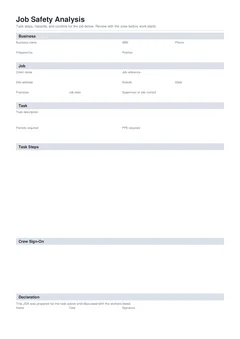
"Have you got a JSA?" is one of the most common gate questions on Australian building sites. The answer is not only yes or no. It is whether your document matches the pack, whether high risk construction work also needs a SWMS, and whether the steps match how the crew will work today.
This guide explains when JSAs get required in practice, how that sits next to legal SWMS triggers, and what to prepare so you are not stuck at the fence.
How to write one: How to write a JSA on site. Comparison: JSA vs SWMS for builders and SWMS vs JSA vs Take 5. Building forms: building forms hub.
Legal line first: SWMS and risk management
Under model WHS laws used across most of Australia, a PCBU must manage risks to health and safety so far as reasonably practicable. For high risk construction work, a Safe Work Method Statement must be prepared before that work starts. SafeWork NSW publishes practical guidance for NSW sites. Other jurisdictions apply the same high risk construction work concept through their WHS laws and construction codes.
High risk construction work includes activities such as fall risk more than two metres, work near energised electrical installations, work near powered mobile plant, trenches deeper than 1.5 metres, and other listed activities. See your state regulator and the model Construction Work Code of Practice.
The regulations name SWMS for that high risk planning duty. They do not create a single national form titled "JSA" as the mandatory high risk document. That is why site language confuses people.
Where JSA requirements come from
In practice, a JSA is required when one or more of these say so:
Principal contractor site pack
Housing and commercial principals often list "JSA required before start" in induction handbooks, site rules, or online portals. No JSA, no start. The layout may be their template or "contractor's own JSA".
Client or head contractor WHS system
Mines, industrial clients, and large builders may standardise on JSA language for every work package, including work that is not high risk construction work.
Your own PCBU procedures
Electrical, plumbing, and building companies often require a JSA for every new job or every high complexity package as internal policy. That policy can be stricter than the minimum legal SWMS list.
Tender, prequalification, and insurance questionnaires
Forms ask whether you use JSAs, how you consult workers, and how you keep records. Winning work then commits you to the system you described.
Supervisor instruction on the day
Even without a portal, a site manager can refuse start until a written step analysis exists for a tricky package.
When you should expect a JSA ask
Common moments:
- First morning on a new principal's site
- Starting a new trade package after another trade finishes
- After a method change (plant swap, redesign, weather event)
- When multiple subcontractors share a face and the principal wants one method written down
- When the purchase order or scope says "submit JSA before mobilisation"
If the induction mentions JSA, prepare it before the first billable hour on site, not after the first complaint.
When a Take 5 is not the same requirement
A Take 5 is a short pre-task check. Some supervisors say "JSA" when they mean any risk paper. Others say "Take 5" when the portal still requires a multi-step JSA. Clarify the name and the depth:
- Take 5: minutes, personal or short checklist
- JSA: step-by-step job analysis with hazards and controls, usually with crew sign-on
- SWMS: high risk construction work planning document with regulated content expectations
Decision path for the short form: When to use a Take 5.
When SWMS is required even if nobody said JSA
Do not wait for the word "SWMS" if the work is high risk construction work. Prepare the SWMS before that work starts. On many NSW housing sites the expected layout is HIISP WHS Form 05. Other projects use different SWMS templates. Content still needs the high risk work, hazards, risks, controls, and how controls are implemented, monitored, and reviewed.
If the gate only said "JSA", still check the high risk list. Provide the JSA they named and the SWMS the law requires when both apply. NSW trigger guide: When is a SWMS required in NSW.
Decision path at the gate
Step 1
Read the pack
What did it actually name?
SWMS, JSA, Take 5, or a form number. Match the word used.
Step 2
Check for high risk work
The legal trigger
If HRCW is involved, a current SWMS must exist before it starts.
Step 3
Check your own procedure
Company system
If it requires a JSA, do one even when the principal only asked for a SWMS.
Step 4
Sign on today's crew
After a real review
Conditions must match the written method. Add late starters.
The pack's wording tells you what to hand over. It does not tell you what the law requires.
Worked examples
Residential second fix carpentry, no high risk activity
Principal pack says JSA before start. No fall risk over two metres, no plant high risk list item.
Prepare: site-specific JSA with steps, hazards, controls, crew sign-on. Optional Take 5 each morning if company habit. SWMS not required for high risk construction work if none applies, but follow any stricter site rule.
Scaffolded work with fall risk more than two metres
Prepare: SWMS before work starts; JSA if the builder still wants that label for the package; Take 5 on change or daily if required. Do not treat JSA alone as the high risk plan.
Electrical work near services that may be energised
Prepare: SWMS for the high risk electrical construction work activity as applicable; JSA if the principal files work under that name; isolation and prove-dead controls consistent across documents.
Client portal only accepts their JSA upload field
Prepare: complete a proper step analysis in their form or download your national JSA PDF if they accept contractor format. Still keep SWMS records for high risk work even if the portal's field is labelled JSA only. Ask the site manager where SWMS files go if the portal is unclear.
What "required" means for subcontractors
If you are a subcontractor:
- The principal can set site entry conditions including JSA submission
- Your PCBU duties for risk management and SWMS still sit with you for your work
- "The builder should have done it" is not a plan for your crew's high risk steps
- Consult your workers so the steps match how they will work, not only how the tender was written
If you are the principal:
- State document names clearly in induction
- Tell subcontractors when high risk construction work needs a SWMS before start
- Do not accept a Take 5 as a SWMS for high risk work
- Keep received JSAs and SWMS files available for the project system
Reuse rules when the site "always wants a JSA"
High volume crews often keep template JSAs for repeat packages. That is fine as a draft source. Before each site:
- Update address, client, date, plant, and other trades
- Adjust steps for this building and access
- Clear and recollect crew sign-on
- Align with any SWMS for high risk steps
Generic JSAs that never change are a common reason safety advisors reject packs. See Common JSA mistakes.
Contracts, POs, and scope notes that create JSA duties
Read the paperwork before mobilisation. JSA requirements hide in:
- Purchase order special conditions
- Subcontract WHS annexures
- Principal contractor site rules linked from the induction QR code
- Client prequalification answers you already submitted
- Builder app checklists that block site access until a file uploads
If you promised JSAs in a prequalification form, treat that as a live duty for the jobs you win under that scheme. If the PO says submit method statements five days before start, plan the writing time into the programme so the crew is not waiting on the fence.
What if the builder will not let you start without a JSA and you only brought a SWMS?
Upload or hand over both if high risk work applies. If the work is not high risk construction work and they still want a JSA, write the step analysis on site before start rather than arguing labels for an hour. A national JSA finished in rows is usually faster than a fight about whether the SWMS "should count".
If they demand their exact template fields, copy your method into their form once, then keep your own PDF for company records so you are not locked into a portal you cannot re-download later.
Related guides
- How to write a JSA on site
- Common JSA mistakes tradies make
- JSA crew sign-on and handover
- JSA vs SWMS for builders
- SWMS vs JSA vs Take 5
- When is a SWMS required in NSW
- When to use a Take 5 pre-task check