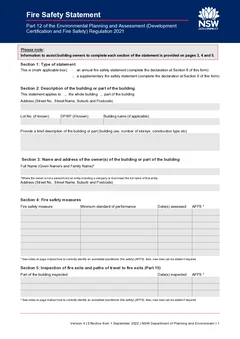
"Do we need an AFSS this year?" is the first filter for owners, strata managers, agents and fire safety contractors. Get the trigger wrong and you either miss a yearly obligation or start a full statement pack for a building that is still only in the certificate stage of new works.
NSW Planning is plain about the form's place in the system. A fire safety statement is issued by or on behalf of the owner of an existing building. It confirms that an accredited practitioner (fire safety) has assessed, inspected and verified each fire safety measure that applies to the building. Annual statements cover essential measures each year. Supplementary statements cover critical measures at shorter intervals set by the schedule.
This guide answers when the statement is required, who must act, and how to separate it from the fire safety certificate. For the full prepare-and-lodge workflow, use the Annual Fire Safety Statement NSW guide. For record packs after lodgement, use the AFSS record keeping and handover guide.
Browse NSW fire safety forms for the live templates, or compare both documents in the certificate vs statement guide.
The short answer
You generally need a NSW Fire Safety Statement when:
- The building is an existing building with a fire safety schedule, and
- Essential fire safety measures apply to that building, and
- The annual statement is due for those essential measures, or
- Critical measures on the schedule require a supplementary statement at a shorter interval
If the job is completion of new building work and the measures have just been installed or upgraded, you are usually in fire safety certificate territory first. Once the building is in its ongoing maintenance and assessment cycle, the statement is the recurring form.
Do not decide from building class alone. Decide from the current fire safety schedule and the Regulation requirements that apply to that schedule.
What the statement is for
NSW Planning describes two statement types on the fire safety certification page:
- Annual fire safety statements must be issued each year and include all essential fire safety measures that apply to a building. The annual statement also verifies that an accredited practitioner has inspected and confirmed that the exit systems comply with the Regulation.
- Supplementary fire safety statements are issued at more regular intervals, as specified in the fire safety schedule, for critical fire safety measures.
Both use the approved fire safety statement template. The current official layout used in Tradie Forms is Version 4.
In plain job language:
| Situation | Usual form |
|---|---|
| Yearly check of essential measures on an existing building | Annual Fire Safety Statement |
| Extra interval checks for critical measures listed on the schedule | Supplementary Fire Safety Statement |
| New work finished and measures installed or upgraded | Fire Safety Certificate |
| Schedule changed after works or an order | Confirm current schedule, then use the form that matches the stage |
If you are unsure which form the building is in, open the current schedule and the last completion or statement pack before booking practitioners.
Which buildings commonly need one
Buildings with a fire safety schedule and essential fire safety measures generally need an AFSS. NSW material commonly links those measures with Building Code of Australia Class 1b and Class 2 to 9 buildings.
That often includes:
- Apartment buildings and other Class 2 residential buildings
- Boarding houses and similar Class 1b or Class 3 uses
- Offices, shops and other commercial buildings
- Warehouses and industrial buildings with scheduled measures
- Health, education and public buildings where a schedule applies
- Mixed-use buildings with shared fire systems and exits
Class alone is not enough. A building may have been altered, a schedule may have been reissued, or a fire safety order may have changed the measures. Always read the current fire safety schedule for that property.
If the property has no fire safety schedule and no essential measures listed for ongoing statements, do not invent an AFSS from habit. Confirm with the owner records, council history and current NSW rules for that building.
Who must make sure it happens
Building owner
The statement is issued by or on behalf of the owner. The owner is responsible for the statement cycle even when a strata manager, agent or fire safety contractor organises the work.
Authorised agent
An agent may prepare and issue the statement on behalf of the owner where authority exists. Keep that authority with the building record so the declaration role is defensible later.
Accredited practitioner (fire safety)
Practitioners assess and verify the measures and, for annual statements, inspect exit systems. NSW Planning and Fair Trading material explain accreditation pathways, including the Fire Protection Association Australia scheme for functions covered by that scheme.
The assessing practitioner must not make the owner declaration. That restriction also extends to their employer, employee or direct associate. Keep assessment roles and declaration roles separate.
Building manager and strata staff
They often book the practitioners, hold the schedule, lodge copies and refresh the foyer display. They still work under the owner's obligation, not instead of it.
Annual versus supplementary: when each is required
Annual statements
Use the annual statement when the yearly essential-measure obligation is due. NSW Planning says annual statements must be issued each year and include all essential fire safety measures that apply to the building. They also cover the exit system inspection requirement.
In practice, the annual due date is usually tracked from the previous annual statement. Confirm the exact timing rules in the current Regulation and any council process for that building before you lock in assessment bookings.
Assessment and inspection timing matters. Existing NSW guidance used in the AFSS workflow says an annual fire safety statement must not be issued unless the assessment and inspection have been carried out within the previous 3 months. Do not collect reports over half a year and then backdate the story.
Supplementary statements
Use a supplementary statement when the fire safety schedule nominates critical fire safety measures and sets more regular intervals for them.
Supplementary is not a shortcut annual statement. It is a different obligation for critical measures. If the schedule does not identify critical measures and shorter intervals, do not force a supplementary form because the team wants a mid-year paper trail for ordinary essential measures.
Existing NSW guidance used in the AFSS workflow says a supplementary fire safety statement must not be issued unless the assessment has been carried out within the previous month. That shorter window is easy to miss when reports arrive late.
When a certificate is required instead
A fire safety certificate is issued by or on behalf of a building owner when new building work is complete. It confirms that a properly qualified person has installed and checked the measures listed in the fire safety schedule so those measures can perform to the minimum standard.
Use the certificate when:
- New building work that includes fire safety measures is complete
- Measures have been installed or upgraded as part of that work
- The completion pack needs the certificate form, not the annual owner statement
After that completion stage, the building usually moves into the ongoing statement cycle under the current schedule. Do not reuse last year's certificate as this year's AFSS, and do not use an AFSS to close brand-new works that still need a certificate.
Read the NSW Fire Safety Certificate final and interim guide when the job is still in the works stage.
Decision path for a live building
Use this path before you open the form.
Step 1
Get the current schedule
Not last year's statement
If you only have last year's statement, stop here.
Step 2
Confirm the building stage
Certificate or statement
New works completion points to a certificate. A yearly cycle points to a statement.
Step 3
Book the assessment windows
Accredited practitioner
Annual assessments inside the previous 3 months, supplementary inside the previous month.
Step 4
Confirm who issues
Owner or authorised agent
The APFS assesses and inspects. They cannot make the owner's declaration.
This path stops the common error of filling a pretty PDF before anyone confirmed the building needs that form this month.
Then plan the three completion paths (council, Fire and Rescue NSW with the current schedule, and building display), check whether critical measures need supplementary statements, and only then fill the official form.
That path stops the common error of filling a pretty PDF before anyone has confirmed the building even needs that form this month.
Special cases that confuse people
Mixed-use and part-building statements
The official form asks whether the statement applies to the whole building or part of the building. Part statements are common on large sites, staged projects and multi-tenancy complexes. The requirement still sits on the owner for the measures that apply. The scope on the form must match the schedule and the assessments.
After a fire safety order or reissued schedule
If council reissues a schedule, or an order changes measures, the next statement must follow the current schedule. Do not keep using an obsolete measure list because it matches last year's PDF.
Change of ownership mid-cycle
A sale does not erase the schedule. The new owner inherits the building's fire safety paperwork trail. Hand over the latest statement, schedule, practitioner reports and lodgement proof as part of settlement or management change.
Multiple buildings under one street address
Industrial parks and campus sites may need separate statements for separate buildings or fire compartments. Check how the schedules are written before combining everything into one form for convenience.
Buildings with few measures
A small commercial building with a short schedule still needs a clean annual statement if essential measures apply. The form is shorter, not optional.
What "required" means for lodgement and display
Needing a statement is only half the duty. Completing the cycle also means:
- Giving the statement to the relevant council
- Providing a copy of the statement and the current fire safety schedule to Fire and Rescue NSW
- Ensuring the statement and current schedule are prominently displayed in the building
If the PDF is signed but never lodged or displayed, the building has paperwork, not a finished obligation. Record keeping after lodgement is covered in the AFSS record keeping and handover guide.
Timing mistakes that look like "not required yet"
Teams sometimes delay the AFSS because:
- The practitioner report is late, so they assume the due date moves
- Building works are underway, so they assume the annual cycle pauses without checking
- A certificate was issued mid-year, so they assume no annual statement is needed under the new schedule
- Critical measures are due, but the team only tracks the annual date
None of those shortcuts replace reading the schedule and current rules. If works are underway, confirm with the certifier, owner and current schedule whether a certificate, annual statement, supplementary statement or combination applies.
Who usually starts the conversation
In practice, the AFSS question is raised by different people at different times:
- Strata or building managers tracking the annual calendar
- Fire safety contractors quoting assessment packages
- Owners or agents responding to council reminders
- Solicitors or buyers during sale due diligence
- Facilities teams taking over a multi-building portfolio
Whoever starts the conversation should still land on the same source documents: current fire safety schedule, last statement or certificate pack, and the current NSW rules for annual and supplementary statements. A contractor quote is not proof the statement is due, and a sale date is not proof the schedule disappeared.
If you are the contractor, ask for the schedule and last statement before you promise a form. If you are the owner or agent, give practitioners the current schedule early so assessments match the measures that actually apply. That avoids a late discovery that the wrong statement type was booked.
Quick checklist: do we need a statement now?
- Building has a current fire safety schedule
- Essential measures apply and the annual date is due, or critical measures are due under a shorter interval
- This is not only a new-works certificate moment
- Owner or authorised agent is ready to issue
- APFS assessments and, for annual statements, exit inspections can fall inside the allowed windows
- Council, FRNSW and display pathways are known for this building
If those boxes are ticked, start the statement. If they are not, fix the gap before you fill measure tables.
Next steps
Open the NSW Fire Safety Statement when the obligation is confirmed. Use the AFSS online guide for preparation and lodgement detail, the common mistakes checklist before download, and the record keeping guide after copies leave the office.
For completion-stage works, start the NSW Fire Safety Certificate. Browse NSW fire safety forms or fire safety forms by state for more templates.
Who does the testing behind the due date
The date on the statement is fixed, but the work behind it is spread across the year. Whoever services the measures needs their own records ready before the practitioner assesses. For emergency and exit lighting that is the six-monthly and annual results in an emergency lighting test register; for alarms it is a smoke alarm service record.
If you are the contractor rather than the owner, the fire safety forms hub has the records that feed a statement.
Official references
Check current requirements on the NSW Planning fire safety certification page, Fire and Rescue NSW fire safety statement lodgement guidance, the Environmental Planning and Assessment (Development Certification and Fire Safety) Regulation 2021, and the NSW guide to selecting an accredited practitioner.