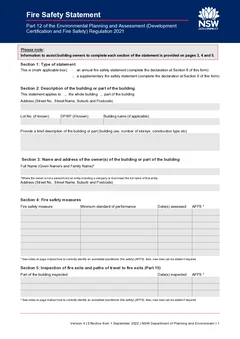
Tradie Forms: choose the right NSW fire safety form before you start filling. Use the Fire Safety Certificate for completion-stage certification, and the Fire Safety Statement for annual or supplementary existing-building obligations. Then fill the official PDF layout, preview it, and download a clean copy.
NSW fire safety paperwork uses similar words for different moments. Certificate. Statement. Annual. Supplementary. Final. Interim. They can all involve a fire safety schedule, fire safety measures, assessment records, and owner declarations.
Pick the wrong form and the job gets messy. A certificate might be prepared when the building actually needs an annual fire safety statement. A supplementary statement might be treated like the yearly AFSS. A final certificate might be used when only part of the building is complete.
This guide sorts the practical difference so owners, agents, fire safety teams, and building managers can start with the right form and keep the job record clean.
What is the difference between a fire safety certificate and a statement?
Use a NSW Fire Safety Certificate when new building work, a completed part of building work, a change of use, or another completion-stage process needs fire safety measures certified against the current fire safety schedule.
Use a NSW Fire Safety Statement when an existing building is in its ongoing fire safety cycle. An annual statement covers essential fire safety measures each year. A supplementary statement covers critical fire safety measures at shorter intervals specified in the current fire safety schedule.
Both forms matter. They just belong to different points in the building life cycle.
What the official guidance says
NSW Planning says a fire safety certificate is issued by or on behalf of a building owner when new building work is complete. It confirms that a properly qualified person has installed and checked the measures listed in the fire safety schedule, helping verify that the measures can perform to the minimum standard.
NSW Planning says a fire safety statement is issued by or on behalf of the owner of an existing building. It confirms that an accredited practitioner (fire safety) has assessed, inspected, and verified the performance of each fire safety measure that applies to the building.
The Environmental Planning and Assessment (Development Certification and Fire Safety) Regulation 2021 then sets out the detail for final and interim fire safety certificates, annual fire safety statements, supplementary fire safety statements, timing, information to include, and completion duties.
Use the NSW Planning fire safety certification page, Fire and Rescue NSW lodgement guidance, and the current Regulation as official references.
Fire Safety Certificate
The Fire Safety Certificate is the completion-stage form.
The Regulation defines a final fire safety certificate as a certificate issued for a building by or on behalf of the owner. It defines an interim fire safety certificate as a certificate issued for part of a building by or on behalf of the owner.
A final certificate suits the whole building work. An interim certificate suits a completed part.
The certificate should be built from the current fire safety schedule and the assessment records for the measures being certified. The official layout asks for building details, owner details, fire safety measures, minimum standards of performance, dates assessed, certificate type, and the matching declaration.
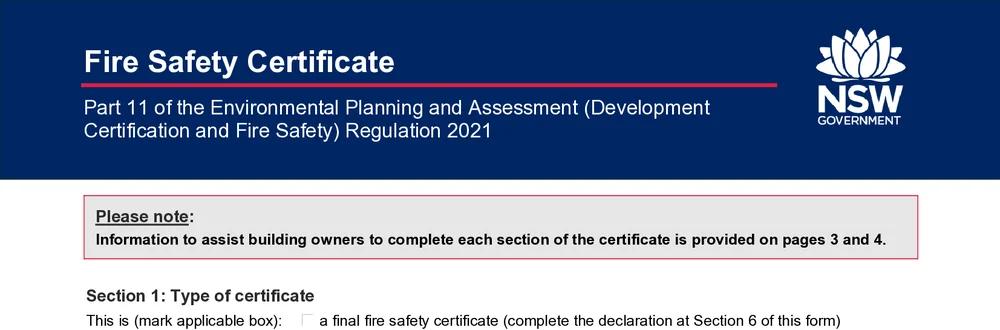
In Tradie Forms, start here:
Annual Fire Safety Statement
The Annual Fire Safety Statement is the yearly existing-building form.
NSW Planning says annual fire safety statements must be issued each year and include all essential fire safety measures that apply to a building. The Fire and Rescue NSW page says an annual statement is issued by or on behalf of the owner and covers the assessment of essential measures and the inspection of the building condition in relation to Part 15.
The Regulation says the owner must give the annual fire safety statement to council within the relevant yearly timing. It also says that as soon as practicable after the annual statement is issued, the owner must give a copy of the statement and current fire safety schedule to the Fire Commissioner and ensure a copy of both is prominently displayed in the building.
The Annual Fire Safety Statement NSW guide. For each document on its own, see the fire safety certificate on-site guide and when is a NSW fire safety statement required. covers AFSS due dates, accredited practitioners, costs, council and FRNSW submission, and the building display copy.
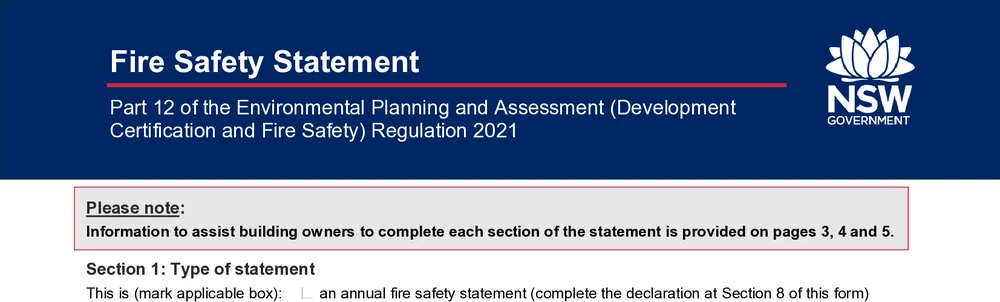
In Tradie Forms, use the statement template and choose annual:
What is a supplementary fire safety statement?
The Supplementary Fire Safety Statement is for critical measures.
NSW Planning says supplementary statements are issued at more regular intervals specified in the fire safety schedule for critical fire safety measures. The Regulation says if a critical measure is specified in the schedule, the owner must ensure council is given a supplementary statement for that measure at intervals of less than 12 months specified in the schedule.
Do not treat a supplementary statement as a spare annual statement. It is tied to critical measures and the intervals shown on the current fire safety schedule.
In Tradie Forms, use the same statement template and choose supplementary:
How to choose the right form
Ask these questions before filling anything:
- Is this tied to new building work, occupation, a completed part, a fire safety order, or a completion-stage certificate? Start with the NSW Fire Safety Certificate.
- Is this the yearly fire safety statement for an existing building? Use the NSW Fire Safety Statement and choose annual.
- Is this for critical fire safety measures at shorter intervals shown in the schedule? Use the NSW Fire Safety Statement and choose supplementary.
- Is the scope only part of a building? Check whether interim certificate or part-building statement details are needed.
- Has the current fire safety schedule changed since the last form? Update the measure rows from the current schedule.
If the answer is still unclear, check the certifier, council, current fire safety schedule, and official guidance before issuing a PDF.
Common mix-ups
Certificate used for an annual cycle
A certificate belongs to completion-stage certification. An annual statement belongs to ongoing existing-building maintenance and yearly reporting. Do not use one because the other form is harder to find.
Supplementary statement treated like the AFSS
Supplementary statements cover critical measures at specified shorter intervals. They do not replace the annual statement for all essential measures unless the official pathway says so for that building and schedule.
Final certificate used for part of the building
If only part of the building is complete, the interim certificate may be the relevant certificate type. Make the scope clear in the building description and supporting records.
Schedule ignored
Every form starts with the current schedule. Measure names, minimum standards, critical intervals, and building scope should not be guessed from old PDFs.
Completion stops at download
Download is not the end. The form may need council, Fire and Rescue NSW, display, owner, certifier, or building practitioner handling depending on the form and pathway.
How Tradie Forms helps
Tradie Forms gives each NSW fire safety form its own path.
For the NSW Fire Safety Certificate, you can choose final or interim, add building and owner details, list fire safety measures, fill declarant details, sign, preview, and download the official PDF layout.
For the NSW Fire Safety Statement, you can choose annual or supplementary, add building and owner details, list measures, add fire exit inspections for annual statements, record APFS practitioner rows, fill the matching declaration, preview, and download the official Version 4 PDF.
Across both, you can:
- Reuse saved owner, building, and declarant details
- Use address search for NSW buildings
- Catch missing fields before download
- Preview the official PDF before you complete
- Download or complete the finished PDF
- Attach or store it with the building record where your job software keeps evidence
Tradie Forms maps entries onto official NSW PDF layouts. It is not affiliated with NSW Planning, Fire and Rescue NSW, any council, or any certifier. The owner, authorised representative, and relevant practitioners remain responsible for checking the form, supporting evidence, and downloaded PDF.
What to keep in the building record
Keep the form with the evidence that explains it:
- Current fire safety schedule
- Completed certificate or statement PDF
- APFS assessment and inspection records
- Owner or agent authority
- Council, Fire and Rescue NSW, certifier, or building practitioner completion records where relevant
- Display copy note or photo where useful
- Any related development consent, construction certificate, occupation certificate, fire safety order, or certifier instruction
That record helps at the next annual cycle, during sale or lease due diligence, when council follows up, or when a practitioner needs to confirm what was previously certified.
The practical rule is to make the form choice visible in the job file. Name the PDF clearly, store the schedule beside it, and keep the lodgement on site proof in the same record. That way the next person does not have to guess whether they are looking at completion-stage certification or an annual cycle document.
Next steps
For completion-stage certification, start the NSW Fire Safety Certificate.
For annual or supplementary statements, start the NSW Fire Safety Statement.
You can also browse NSW fire safety forms or fire safety forms by state.
Official references
For current requirements, check the NSW Planning fire safety certification page, Fire and Rescue NSW fire safety statement lodgement guidance, the Fire and Rescue NSW AFSS submission page, the NSW fire safety statements FAQ, and the Environmental Planning and Assessment (Development Certification and Fire Safety) Regulation 2021.