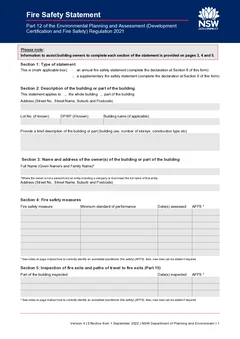
Tradie Forms: complete the NSW Fire Safety Statement on the official Version 4 layout. Work through the statement type, building and owner details, fire safety measures, practitioner rows and declaration before you lodge, display and store the PDF.
An annual fire safety statement brings the building owner, fire safety schedule, accredited practitioners, council and Fire and Rescue NSW into one job. The form is short compared with the inspection and assessment work behind it, but every name, measure, date and accreditation number still needs to line up.
This guide answers the main AFSS questions first, then gives you a practical way to prepare the official form without rebuilding the job from scattered reports and last year's PDF.
For the wider set, browse NSW fire safety forms. See the fire safety forms hub for the rest of the Australian set.
What is an annual fire safety statement (AFSS)?
An annual fire safety statement is a document issued by or on behalf of a NSW building owner confirming that the essential fire safety measures applying to the building have been assessed by an accredited practitioner and can perform to the required standard.
It is ongoing building paperwork, not the completion-stage fire safety certificate used when new building work is finished. The annual statement also includes the required inspection of the building's fire exits and paths of travel.
The current fire safety schedule is the working source. It identifies the measures that apply and the minimum standards of performance. Do not rebuild the statement from memory. A reissued schedule, building work or fire safety order can leave last year's statement out of date.
The official NSW form also has a supplementary statement option. That option covers critical fire safety measures at the shorter intervals set by the schedule. It is not a second name for the yearly AFSS.
Which buildings need an AFSS?
Buildings with a fire safety schedule and essential fire safety measures generally need an AFSS, with those measures commonly found in Building Code of Australia Class 1b and Class 2 to 9 buildings.
That can include apartment buildings, boarding houses, offices, shops, warehouses, health buildings and public buildings. The class alone does not tell you the whole obligation. Check whether the property has a current fire safety schedule and what that schedule requires.
The NSW guide for building owners explains that fire safety measures are commonly found in Class 1b to 9 buildings. The current Regulation sets the legal framework, while the schedule for the actual building identifies the measures and timing you need to work from.
If you have taken over a building and cannot find the schedule, ask the owner, building manager or relevant council for the current record before starting the form. A previous AFSS can help locate names and references, but it should not replace the schedule.
Who can assess and sign an AFSS?
The measures and exit systems must be assessed or inspected by an accredited practitioner (fire safety), while the statement itself is issued by or on behalf of the building owner.

These roles must stay clear. Practitioners assess, inspect and verify the parts covered by their accreditation. The owner or a properly authorised agent issues the statement and makes the declaration. A practitioner involved in the assessment cannot make the owner's declaration, and the restriction also applies to their employer, employee or direct associate.
Use the NSW guide to selecting an accredited practitioner to plan the work. The FPA Australia register lets you check practitioners and their current accreditation categories. One person may not hold every category needed for a building, so match the practitioner to each measure rather than assuming one accreditation covers the lot.
Keep each practitioner's name, contact details, accreditation number, assessment date and signature or separate signed document with the job. The official form can list multiple practitioners where different people assessed different measures.
How do you lodge an AFSS in NSW?
Sections 89 and 91 of the Regulation require the relevant annual or supplementary statement to go to council. As soon as practicable after issue, the owner must also give the Fire Commissioner a copy with the current fire safety schedule and ensure both documents are prominently displayed in the building.
Council is the first pathway to confirm because its portal, email, fee and supporting-document process can differ. Use the council that applies to the building, not the owner's postal address.
For the FRNSW copy, follow the current Fire and Rescue NSW lodgement guidance. FRNSW now directs owners and agents to its online Annual Fire Safety Statement submission form. Its current contact address for help is firesafety@fire.nsw.gov.au.
After submission, keep the council receipt or email, FRNSW confirmation and a note confirming the display copy was replaced. The displayed statement and schedule should be the same current documents held in the job record.
Tradie Forms prepares the official PDF. It does not lodge the statement, choose the correct council or replace the owner's responsibility to complete every required step.
When is an AFSS due?
The Regulation requires the annual statement to be given to council within the later of 12 months after the previous annual statement was given, or 12 months after a fire safety certificate issued within the previous 12 months.
Do not set the diary reminder from the inspection invoice or PDF download date. Check the last statement, council record and current schedule. Start gathering practitioner assessments early enough to resolve failed measures or missing reports before the due date.
The Regulation also limits how old the supporting work can be when the statement is issued. For an annual statement, the relevant assessments and inspection must have been carried out within the previous three months. For a supplementary statement, the assessment must have been carried out within the previous month.
Critical fire safety measures have supplementary statement intervals shorter than 12 months, as specified in the current fire safety schedule. A supplementary cycle does not remove the separate annual statement obligation.
For a repeat building, store the issue date, next due date, schedule version and practitioner contacts together. That gives the next cycle a reliable starting point.
How much does an AFSS cost?
There is no single NSW AFSS price because practitioner fees depend on the building, the number and type of measures, the records available and the work needed before measures can be verified.
Ask for a scope that separates assessment work, rectification, return visits and statement preparation. A small building with a clear schedule and complete service records will not have the same job as a large site with many measures and missing evidence.
Fire and Rescue NSW states that there is no charge for its fire safety statement lodgement service. Council charges are separate and can vary, so check the relevant council's current fees before quoting the whole job as fee-free.
The form itself is only one part of the cost. Owners should allow for the qualified assessment work and any repairs required to bring measures back to the schedule's standard. Avoid promising a fixed total before the schedule and site scope have been checked.
Annual vs supplementary vs interim or final fire safety certificate
Use an annual statement for the yearly assessment of essential measures, a supplementary statement for critical measures on shorter schedule intervals, and an interim or final fire safety certificate for completion-stage work.
An interim certificate can apply to a completed part of building work. A final certificate applies at final completion. Those certificates are not substitutes for an existing building's annual cycle.
Read the NSW fire safety certificate vs statement guide for the full comparison. If the question is specifically whether a certificate should be interim or final, use the final and interim certificate guide.
Fill the AFSS form online
Fill the NSW Fire Safety Statement online when you are ready to map the building record onto the official Version 4 PDF layout.
Before you start, collect:
- The current fire safety schedule
- The previous statement and issue date
- Building, lot and plan details
- Owner details and agent authority where applicable
- Measure names, minimum standards and assessment dates
- Practitioner contacts, accreditation numbers and signatures
- Exit inspection details for an annual statement
Tradie Forms breaks the PDF into sections you work through one at a time for statement type, building, owner, measures, exits, practitioners and declaration. Add repeat rows without working inside tiny PDF cells, catch missing required entries, preview the finished layout and download the PDF for review.
The final check still belongs to the owner, authorised agent and practitioners. Read the downloaded PDF against the schedule. Confirm the building scope, measure wording, assessment dates, practitioner allocation, declaration and signatures before anyone lodges or displays it.
Common AFSS mistakes before lodgement
The most common errors are mismatched schedule wording, the wrong statement type, old assessment dates, incomplete practitioner details and a declaration made by the wrong person.
Another easy miss is treating council lodgement as the end of the job. The FRNSW copy, current schedule, display copy and business record still need to be completed.
Use the common NSW Fire Safety Statement mistakes guide as a pre-download check. For certificate jobs, the fire safety certificate handover guide covers the supporting records to keep together.
What to keep after the statement is issued
Keep the signed AFSS, current schedule, practitioner assessment evidence, separate signed practitioner documents, owner authority, council receipt, FRNSW confirmation and display completion note in one building record.
Use a filename with the building, statement type and issue date. Record the next annual due date and any shorter supplementary dates. If a measure required repair or a repeat visit, keep that trail beside the final assessment rather than leaving it in a separate inbox.
Tradie Forms is not affiliated with NSW Planning, Fire and Rescue NSW, FPA Australia or any council. It maps your entries onto the official NSW statement layout. Check the current official requirements and the downloaded PDF before lodgement.
The measure records behind the statement
The practitioner endorsing your statement is signing off measures that were tested through the year, not on the day. Emergency and exit lighting sits on almost every schedule, and the six-monthly results are what the assessment leans on. Keep them as you go in an emergency lighting test register, and use a smoke alarm service record where alarms are listed on the schedule.
Chasing twelve months of test sheets the week the statement is due is what makes an AFSS painful. Contractors doing the testing can browse the fire safety forms hub for the rest of the set.
Official references
Check the NSW Planning fire safety certification page, Fire and Rescue NSW lodgement guidance, NSW practitioner selection guide and the current Regulation before relying on this guide for a live building.