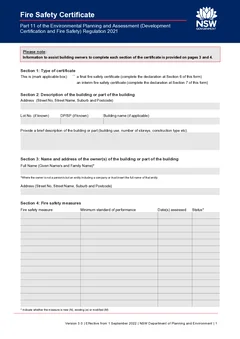
Tradie Forms: complete the NSW Fire Safety Certificate on the official layout for final or interim certification. Add the building, owner, fire safety measures, declarant details and the right declaration block, then preview and download the finished PDF.
Fire safety certificates sit at a high-pressure point in a build. The work is complete or partly complete, the owner or certifier needs paperwork, and the fire safety schedule has to match what is being certified.
A final certificate and an interim certificate look similar, but they do not mean the same thing. Measure rows need the right standard and assessment date. Owner details need to match the building record. Copies have to go where the rules require after the certificate is issued.
Use the NSW Fire Safety Certificate template to assemble the certificate at the building or in the site office while the schedule and assessment details are still in front of you, or browse NSW fire safety forms. The fire safety forms hub covers the other states.
What is the NSW fire safety certificate for?
It certifies that the fire safety measures for completed building work meet the standard set in the fire safety schedule. NSW Planning says a fire safety certificate is issued by or on behalf of a building owner when new building work is complete, and confirms that a properly qualified person has installed and checked the measures listed in the schedule.
The Environmental Planning and Assessment (Development Certification and Fire Safety) Regulation 2021 defines two certificate types:
- A final fire safety certificate, issued for a building by or on behalf of the owner
- An interim fire safety certificate, issued for part of a building by or on behalf of the owner
The same Regulation says a final or interim certificate certifies that each relevant essential fire safety measure in the current fire safety schedule has been assessed as capable of performing to at least the standard required by the schedule. If you are still working out whether the certificate applies at all, start with when a NSW fire safety certificate is required.
Do you need a final or an interim certificate?
Choose final when the relevant building work as a whole is complete and the measures being certified apply to the building. Choose interim when only a completed part of the building is being certified and the certificate is not for the whole of the building work.

The decision matters because the declaration section changes with it. Tradie Forms shows the final declaration for a final certificate and the interim declaration for an interim certificate, so you do not fill both by mistake.
If you are unsure which type belongs to the job, check the development consent, the construction certificate, the occupation certificate pathway, the fire safety schedule and the certifier's instructions before issuing the PDF. Getting the type wrong creates confusion about the scope that was actually certified.
Start with the current fire safety schedule
The schedule drives the certificate. The Regulation says a fire safety schedule must specify the fire safety measures for the building and the minimum standard of performance for each measure.
Have the current schedule open before you start filling, and confirm:
- The building or part of building covered
- Each fire safety measure that needs to be addressed
- The minimum standard of performance for each measure
- Whether measures are new, existing or modified where the form asks for status
- The assessment records and dates behind each measure
Do not copy the measure table from an old certificate unless you have checked it against the current schedule. Building work, orders, reissued schedules or corrected records can all change what belongs on the certificate.
What to collect before you fill the form
Building details
The certificate asks for the building address, lot number, DP or SP details where known, building name where applicable, and a short description of the building or part.
Be specific if the certificate covers part of a building. Level, tenancy, stage, wing or building section details help the owner, certifier and any later building manager understand the scope. "Warehouse" or "office" may be fine for a small building, but not for a staged project or a mixed-use site.
Owner details
Add the owner name and address. If the owner is a company, owners corporation, trust or other entity, use the entity name that belongs on the project record. The certificate is issued by or on behalf of the owner, so the owner block is not a spare contact field.
Fire safety measures
The measure table needs the fire safety measure, the minimum standard of performance, the assessment date and the status. The Tradie Forms template supports up to 14 measure rows, matching the official layout.
Use the schedule wording and standard where practical. If a measure is an original measure, or the schedule wording needs clarification, check with the certifier or the current regulatory guidance before issuing rather than inventing a description.
Declarant details
The certificate includes contact details for the person making the final or interim declaration: full name, organisation, title, address, phone, email and signature details as the layout requires.
Read the declaration before signing. Tradie Forms can place the signature onto the official PDF line, but the person issuing the certificate remains responsible for the declaration.
What has to happen after the certificate is issued?
The obligations continue past the download. Section 84 of the Regulation says a person must not issue a fire safety certificate unless the assessments required for the certificate have been carried out within the previous three months. Section 85 says that as soon as practicable after a certificate is issued, the owner must give a copy of the certificate and current fire safety schedule to the Fire Commissioner, give a copy to a building practitioner where required under the Design and Building Practitioners Act pathway, and ensure the certificate and schedule are prominently displayed in the building.
That means the closeout pack does not stop at the PDF. Keep the certificate, the current schedule, the assessment evidence and the completion record together, along with a note of where copies were sent or displayed. The certificate handover records guide covers how to structure that evidence measure by measure.
What to keep with the certificate
Store the certificate alongside:
- The current fire safety schedule
- Assessment evidence and practitioner records
- Development consent, construction certificate, fire safety order or certifier instructions where relevant
- Owner or agent authority
- The Fire Commissioner submission record
- The building practitioner completion record where relevant
- The display copy record
- Photos or site notes supporting the building or part description
That record helps when the project moves to occupation certificate, when the first annual statement becomes due, or when the next practitioner needs to understand what was certified. Common gaps in this pack are covered in common NSW fire safety certificate mistakes.
How Tradie Forms helps
Tradie Forms turns the NSW Fire Safety Certificate into sections you work through one at a time: certificate type, building or part of building, owner details, fire safety measures, declarant details, and the final and interim declarations.
You choose final or interim first and see the matching declaration. NSW address search fills the building, owner and declarant blocks. Measure rows are added like a job sheet instead of fought with as PDF cells. Declarant details save for repeat certificate work, missing required fields are flagged before you download, and preview shows the official layout as a certificate reader will see it.
Check the certificate type, measure rows, assessment dates, declaration block and signature in that preview. If the preview does not match the file evidence, fix the entry before the certificate is issued.
Tradie Forms maps your entries onto the NSW Fire Safety Certificate PDF layout. It is not affiliated with NSW Planning, Fire and Rescue NSW, any council or any certifier, and it does not lodge or approve anything. The owner, authorised representative and relevant practitioners remain responsible for the certificate, the supporting evidence and the finished PDF.
Next steps
Start the NSW Fire Safety Certificate, or read the on-site guide for a section-by-section walk through.
If the building is already in the annual or supplementary cycle, use the NSW Fire Safety Statement instead and check the annual fire safety statement guide for timing and lodgement. The certificate versus statement guide covers the difference if you are choosing between them.
Official references
For current requirements, check the NSW Planning fire safety certification page, the Environmental Planning and Assessment (Development Certification and Fire Safety) Regulation 2021, the Fire and Rescue NSW fire safety statement lodgement guidance where statement work is involved, and the NSW guide to selecting an accredited practitioner.