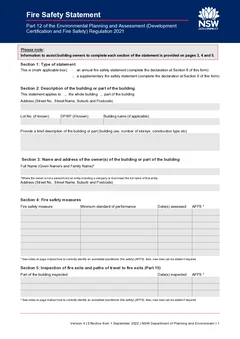
An AFSS is not finished when someone hits download. The real closeout is when council has the statement, Fire and Rescue NSW has its copy with the current schedule, the building display is up, and the office can find every supporting document without opening six inboxes.
This is an eight-document lodgement pack checklist for NSW Annual Fire Safety Statements. It is about the record set around the statement, not the full due-date rules. For timing, practitioners and lodgement steps, use the Annual Fire Safety Statement NSW guide. For certificate completion packs, see the NSW Fire Safety Certificate handover guide. Browse NSW fire safety forms. See the fire safety forms hub for the rest of the Australian set.
NSW Planning describes a fire safety statement as a document issued by or on behalf of the owner of an existing building. It confirms that an accredited practitioner (fire safety) has assessed, inspected and verified the performance of each fire safety measure that applies to the building. The signed PDF is the front page of that story. It is not the whole story.
What is in the AFSS lodgement pack?
1. Signed NSW Fire Safety Statement PDF (Version 4)
One signed final on the approved layout. Preview address, owner, statement type, measures, APFS rows, declaration and dates before anyone lodges.
Fix on the file: keep one signed final and send that same file everywhere. Do not lodge version A to council and a corrected version B to FRNSW an hour later while the foyer still shows last year.
2. Current fire safety schedule
The schedule the measure table was built from, labelled with the date it was current for this cycle. Pair the same schedule with the FRNSW copy.
Fix on the file: do not attach last year's schedule because it was still open on the desktop. The statement is only as good as the schedule it rests on.
3. APFS reports, signatures or signed supporting documents
Accredited practitioner (fire safety) evidence for every measure claimed, plus exit system inspection details for annual statements. Names, accreditation numbers, contact details and signatures or signed attachments.
Fix on the file: gather this before the declaration is final. Chasing practitioner details after the PDF has gone out is how packs stall.
4. Owner or authorised agent authority
Ownership details used on the statement, plus written authority and contact details when an agent declares. NSW Planning material is consistent that the statement is issued by or on behalf of the owner, while accredited practitioners assess and inspect. An accredited practitioner who assessed a measure or inspected exits for the annual statement must not make the owner declaration. That restriction also extends to their employer, employee or direct associate.
Fix on the file: store the authority letter with the statement, not only in someone's email. When staff change, the building history still needs to show who was allowed to sign.
5. Council lodgement proof
Which council received the statement, date lodged or delivered, method (portal, email, counter, post or agent service), any receipt number or acknowledgement, and the exact PDF version that was sent.
Fix on the file: do not treat "emailed to council" as enough on its own. If council later asks, you should produce the same file that was lodged, not a later draft with one measure changed.
6. Fire and Rescue NSW submission proof
Date submitted, method used, confirmation that the current fire safety schedule went with the statement, any acknowledgement returned by FRNSW, and who in the business submitted it. Current lodgement paths sit on the FRNSW service pages linked in the official sources for this article.
FRNSW lodgement has been described as free of a lodgement fee on current public guidance, but practitioner fees and council fees are separate and vary by building and service provider. Do not treat any single statewide AFSS price as fixed. Record costs against the building only if the owner needs an annual cost trail.
Fix on the file: never send the statement without the current schedule.
7. Building display record
FRNSW guidance says the owner must ensure the statement and current fire safety schedule are prominently displayed in the building. Capture location, date refreshed, who refreshed it, confirmation that the previous year's documents were removed or archived, and a photo if strata wants proof.
Fix on the file: do not leave display to "the building manager will sort it" with no note. Out-of-date foyer packs are a common follow-up.
8. Next-due and forward note
Next annual due date (or the date the owner tracks from the last statement), any supplementary critical-measure dates from the schedule, which practitioners covered which measures, known access issues, planned measure upgrades, and who holds foyer pack keys.
Fix on the file: put the next due date in the same place as the PDF. A complete pack with no diary note still creates next year's scramble.
Optional but useful alongside the eight: building scope notes when the statement covers only part of a site, and photos or defect close-out notes that explain follow-up.
How should you store the eight documents?
A simple structure works better than a clever one that only one person understands.
Example folder or job tags:
2026-AFSS-signed-PDF2026-fire-safety-schedule-current2026-APFS-reports2026-owner-agent-authority2026-council-lodgement2026-frnsw-submission2026-display-recordnext-due-notes
Keep draft PDFs out of the final folder, or mark them clearly as draft. Index by building and year, not only by strata plan or street. On part-building and multi-building sites, store wing, level, tenancy or fire compartment description, and whether the schedule is whole-site or part-site.
Roles that must stay separate in the pack
| Role | What to keep |
|---|---|
| Owner | Ownership details used on the statement |
| Authorised agent | Written authority and contact details |
| APFS practitioners | Reports, accreditation numbers, signatures or signed attachments |
| Declarant | Name, capacity and signed declaration date |
| Building manager | Display and site access notes if they handle the foyer pack |

Use the common NSW Fire Safety Statement mistakes guide as a pre-download check before the pack is sealed.
How does a certificate pack differ from a statement pack?
Do not merge completion certificates and annual statements into one loose "fire safety" folder.
- A NSW Fire Safety Certificate sits with new or altered work at completion.
- A NSW Fire Safety Statement sits with the recurring existing-building cycle.
After major works, keep a handoff note: which schedule version is now current, which certificate closed the works, and when the first annual statement under the new arrangement is due.
Closeout checklist when copies leave the business
Step 1
Statement signed
Owner or authorised agent
With authority on file and the current schedule attached.
Step 2
Council copy
Lodged
Store the acknowledgement, not just the sent email.
Step 3
FRNSW copy
Submitted with the current schedule
Store the confirmation the same way.
Step 4
Building display refreshed
On site
Record where and when, then file the full pack under building and year.
Two lodgements and a display, each needing its own evidence. Missing any one leaves the cycle looking incomplete a year later.
- Preview the official Version 4 PDF
- Confirm the schedule is current
- Confirm APFS evidence is complete
- Confirm the declarant is the owner or authorised agent, with authority on file
- Lodge the council copy and store the acknowledgement
- Submit the FRNSW copy with the current schedule and store the confirmation
- Refresh the building display and record where and when
- Save the full eight-doc pack under the building and year
- Note next annual and any supplementary dates
- Tell the owner or building manager where the pack lives
Handover to a new manager or owner
Hand over the latest signed AFSS PDF, current schedule, last three years of statements if available, APFS reports for the latest cycle, council and FRNSW lodgement proof, display location notes, open defects or upgrades still underway, and practitioner contacts from the last cycle.
How the form helps without overclaiming
The NSW Fire Safety Statement keeps statement type, measure rows, fire exit rows, APFS rows and the matching declaration in order so the downloaded PDF matches the official Version 4 layout. Tradie Forms does not lodge with council or FRNSW, and does not replace display or storage duties. The owner, authorised agent and relevant practitioners remain responsible for assessments, declarations, lodgement pathways, display and storage.
Related: when a NSW Fire Safety Statement is required, certificate vs statement guide.
The measure records that travel with the pack
A statement pack is only as good as the testing behind it. When a building changes hands, the incoming manager needs the measure records as well as the statement, or the next assessment starts from nothing. Emergency and exit lighting results belong in an emergency lighting test register, and alarm servicing in a smoke alarm service record, so both hand over as a set rather than a folder of loose sheets.
Official references
Check current requirements on the NSW Planning fire safety certification page, Fire and Rescue NSW fire safety statement lodgement guidance, the Fire and Rescue NSW AFSS submission page, and the Environmental Planning and Assessment (Development Certification and Fire Safety) Regulation 2021.