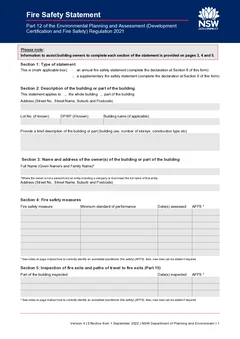
Most AFSS mistakes are not dramatic. They are small mismatches that make the statement harder to lodge, display or defend later.
The wrong statement type. A measure copied from last year's schedule. APFS details missing from the table. The owner declaration signed by someone too close to the assessment. The Fire and Rescue NSW copy forgotten after council lodgement.
The statement sits between the owner, council, Fire and Rescue NSW, accredited practitioners, building managers and the people using the building, so a clean one saves a lot of chasing. For due dates, practitioner roles and the current submission steps, read the annual fire safety statement guide first, then use this checklist. If you are not sure the statement is due at all, check when a NSW fire safety statement is required.
Which statement type does this building need?
That depends on the fire safety schedule, not on what was issued last time. NSW Planning says annual fire safety statements must be issued each year and include all essential fire safety measures that apply to a building. Supplementary fire safety statements are issued at more regular intervals, as specified in the fire safety schedule, for critical fire safety measures.
The current schedule tells you which measures are essential, which are critical and what intervals apply. Do not pick annual or supplementary from memory. In Tradie Forms you choose the statement type first, and the app then shows the matching declaration section and keeps the annual fire exit section tied to annual statements.
Mistake: copying last year's measure table
Last year's PDF is a useful reference, but it is not the source of truth. The fire safety schedule specifies the measures and the minimum standards of performance, and it may have been reissued, corrected, changed after building work or affected by an order.
Before filling the measure table, check the measure name, the minimum standard of performance, whether the measure is essential or critical, the critical measure intervals where applicable, and the building or part of building covered. Then fill the statement from that current schedule.
Mistake: assessment dates fall outside the window
The timing rules are easy to miss when practitioner reports arrive over several weeks. The Regulation says an annual fire safety statement must not be issued unless the assessment and inspection have been carried out within the previous three months. It says a supplementary fire safety statement must not be issued unless the assessment has been carried out within the previous month.
If a report is old, do not quietly drop it into the table. Check the current rules and get the dates right before issuing.
Mistake: APFS details are incomplete
The NSW Planning FAQ says the statement form must contain the details and signature of each accredited practitioner who assessed the fire safety measures, or the person issuing the statement can obtain and attach a separate signed document from each practitioner.
Names alone are not enough. Keep the APFS details, accreditation numbers, signatures or signed supporting documents, and contact details together. In Tradie Forms, APFS rows sit in their own section so practitioner details are captured properly rather than buried in a notes field.
Who is allowed to sign the owner declaration?
The owner, or an authorised agent acting for the owner. The NSW Planning FAQ says the statement is issued by or on behalf of the owner. It also says an accredited fire safety practitioner must not make the declaration if they assessed a fire safety measure or inspected the building's exit system for the annual statement, and that the restriction extends to their employer, employee or direct associate.
This one catches people when the practitioner has done the hard work and everyone wants the form finished quickly. Keep the roles separate:
- The APFS assesses, inspects and verifies the relevant measures
- The owner or authorised agent issues the statement
- The declarant signs the annual or supplementary declaration
If an agent signs, keep the owner's authority with the building record.
Mistake: the building scope is unclear
The official form asks whether the statement applies to the whole building or part of the building. That choice matters on mixed-use buildings, staged sites, strata properties, shopping centres and buildings with multiple tenancies.
If it applies to part of a building, describe the part clearly using level, tenancy, building name, wing, stage or area details.
A future reader should not have to guess whether the statement covers the whole site or one section of it.
Mistake: Fire and Rescue NSW completion is missed
Council lodgement is only one part of the completion. Fire and Rescue NSW says the owner of a building with a fire safety schedule is required to provide a copy of the fire safety statement to the Commissioner of FRNSW. The FRNSW lodgement guidance also says the owner must ensure the statement and the current fire safety schedule are prominently displayed in the building.
Step 1
Assess and sign
APFS and owner
Every measure assessed inside the allowed window.
Step 2
Council
Owner lodges
The step most people treat as the whole obligation.
Step 3
Fire and Rescue NSW
Copy to the Commissioner
A separate pathway, not a copy of the council lodgement.
Step 4
Displayed in the building
Owner
Statement and current schedule, prominently displayed.
Downloading or emailing the PDF is not the same as completing these pathways.
Keep the FRNSW submission record, the council lodgement record and the display copy record together.
Mistake: the standard form is altered
The NSW Planning FAQ says the Regulation requires a fire safety statement to be in the form approved by the Planning Secretary, and that changes to the standard form, including adding or altering letterheads and logos or adding and removing sections, may contravene the requirements.
That is one reason the official layout matters. Tradie Forms maps your entries onto the NSW statement PDF layout instead of turning the form into a custom letter.
Mistake: the evidence is split across inboxes
The final PDF is important, but it is not the whole record. Keep these together:
- The completed NSW Fire Safety Statement PDF
- The current fire safety schedule
- APFS reports and signatures
- Owner or agent authority
- The council lodgement receipt
- The Fire and Rescue NSW submission record
- The display copy record
- Photos, job notes or building manager completion notes where useful
When the next annual cycle starts, that record saves the team rebuilding the story from scratch. AFSS record keeping and handover covers how to structure it.
Mistake: nobody reads the finished PDF
The form catches missing fields, but the PDF still needs a human review. Before lodgement, preview the official layout and read it as the council, Fire and Rescue NSW, the owner or the building manager will see it.
Check the building address on every page, the owner name, the statement type, the measure rows, the APFS rows, the declaration date and the signature. If the schedule is attached separately, confirm the version in the job record is the current one. This is much faster than correcting a form after copies have already gone out.
A cleaner check before you download
- The statement type matches the due obligation.
- Measure rows match the current fire safety schedule.
- Assessment and inspection dates fit the current timing rules.
- APFS details and signatures or signed documents are ready.
- The declarant is the owner or authorised agent, not the assessing APFS.
- The building scope is clear.
- Council, Fire and Rescue NSW and display copies are planned.
- The PDF has been previewed on the official layout.
Keep a dated note of that check with the job record. It gives the next annual cycle a clearer starting point and answers most follow-up questions without a search.
How Tradie Forms helps
Tradie Forms turns the NSW Fire Safety Statement into sections you work through one at a time: statement type, building and scope, owner details, fire safety measure rows, fire exit inspection rows for annual statements, APFS practitioner rows, declarant details, and the annual or supplementary declaration.
You can save declarant details for repeat buildings, use NSW address search for the building, owner and declarant blocks, add measure and practitioner rows without fighting PDF cells, catch missing fields early, preview the official Version 4 layout, and download the finished PDF for council, Fire and Rescue NSW, display, owner records and job storage.
Tradie Forms is not affiliated with NSW Planning, Fire and Rescue NSW or any council, and it does not lodge or approve anything. The owner, authorised agent and relevant practitioners remain responsible for the statement, the evidence, the lodgement pathway and the finished PDF.
Next steps
Start the NSW Fire Safety Statement, or browse NSW fire safety forms. The fire safety forms hub has the national set for contractors working across borders.
For completion-stage certificates on new building work, use the NSW Fire Safety Certificate and the certificate versus statement guide if you are choosing between the two.
The mistake that starts twelve months earlier
Most late statements are not a lodgement problem. The measure records were never kept properly, so the assessment stalls while someone reconstructs a year of testing. Emergency and exit lighting is the usual culprit because the six-monthly discharge test is easy to skip and hard to prove later. An emergency lighting test register filled on site keeps the trail intact, and a smoke alarm service record does the same for alarms.
Official references
For current requirements, check the NSW Planning fire safety certification page, the Fire and Rescue NSW fire safety statement lodgement guidance, the Fire and Rescue NSW AFSS submission page, the NSW fire safety statements FAQ, and the Environmental Planning and Assessment (Development Certification and Fire Safety) Regulation 2021.