High risk construction work should not start on a blank page or a phone PDF that jumps around the page. SafeWork NSW expects a SWMS prepared before the work begins, available to the people doing the job, and reviewed when the site changes.
This guide walks through the Housing Industry Site Safety Pack WHS Form 05 path: what belongs on the form, how to write task rows that workers can follow, and how to finish the PDF while the job is still in front of you.
Open the NSW WHS SWMS form when you are ready to fill. Related NSW building templates live on the NSW building forms hub. For when a SWMS is mandatory, see When is a SWMS required in NSW.
What is a SWMS in NSW?
SafeWork NSW describes a SWMS as a safety planning document for high risk construction work under the WHS Regulation. It must be site-specific. Workers, supervisors, and others at the workplace need to understand the hazards, risks, and controls that keep people safe.
A SWMS is not a general WHS policy and not a full risk assessment for every task on site. It is the document that covers the high risk construction work activities for that job. SafeWork NSW says you do not need to include activities that are not defined as high risk construction work in the SWMS.
Use the official prepare safe work method statement page as the source of truth when this guide and a site pack disagree.
Who prepares the SWMS?
SafeWork NSW says a PCBU that carries out high risk construction work must ensure a SWMS is prepared, or has already been prepared by another person such as another PCBU.
On many residential jobs that means:
- The subcontractor prepares the SWMS for the high risk work they will do
- The principal contractor receives a copy for the project file
- PCBUs consult, cooperate, and coordinate when more than one business is involved
If you are the sparky doing work near energised services, or the carpenter on a roof with a fall risk over two metres, do not assume the principal already wrote your method. Check what is already prepared for that activity and whether it matches how your crew will work.
What must be on a SWMS?
As a minimum, SafeWork NSW says the SWMS must:
- Identify the high risk construction work
- Specify the hazards and associated risks
- Describe the control measures
- Describe how controls will be implemented, monitored, and reviewed
- Be understood by the people using the document
When you develop the SWMS, consider site conditions: access, other structures, powerlines, ground conditions, other trades, and access to safety equipment.
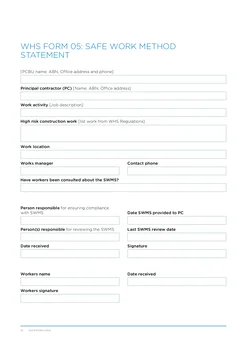
HIISP Form 05 groups that duty into practical fields: PCBU details, principal contractor, work activity and location, contacts, consultation, task rows, compliance review, and worker sign-off. Fill those sections in order so you are not hunting PDF tabs on a phone.
Collect these details before high risk work starts
PCBU and principal contractor
Enter the business name, ABN, address, and phone for the PCBU. Add the principal contractor name, ABN, and address when a principal is involved.
Saved business details help on the next job, but only if they stay current after a rebrand, ABN change, or office move.
Work activity and high risk description
Write the activity in plain language a site supervisor can read in thirty seconds. "Roof work" is weak. "Install metal roofing on two-storey dwelling, fall risk greater than two metres on east elevation" is usable.
Name the high risk construction work type that applies. SafeWork NSW lists activities such as fall risk more than two metres, work near energised electrical installations, work near powered mobile plant, trenches deeper than 1.5 metres, and asbestos disturbance. Full list: construction work page.
When the powered mobile plant is a crane, keep the SWMS beside the NSW mobile crane safety checklist guide so the work method and lift-site checks stay aligned.
Location and contacts
Use the real site address, not the builder's office. Add the works manager and a phone number that will answer during the task.
Consultation
Record how workers were consulted: toolbox talk, pre-start, walk-through of the method, or another agreed process. SafeWork NSW expects the document to be understood by the people using it. A signature without a conversation is a weak system.
Write SWMS task rows people can follow
HIISP Form 05 supports task rows with task, hazards and risks, and control measures. Keep each row focused on one step of the high risk work.
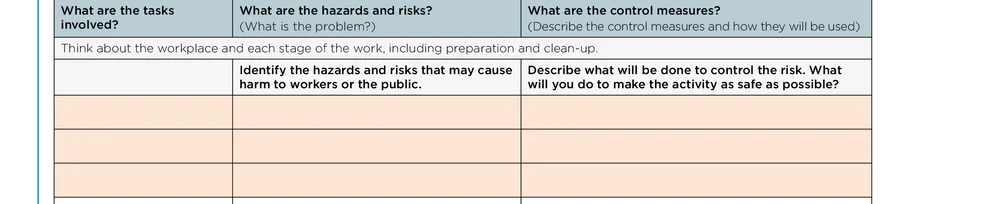
SafeWork NSW also wants you to describe how controls are implemented, monitored, and reviewed. Put that in the row or in the compliance notes: who installs edge protection, who checks it, when it is re-checked after weather or other trades, and what happens if the method changes.
You can cover more than one high risk activity in one SWMS, or write separate SWMS documents. If activities interact, cross-reference them. Example: falls work during asbestos roof removal needs both fall and asbestos controls to work together.
Generic SWMS templates need a site check
SafeWork NSW allows a generic SWMS for high risk activities you do regularly. To stay compliant, review it against this site's hazards before work starts. A SWMS written for a single-storey slab home does not automatically fit a sloping block with live power nearby and a crane on the street.
If you reuse a SWMS template, change the location, activity description, and any row that does not match this site before you download.
Implement, stop, and review
High risk construction work must be carried out in accordance with the SWMS. SafeWork NSW says the PCBU must ensure:
- Controls are in place before the activity starts
- Hazards, risks, and controls are communicated to workers
- Work stops if it is not following the SWMS, as soon as it is safe to stop
- The SWMS is reviewed when needed
- Work does not resume until it can follow the (reviewed) SWMS
Review when the high risk process changes, when the site environment changes, or when controls change. Consult other PCBUs, workers, and relevant health and safety representatives as part of that review.
Where the finished SWMS lives
Keep the SWMS available at the workplace where the high risk construction work will be carried out, until the work it relates to is completed. Electronic storage is fine if workers can get to it easily on site.
On many residential projects the principal contractor also needs a copy. SafeWork NSW construction guidance says the principal contractor must get a copy of the SWMS relating to high risk construction work and that the SWMS must be updated when control measures change.
Open the NSW WHS SWMS template when you are ready to fill Form 05 on site. It does not lodge the SWMS with SafeWork NSW and does not replace the principal's project WHS system.
Related forms for the same site file: site-specific risk assessment (Form 04), toolbox talk record (Form 06), plus national JSA or Take 5 when the pack asks for a broader or shorter risk document.
More SWMS guides: When is a SWMS required in NSW, common SWMS mistakes, SWMS vs JSA vs Take 5, and the NSW WHS site pack walkthrough.
Official sources
Check these before you rely on this guide for a specific job:
- Prepare safe work method statement
- Construction work
- Housing industry site safety pack
- HIISP Form 05 PDF
You remain responsible for the accuracy of the SWMS and for how work is carried out on site.