Cross-border plumbing crews learn the hard way that a backflow report is not a national form with a different logo. Queensland and South Australia both want a clear device and test record, but the approved form, the receiver, and the clock are different.
Use this comparison when your business runs annual tests in both states, or when a national facilities client asks why last month's QLD PDF cannot be reused on an Adelaide site. For the wider national picture, see the Australian backflow test report guide.
Browse QLD plumbing forms for the Queensland pack. Use the Form 9 testing guide and Form 9 record keeping guide when the job is on the QLD side.
Side-by-side snapshot
| Topic | Queensland Form 9 | SA OTR backflow report |
|---|---|---|
| Official form | Form 9 under Plumbing and Drainage Regulation 2019 | OTR Backflow Prevention Device Report |
| Main receiver | Relevant local government and the owner | Office of the Technical Regulator |
| Timing | Within 10 business days after inspecting or testing | Within seven days of completing the work |
| Typical use | Registration and report on inspection and testing of testable devices, registered air gaps and registered break tanks | Commissioning, annual testing, replacement, removal or decommissioning records for OTR |
| Tester focus | Authorised backflow prevention licensee details on the form | Licensed plumber with backflow prevention accreditation details on the form |
| Live Tradie Forms template | QLD Form 9 | SA Backflow Prevention Device Report |
The technical work at the device can look similar. The paperwork path after the gauges come off does not.
What QLD Form 9 is for
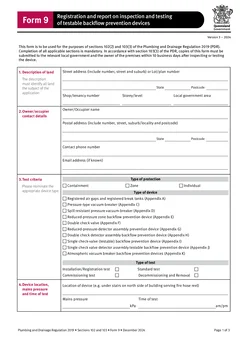
The official Queensland Form 9 is titled for registration and report on inspection and testing of testable backflow prevention devices. It is used for sections 102(2) and 103(3) of the Plumbing and Drainage Regulation 2019.
The form states that completion of all applicable sections is mandatory. It also requires copies to the relevant local government and the owner of the premises within 10 business days after inspecting or testing the device.
In the field, Form 9 usually captures:
- Land description and street address
- Local government area
- Owner or occupier contacts
- Protection type and device type
- Device location and mains pressure
- Main device details and readings
- Bypass, PVB, registered air gap or break tank details where applicable
- Test kit serial and verification details
- Authorised tester and contractor licence details
- Result, comments, signature and date
QBCC guidance also reminds the trade that a backflow prevention endorsement is required to test, commission or maintain these devices, and that Form 9 must be sent to the relevant local government within the required window.
Council remains the property-level authority for lodgement method and any local fee. Tradie Forms prepares the PDF. It does not lodge with council for you.
What the SA OTR report is for
South Australia uses the Office of the Technical Regulator Backflow Prevention Device Report for commission, inspection and maintenance style reporting.
OTR plumbing guidance says backflow prevention devices must be installed and commissioned by a licensed plumber with backflow prevention accreditation on their licence. The same guidance says the completed backflow prevention device commission, inspection and maintenance report must be forwarded to the OTR within seven days of completing the work.
The official report records the practical test story for SA regulators:
- Test type such as commissioning, annual test, replacement or decommissioning
- Site and owner or occupier details
- Exact device location
- Device identity and type
- Test kit and calibration details
- Valve or device readings matched to the device type
- Registered break tank or air gap details where relevant
- Tester licence and certification details
Current OTR instructions on the form and plumbing page give the submission pathway, including email and postal options. Always check the live OTR page before you send, because contact details and instructions can change.
Timing: 10 business days versus seven days
This is the comparison crews feel first.
Queensland
Count 10 business days from inspecting or testing the device. Both the local government copy and the owner copy sit inside that window. Waiting for Friday admin after a Monday test burns half the available days before anyone has opened the PDF.
South Australia
Count seven days from completing the work, and the completed report goes to OTR. That is a shorter calendar habit for many annual runs, especially if the crew is still on the road and the office only batches paperwork weekly.
Practical tip for mixed-state businesses:
- Finish the report on site or in the van in both states
- Use separate lodgement checklists: council + owner for QLD, OTR for SA
- Do not let a seven-day SA job sit in the same weekly batch as a ten-business-day QLD job without dates on each file
Who gets the PDF
Queensland receivers
- Relevant local government for the premises
- Owner of the premises
- Your own job record and, where useful, the occupier or facilities contact
South Australia receivers
- Office of the Technical Regulator
- Your own job record
- Owner, occupier or facilities contact as your contract and good practice require
SA's formal seven-day instruction is aimed at OTR. That does not mean the owner should be left without a copy. Keep customer completion clean in both states even when the regulator pathway differs.
What both forms still force you to get right
State differences do not excuse weak field capture. Both reports fail for the same human reasons.
Device identity
Make, model, size, serial number and device type must match the installed unit. Last year's PDF is a clue, not a substitute for reading the tag.
Location
Write a location the next tester can find.
Readings and result
Enter the readings for the device type actually tested. Mark pass or fail honestly. If you repair and retest, keep the sequence clear in the report and job notes.
Test kit
Kit serial and verification or calibration details must be current. Saved office defaults go stale.
Tester credentials
The person and licence details on the form must match the person authorised to do the work in that state.
If you want a pure Queensland mistakes list, use common QLD Form 9 mistakes.
Job-type language on each form
Queensland Form 9
Form 9 is framed around registration and report on inspection and testing. Crews use it for new devices, annual tests, replacements, removals and related register updates covered by the form and local process. Make the report match the event. A removal written like an annual pass confuses the council register.
SA OTR report
The SA form language is built around commission, inspection and maintenance style events, including commissioning, annual testing, replacement and removal or decommissioning. Pick the test type that matches the visit before you fill readings. A decommissioning report should not look like a clean annual pass for a device that is no longer in service.
Qualifications and endorsement
Do not assume a licence stamp from one state automatically satisfies the other state's form.
- In Queensland, plan the job around the backflow endorsement and authorised tester details expected for Form 9 work.
- In South Australia, OTR guidance requires a licensed plumber with backflow prevention accreditation on their licence for installation and commissioning of these devices, and the report records tester details for the work completed.
If your business employs testers across both states, keep credential matrices in the office so dispatch does not send the wrong ticket holder to the wrong side of the border.
Lodgement mechanics
Queensland
Councils differ. Some accept email, some use portals, some have local instructions or fees. Confirm the method for that premises. Track acknowledgement for both council and owner copies.
South Australia
OTR is the central receiver for the report under the current plumbing trades guidance. Use the current OTR email or postal details from the official page or form instructions. Keep the send proof with the job.
Because the receivers differ, your software folders and job statuses should differ too. A generic "backflow lodged" tag that does not say council or OTR will hurt audits later.
Which form should you open today?
Use this quick filter:
- Where is the device installed? Queensland or South Australia decides the form.
- What event happened? Annual test, commission, replace, remove or related report type.
- Who must receive the PDF, and by which deadline?
- Are the tester credentials valid for that state and device work?
- Open the matching template, finish at the device, preview, download, send, store.
If the property is outside QLD and SA, do not force either PDF. Use the national backflow guide and the local water authority or regulator process for that state.
Portfolio clients and multi-state contracts
Facilities managers often want one spreadsheet for every backflow device in the national portfolio. That spreadsheet is useful for booking and due dates. It is not a substitute for the state form.
When you service a portfolio that includes Queensland and South Australian sites:
- Tag each asset with state, regulator path, due date and last report file name
- Keep QLD Form 9 and SA OTR PDFs in separate naming or folder conventions
- Do not paste SA readings into a QLD PDF because the columns look familiar
- Report completion status as "council and owner sent" or "OTR sent", not only "done"
- Give the client the correct state PDF plus your own summary sheet if they want a national view
The client summary can list pass or fail, next due and device identity. The regulator still gets the approved form for that state. Mixing those layers is how a clean technical test becomes an incomplete compliance file.
Shared on-site workflow that still respects both states
A crew that works both states can keep one field habit and two closeout habits.
Shared field habit
- Confirm the asset and hazard protection level
- Photograph or note the tag and exact location
- Test with a current verified kit
- Write readings before packing up
- Confirm owner or site contact for customer copies
Queensland closeout
- Complete Form 9
- Send local government copy
- Send owner copy
- Store both proofs inside 10 business days of the test
South Australia closeout
- Complete the OTR report
- Forward to OTR within seven days
- Store send proof and customer copy
- Diary the next annual due date
That split stops the worst cross-border error: a perfect technical test attached to the wrong regulator pathway.
Related Queensland paperwork
On Queensland sites, Form 9 may sit with:
- Form 1 for permit work
- Form 5 for other testing or commissioning reports
- Form 14 for compliance declarations on permitted work
Those forms do not replace Form 9 for testable backflow reporting. Keep the backflow report in its own lane. See the QLD plumbing forms list for the wider set.
Next steps
For a Queensland device, start QLD Form 9. For a South Australian device, start the SA Backflow Prevention Device Report.
Read the QLD Form 9 testing guide, common Form 9 mistakes, and Form 9 record keeping when you are on the QLD pathway. Use the national backflow template guide when the property sits outside these two systems.
Browse QLD plumbing forms for more Queensland templates. The plumbing forms hub has the national set if you work across borders.
Official references
Check the current Queensland Form 9 PDF, Business Queensland plumbing forms page, Plumbing and Drainage Regulation 2019, QBCC backflow guidance, SA OTR plumbing trades page, and the SA OTR Backflow Prevention Device Report PDF before relying on this comparison for a live job. For the South Australian form on its own, see the SA backflow prevention device report guide.