A backflow test report turns the readings at the device into a record the property owner, water authority or council can use. The exact form and submission route change across Australia, but the job-site problem stays the same: the device tag, test kit and pressure readings are in front of you now, while the paperwork often waits until later.
This national guide explains what belongs in a backflow report and points you to the available state forms. Always check the local water authority, council or plumbing regulator before the test. They decide which form, tester qualification, submission period and fee apply to the property.
What is a backflow test report?
A backflow test report is the record a qualified backflow tester completes after commissioning, inspecting, testing, maintaining, replacing or decommissioning a testable backflow prevention device.
It connects the test result to a specific device and property. A useful report identifies the device, its exact location, the owner or occupier, the test kit, the readings taken, the result, any repairs and the person responsible for the test.
The report is not just a pass sticker. It gives the authority and property owner enough information to update the device register and understand what happened during the visit. Where a device fails, the repair and retest trail should stay with the original test record.
Australian plumbing requirements draw on the Plumbing Code of Australia, AS/NZS 3500.1 for water services and AS/NZS 2845.3 for field testing and maintenance of testable backflow prevention devices. Adoption and local processes can change, so use the standard and rules currently called up in your jurisdiction.
What must the report include?
A backflow report should include property, device, test, result and tester details that identify the asset and show how the result was reached.
Property and contact details
Record the work site, owner and occupier or site contact.
On a shopping centre, industrial site or block with several tenancies, a street address alone may not identify the device. Add the plant room, boundary, tenancy, level, meter or fire-service location used on the asset register.
Device identity
Copy the make, model, serial number, nominal size and device type from the installed equipment. Record whether the device provides containment, zone or individual protection where the form asks for it. If there is a bypass device, registered air gap or registered break tank, keep its details separate from the main device.
Visit and test details
State why the report is being completed. Common options include commissioning, annual test, maintenance, replacement, retest and decommissioning. Add the test date, previous test date or authority reference where required.
Record the calibrated test kit number and calibration date. Then enter the readings and valve results for the actual device type. Reduced pressure zone, double check, single check and pressure-type vacuum breaker devices do not share one set of test fields.
Result and follow-up
Mark pass or fail only after the required test sequence is complete. Note repairs, parts replaced and the retest result where the authority's form provides space. Do not turn a failed first result into a clean pass with no history in the job record.
Tester and licence details
Record the tester's name, business, contact details, plumber licence and backflow endorsement or accreditation required in that state. Add the signature and signed date. Reusing saved details can cut typing, but check the licence, phone, business and test-kit calibration before every report.
Backflow report forms by state
The right backflow report comes from the regulator, council or water authority responsible for that property. There is no single national lodgement form.
Queensland
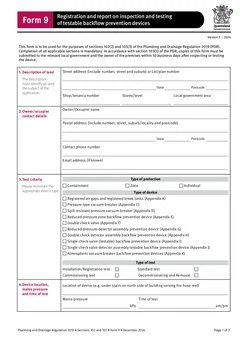
Queensland uses Form 9 to register and report on the inspection and testing of testable backflow prevention devices, registered air gaps and registered break tanks.
QBCC guidance says a backflow prevention endorsement is required to test, commission or maintain these devices. It also says Form 9 must be sent to the relevant local government within 10 business days after inspecting or testing a device.
Fill QLD Form 9 backflow online, then read the QLD Form 9 testing guide and record-keeping and handover guide. The relevant council remains the authority for the property, so check its current submission address and any local fee.
South Australia
South Australia uses the Office of the Technical Regulator Backflow Prevention Device Report for commissioning, annual testing, replacement and removal or decommissioning.
The official form records the device, site owner, occupier, exact location, test kit, tester licence, readings and registered break tank or air gap details. Its current instructions say to send the completed report to OTR within seven days.
Fill the SA Backflow Prevention Device Report online and check the OTR plumbing page for the current email, postal details and instructions before submitting it.
New South Wales
In NSW, the local water utility or council commonly manages the device register and annual test report process, so use the form published for the property's service area.
Do not assume a report accepted by one council is the nominated form in another. Check whether the authority requires an online submission, its own inspection and maintenance report, a lodgement fee or a short return period after testing. The tester should hold the licence and backflow qualification required for the work.
If your NSW plumbing business has an authority PDF it uses repeatedly, request that custom form template for your Tradie Forms workspace.
Victoria
In Victoria, check the relevant water corporation and current Victorian Building Authority requirements for the property and work. The water corporation may maintain the containment device register or specify how annual results are returned.
Use the authority's current report rather than renaming a Queensland Form 9. Confirm who receives the result, what plumber registration or specialised class applies and whether the owner also needs a copy.
Businesses with a repeat Victorian water-corporation PDF can request a mapped template instead of rebuilding it for every test.
Western Australia
WA Water Corporation says testable devices at property boundaries for medium- and high-risk properties and fire services require testing at commissioning, after maintenance and every 12 months by an accredited tester.
Check the Water Corporation process and the local job requirements before testing. Keep the device identity, accredited tester, readings, repairs and submission record together even where results are entered through an online service rather than attached as a standalone PDF.
Tasmania
In Tasmania, confirm the current process with the relevant council, permit authority or water service provider for the property. The required report and return path can depend on the device and local register.
Use the authority's nominated form and check the qualification, annual testing and submission instructions before quoting the paperwork. If the same PDF appears across your jobs, request it as a custom template.
How often is backflow testing required?
Testable backflow prevention devices are commonly tested at commissioning, after maintenance and at intervals not exceeding 12 months, but you must confirm the rule and due date for the device's jurisdiction and register.
Annual does not mean any time in the calendar year. Use the last test date, authority reminder or register due date. Book enough time for a repair and retest if the device fails.
Low-hazard non-testable devices may follow a different maintenance path. Do not create an annual test result for a device that is not testable, and do not skip a registered air gap, break tank, fire service or bypass device that the authority expects in the report.
For repeat sites, record:
- Authority or council asset reference
- Device serial number and exact location
- Last test and next due date
- Test kit and calibration record
- Initial result, repairs and retest result
- Date and method the report was submitted
That record makes the next visit faster and reduces the chance of testing the wrong device on a multi-device property.
Fill your backflow report online
Start the QLD Form 9 backflow report or SA Backflow Prevention Device Report while the device, tag and test kit are still in front of you.
Tradie Forms turns each official PDF into sections you work through one at a time. You can enter the property, device, test results and tester details, catch missing required fields, preview the official layout and download the PDF for the authority, owner and job record.
Before you finish, compare the report with the device tag and test sheet. Check the serial number, device type, location, pressure units, pass or fail boxes, repair notes, licence number, signature and date. Then follow the current submission route for the property.
Tradie Forms is not affiliated with QBCC, OTR, SA Water, Water Corporation, a council or a water retailer. It prepares the PDF but does not test the device, decide whether it passes or lodge the report.
Browse Queensland plumbing forms for related permit, testing and completion paperwork, or compare the two live state forms directly in the QLD Form 9 vs SA backflow report guide. Plumbing forms for every state sit on the plumbing forms hub.
For the South Australian state form, see the SA backflow prevention device report guide.
Official references
Check the current Standards Australia AS/NZS 3500.1 overview, AS/NZS 2845.3 catalogue record, QBCC backflow guidance, SA Water backflow requirements, SA OTR plumbing page and WA Water Corporation guidance before relying on this guide for a live job.