You have tested a backflow prevention device on a South Australian site, the gauges are packed, and there is a report to complete before anyone will accept the job as done. The readings are the easy part. What holds the report up later is whether the device can be identified, whether the kit behind the readings is recorded, and whether the person who did the test is clear on the page.
This guide walks the report section by section, in the order you meet it at the device.
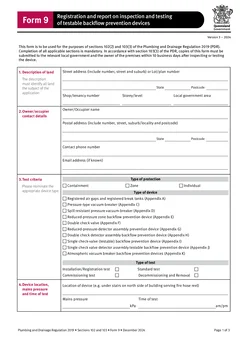
Open the SA backflow prevention device report at the device, or browse SA plumbing forms for the rest of your South Australian paperwork. If you also work in Queensland, see QLD Form 9 vs the SA backflow report before you reach for the wrong layout. Plumbing forms for every state sit on the plumbing forms hub.
What is the SA backflow prevention device report?
It is the record that a testable backflow prevention device was tested and what the results were. The Office of the Technical Regulator publishes the form for South Australian plumbing work, and it sits alongside the OTR plumbing trades guidance for licensed plumbers working in the state.
Backflow prevention devices exist to stop contaminated water being drawn back into the drinking water supply. A testable device is one that can be verified rather than assumed, which is the entire reason the report exists. The readings show the device is still doing its job.
The report is a point-in-time record. Its value comes from being specific enough that someone can compare this year's result with last year's and see whether the device is deteriorating.
Site, owner, and occupier
The first practical section identifies where the device is and who is connected to it.
Record the site address precisely, and separate the owner from the occupier where they differ. On commercial and tenanted properties those are frequently different people, and the person who arranged the test is often neither. Getting this right is what makes the report reach whoever needs it.
Location detail within the site is worth more effort than it usually gets. "Front boundary, in ground box, north of driveway" can be found by a tester who has never been on the property. "Main line" cannot, and an unfindable device is one that quietly stops being tested.
Device identity
This is the field that makes or breaks the report's usefulness next year.
Record the device type, make, model, size, and serial number from the nameplate rather than from the job notes. A serial copied forward from last year's report is how a replaced device silently inherits the history of the one it replaced.
Where a property has several devices, the identity plus the location is what keeps them apart. Two devices of the same make and size on one site are indistinguishable in a record that names only the type.
If the nameplate is unreadable or missing, say so rather than guessing. An honest note about an illegible plate is a finding the owner can act on.
Test kit and calibration
The form asks about the test kit because a result is only as trustworthy as the instrument that produced it.
Record the kit and its calibration date. If the calibration has lapsed, that is a problem to resolve before testing rather than a field to leave blank, because a reading from an uncalibrated kit is difficult to rely on if the report is ever reviewed.
This is also the field that repeats across every job you do, which makes it worth saving and reusing rather than retyping at each device.
The valve readings
The readings depend on the device type, and the form follows the type you nominate.
Record what you measured rather than what you expected. A device that passes comfortably and one that passes marginally are both passes, and the difference between them is the early warning that shows up when someone compares this year with last year. Rounding a marginal reading to a comfortable one throws that away.
Where a device fails, the report needs to show it failed and what happened next. A fail with no action recorded leaves an open question about whether the water supply is still protected, which is the one thing the whole exercise exists to answer.
Certification and sign-off
The certification block identifies the tester: name, licence, and contact details, with the contractor details behind them.
This is not a formality. The report is a statement that the device was tested and what the results were, and an anonymous statement is hard to rely on. It is also the practical route back to you if a question arises, which is usually easier for everyone than the alternative.
Sign after the rest of the report is complete rather than before, which sounds obvious and is a common enough habit to be worth saying.
Where reports go wrong
A few patterns recur.
Owner and occupier merged. On tenanted commercial sites the report then reaches the wrong person, or nobody.
Serial numbers carried forward. The device was replaced and the report says otherwise, which corrupts the history for everyone who comes after.
A fail with no action. The reading is recorded, the consequence is not, and the file leaves an open safety question.
No copy kept. The report goes to the owner and nowhere else, and the tester has nothing when asked about it later.
Keeping the record findable
File the report against the property rather than the job number, because property is how it will be searched for. Someone asking about a device next year will know the address, not your job reference.
Keep your own copy rather than relying on the owner or the managing agent holding one. Commercial properties change managers regularly, and the tester is frequently the only continuous record of what has been tested and when.
Where you service the same property annually, the run of reports is more valuable than any single one. It shows whether a device is stable or drifting, which is the information that lets you have a useful conversation about replacement before a failure forces it.
Annual testing and the reminder problem
Testable devices need retesting, and the practical failure is not the test itself but nobody remembering it is due.
Owners rarely track this. Building managers change. The tester is usually the only party with a reason to know, and a business that runs its own reminder list off the previous year's reports keeps the work and keeps the properties protected. One that waits to be called loses both.
Set the next due date at the time you file the report rather than intending to work it out later. It takes seconds while the report is open and it is the difference between a book of repeat work and a list of properties you used to service.
When you inherit someone else's device
Picking up a property another tester has serviced is common, and the first visit is the one where the record has to be rebuilt.
Do not assume the previous report is accurate. Read the nameplate yourself, confirm the location detail, and record what you actually find. Where your findings differ from the history you were given, note the difference rather than quietly correcting it, because the discrepancy is itself useful information about the property.
If no history exists at all, the first report becomes the baseline. Spending an extra ten minutes on device identity and location on that visit pays for itself every year afterwards.
Related reading: the generic backflow test report template guide for the national picture, and QLD Form 9 vs the SA backflow report if you cross the border.
Where the form helps
The SA backflow prevention device report follows the order above, so the device identity and location are captured at the device rather than reconstructed later. Your business, tester, licence, and test kit details are saved and reused across jobs, which removes the retyping that makes people cut corners on the fields that matter.
The form flags missing entries before download, you preview the entries mapped onto the report layout, then download the finished PDF to hand over and keep with the property record.
Tradie Forms maps your entries onto that layout. The licensed plumber remains responsible for the testing, the readings, and checking the downloaded PDF before it goes to the owner.
Official references
Check the SA Office of the Technical Regulator plumbing trades page for South Australian plumbing requirements and the OTR Backflow Prevention Device Report PDF for the current form, along with the AS/NZS 2845.3 catalogue page for the backflow prevention devices standard and the Standards Australia NCC 2022 plumbing and drainage spotlight for how the water services standards are referenced. Requirements and licence conditions change, so confirm the current form and your obligations before relying on this guide for a live job.