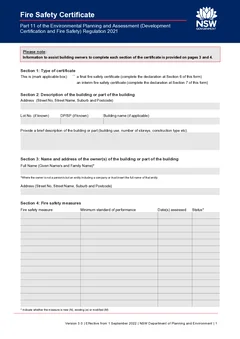
Tradie Forms: complete the NSW Fire Safety Certificate on the official layout, check the property, owner and measure details before you download it, preview the PDF, and keep the finished certificate with the fire safety schedule and the completion record.
NSW fire safety paperwork lands in the final stretch of a job. The measures have been installed or upgraded, the owner wants to move forward, the builder wants the closeout finished, and the certificate has to match the fire safety schedule.
That is the worst moment to be hunting for measure descriptions, practitioner details and property references across three email threads. A clean completion starts before you open the form.
Use the NSW Fire Safety Certificate template to fill the official PDF layout online, or browse NSW fire safety forms. If you are not certain the certificate is the right document for this job, start with when a NSW fire safety certificate is required.
What does a NSW fire safety certificate record?
It records that new building work is complete and that the fire safety measures listed in the fire safety schedule have been installed and checked. NSW Planning says the certificate is issued by or on behalf of a building owner when new building work is complete, and that it confirms a properly qualified person has installed and checked the listed measures so they can perform to the minimum standard.
The same NSW Planning guidance says certificates must use the fire safety certificate template. That is why the layout matters: the certificate is a completion record for a specific building, a specific schedule and a specific set of measures, and it needs to be readable as one.
Tradie Forms maps your entries onto the official PDF layout. The owner, the practitioner and the responsible parties still have to check the work, the schedule and the finished certificate.
Start with the fire safety schedule
The schedule is the anchor for everything else. It plays the key role in making sure a building's fire safety measures are installed and maintained to a minimum performance standard, and it specifies the measures and the standard for each one.
Before you fill the certificate, gather:
- The current fire safety schedule
- Building address and owner details
- Development or certificate references where applicable
- The essential fire safety measures that apply to the work
- The minimum standard of performance for each measure
- Details of the properly qualified person for each measure
- Installation, inspection or commissioning records
- Supporting reports, defect notes or photos
If the schedule and the certificate do not line up, nobody downstream can trust the closeout. The on-site guide to the NSW fire safety certificate walks through the same detail section by section if you are filling one now.
What to check before you download the PDF
Property and owner details
Check the legal property address, building name, owner details and any references. A commercial site, a strata property or a staged project may have more than one building or address description, so be specific about which one the certificate covers.
Fire safety measures
Each measure row should match the schedule. Do not shorten measure names so far that a reader cannot connect them back to the schedule wording.
Standards of performance
Take these from the schedule and the supporting documents. If a standard, specification or approval detail is referenced, keep that source document with the job record so the reference can be followed later.
Qualified person details
Record the person who installed and checked the relevant measures. Check names, company details, accreditation or qualification details where required, contact details and signatures.
Dates and signatures
Dates tell the story of the closeout. Inspection, installation, certificate and completion dates should make sense read against each other and against the job file.
What happens after the certificate is issued?
The paperwork does not stop at the download. Section 85 of the Regulation says that as soon as practicable after a certificate is issued, the owner must give a copy of the certificate and the current fire safety schedule to the Fire Commissioner, give a copy to a building practitioner where the Design and Building Practitioners Act pathway requires it, and ensure the certificate and schedule are prominently displayed in the building.
Step 1
Certificate issued
With the current fire safety schedule
The schedule travels with the certificate, not separately.
Step 2
Copy to the Fire Commissioner
Owner, as soon as practicable
Certificate and schedule together.
Step 3
Copy to a building practitioner
Where the DBP Act pathway requires it
Not every job, so confirm which pathway applies.
Step 4
Displayed in the building
Owner
Prominently, and kept displayed rather than filed.
Section 85 of the Regulation puts these on the owner. Keeping evidence of each is what makes the handover reconstructable later.
Keep evidence of each of those steps with the job. Downloading or emailing the finished PDF is not the same as completing the handover, and a record of where copies went is the thing that is hardest to reconstruct a year later.
Store evidence measure by measure
Fire safety certificates are far easier to review when the evidence follows the same measure order as the certificate. If the schedule lists several measures, store documents under each measure rather than dropping every file into one folder.
For each measure, keep the measure name as it appears on the schedule, the standard of performance or reference, the installer or properly qualified person details, the commissioning or test record, photos where useful, any defect and rectification notes, and the date checked.
That structure makes the certificate easier to read and easier to defend. The owner sees the certificate, and the office can see the support behind each row.
Is a fire safety certificate the same as a fire safety statement?
No, and mixing them up is the most common reason a NSW fire safety pack has to be redone. The certificate relates to new building work when that work is complete. The fire safety statement is issued by or on behalf of the owner of an existing building and confirms that an accredited practitioner has assessed, inspected and verified each applicable measure.
NSW Planning says annual fire safety statements are issued each year, while supplementary statements are issued at the shorter intervals in the fire safety schedule for critical measures. If the building is in that recurring cycle, use the NSW Fire Safety Statement and the annual fire safety statement guide for timing and lodgement instead. The certificate versus statement guide covers the split in more detail.
If the same site will later need an annual statement, link the records in the job file but keep them separate. It should stay obvious what was issued at completion and what belongs to the yearly cycle. AFSS record keeping and handover covers the statement side of that filing.
Common closeout gaps
The schedule is not in the pack. The certificate is much easier to check when the schedule sits beside it. Keep both with the job.
Measure wording does not match. Rewording a measure makes the certificate harder to reconcile. Use the schedule language unless there is a clear reason to add detail.
Supporting reports live somewhere else. If commissioning reports, test records or photos support the certificate, store them with the finished PDF.
Statement timing is confused with certificate timing. Certificates and annual statements belong to different job moments. Use the right record for the moment you are in.
The PDF goes out without a final read. Preview the official layout and check names, signatures, measure rows and dates before the certificate leaves the business. The common NSW fire safety certificate mistakes guide has the full list.
A practical closeout rhythm
- Pull up the current fire safety schedule.
- Confirm the property and owner details.
- Match each measure row to the schedule.
- Add properly qualified person details for each measure.
- Attach or store the supporting records.
- Preview the official PDF layout.
- Download the finished certificate.
- Store it with the schedule and the site pack, and record where copies went.
Before it leaves the business, run one last read. Does the property match the schedule? Are all listed measures included? Do the qualified person details match the supporting records? Are dates and signatures complete? Is the certificate clearly labelled in the job record? That check takes two minutes and catches the gaps that take a week to fix afterwards.
How Tradie Forms helps
Tradie Forms turns the NSW Fire Safety Certificate into sections you work through one at a time, so you can work through property, owner, measure, qualified person and certification details without wrestling with a flat PDF.
Saved business details stop you retyping the same company block on every job. Missing-field checks catch the blanks before you download. Preview shows the official layout as a reader will see it. The finished PDF can then be stored with the job record beside the commissioning sheets, reports and the fire safety schedule.
Tradie Forms does not certify fire safety measures, lodge anything or approve work. It helps the paperwork get filled, checked and downloaded cleanly.
Next steps
Start the NSW Fire Safety Certificate when new building work and measure checks are ready for completion. For existing buildings in the annual or supplementary cycle, use the NSW Fire Safety Statement, or browse NSW fire safety forms for the rest of the set. Fire safety forms for every state sit on the fire safety forms hub.
Official references
For current requirements, check the NSW Planning fire safety certification page, the Environmental Planning and Assessment (Development Certification and Fire Safety) Regulation 2021, the Fire and Rescue NSW fire safety statement lodgement guidance, and the NSW guide to selecting an accredited practitioner.