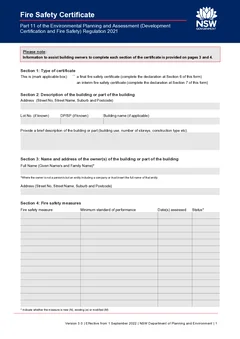
A fire safety certificate sits at the end of building work when owners, certifiers, and councils need proof that essential fire safety measures match the fire safety schedule.
This guide answers the trigger question: when do you need a final certificate, when do you need an interim certificate, and when you are looking at a different document such as the annual fire safety statement. Use the NSW Fire Safety Certificate form once the evidence chain is real, or browse NSW fire safety forms.
What do NSW Planning and the Regulation say?
NSW Planning says a fire safety certificate is issued by or on behalf of a building owner when new building work is complete. The certificate confirms that a properly qualified person has installed and checked the measures listed in the fire safety schedule, helping verify that the measures can perform to the minimum standard.
The Environmental Planning and Assessment (Development Certification and Fire Safety) Regulation 2021 defines two certificate types:
- A final fire safety certificate, issued for a building by or on behalf of the owner
- An interim fire safety certificate, issued for part of a building by or on behalf of the owner
The same Regulation says a final or interim certificate certifies that each relevant essential fire safety measure in the current fire safety schedule has been assessed as capable of performing to at least the standard required by the schedule.
| Type | Covers |
|---|---|
| Final | Building work as a whole |
| Interim | A completed part of a building, not the whole work |
When is a final certificate the right document?
Choose a final fire safety certificate when the relevant building work is complete and the measures being certified apply to the building as a whole for that work.

Typical moments:
- Building work under a construction certificate or complying development path has reached the stage where a final fire safety certificate is required for occupation or completion paperwork
- The fire safety schedule measures for that work have been installed and assessed
- The certifier or consent pathway asks for a final certificate, not an interim one
If only part of the building is complete and the certificate is not meant to cover the whole work, interim may be correct instead. For the type decision in more depth, see final vs interim.
When is an interim certificate the right document?
An interim fire safety certificate is for a completed part of a building. It is used when part of the building is complete and the certificate is not for the whole building work.
Typical moments:
- Staged occupation or staged completion where only a defined part is ready
- Certifier instructions call for interim certification of completed measures in that part
- The declaration must match the interim block, not the final block
Do not issue a final certificate for a partial stage just because the PDF fields look similar. The declaration type is part of the legal meaning of the document.
Large projects can generate more than one certificate over time. An interim certificate for a completed wing does not automatically satisfy a later final certificate for the whole building work. Keep each version in the job file with date, type, part covered if interim, and schedule reference.
Start from the fire safety schedule
The current fire safety schedule drives the certificate. The Regulation requires the schedule to specify fire safety measures and the minimum standard of performance for each measure.
Before deciding the certificate is due, confirm:
- Which building or part of building the schedule covers
- Which essential fire safety measures are relevant to this certificate
- The minimum standard of performance for each measure
- Assessment evidence and dates for those measures
- Whether the schedule has been reissued or corrected since the last draft certificate
If the schedule is wrong or outdated, fix the schedule path first. The certificate is not a place to invent measures. For how to enter the rows once the schedule is right, see the on-site certificate guide.
Keep the schedule version with the assessment evidence and finished certificate. If the schedule changes between the first draft and signing, rebuild the measure rows from the current version instead of editing one or two lines from memory. That keeps the certificate, practitioner evidence and certifier record on the same basis.
Is this certificate or an annual fire safety statement?
Many NSW buildings also have ongoing fire safety statement duties after occupation. That is a different document family from the certificate issued around new building work.
| Document | Typical moment |
|---|---|
| Fire safety certificate (final or interim) | New building work complete; schedule measures assessed for that work |
| Annual fire safety statement | Ongoing building obligation after occupation / for existing buildings as required |
If the client asked for an "AFSS" or annual statement, open the NSW fire safety statement path and certificate vs statement. Do not force statement wording onto the certificate form. For statement timing, see when is a NSW fire safety statement required.
Who needs to be involved?
The certificate is issued by or on behalf of the building owner. A properly qualified person assesses the measures. Certifiers, managing agents, and fire safety practitioners often sit in the middle of the paperwork chain.
Before you treat the certificate as ready:
- Confirm who is authorised to issue on behalf of the owner
- Confirm the owner identity matches the approval and schedule records
- Confirm who assessed each measure and against which standard
- Confirm where copies must go (owner, display, certifier, council pathway as applicable)
Talk to the certifier early when the building is close to completion. Ask whether they expect a final certificate, an interim certificate for a defined part, or both across stages. After issue, see handover and records.
Practical decision patterns
New warehouse complete. Building work finished, all schedule measures assessed for the building as a whole. Final fire safety certificate is the usual document type, subject to certifier instructions.
Mixed-use building with one tower floor ready. Only a defined part is complete and the certificate is not for the whole building work. Interim certificate with a clear description of the part covered.
Client asks for "the yearly fire paper". That is often the annual fire safety statement path, not the certificate for new building work. Switch to the statement form rather than forcing statement wording onto the certificate.
Staged occupation across wings. Certifier wants an interim certificate for Wing A this month and a final later for the whole building. That is two certificate events, not one PDF reused with the type flipped in a viewer. Keep separate dated downloads and separate evidence packs.
Schedule amended after practical completion walk. Measures were assessed against an earlier schedule version, then a later version lands with an extra measure. Do not treat the old assessment pack as enough until that measure is assessed.
What the certificate is not
The fire safety certificate is not:
- An annual fire safety statement for ongoing building obligations
- A substitute for fixing a wrong or missing fire safety schedule
- Permission to occupy without the rest of the certification pathway the consent requires
- A place to list measures you hope will be installed later
If those are the real problems, fix the schedule, statement, or consent pathway first. The certificate comes after the evidence chain is real. Avoid the rework list in common certificate mistakes.
Decision checklist
- Is this about new building work and the fire safety schedule for that work?
- Is the work complete for the whole building (final) or only a defined part (interim)?
- Do you have the current schedule and assessment evidence?
- Is the client actually asking for an annual statement instead?
- Do you know who issues on behalf of the owner and who assessed the measures?
If step 1 is yes and step 4 is no, you are on the certificate path. Open the NSW Fire Safety Certificate form.
Tradie Forms maps your entries onto the official layout. It does not lodge the certificate or approve the work.
Next steps
Start the NSW Fire Safety Certificate when the schedule and assessment pack are ready. Walk the fields with the on-site guide, choose type with final vs interim, or browse NSW fire safety forms. The fire safety forms hub covers the other states.
Official references
For current requirements, check the NSW Planning fire safety certification page, the Environmental Planning and Assessment (Development Certification and Fire Safety) Regulation 2021, the Fire and Rescue NSW fire safety statement lodgement guidance where statement work is involved, and the NSW guide to selecting an accredited practitioner. Confirm the current consent, schedule, and certifier instructions for your building before issuing a certificate.