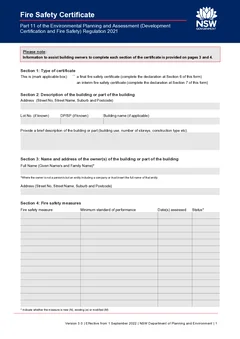
Tradie Forms: complete the NSW Fire Safety Certificate on the official layout while the schedule and assessment pack are still open. Pick final or interim, enter measure rows, complete the matching declaration, preview, then download.
Fire safety certificates fail when the team leaves the building and tries to rebuild the schedule from memory. Complete the NSW Fire Safety Certificate on site or in the site office: lock building and owner details, enter measure rows from the current schedule, complete the declarant and declaration, then download.
Confirm the certificate is the right document with when is a NSW fire safety certificate required. Avoid rework with common mistakes. More NSW fire forms: NSW fire safety hub.
What should you gather before you start?
Gather the current fire safety schedule for the building or part, assessment records and dates for each relevant essential fire safety measure, building address as used on the approval, owner details, clarity on final versus interim, and declarant identity and contact details for the person issuing on behalf of the owner where applicable.
NSW Planning describes the certificate as confirmation that a properly qualified person has installed and checked the measures listed in the fire safety schedule. Do not start the PDF without that evidence chain.
Stop and switch documents if the client actually needs an annual fire safety statement, the schedule is not current, you cannot confirm final versus interim, or assessment evidence for a relevant measure is missing. For the practical split, see certificate vs statement.
Step 1: Certificate type
Select final or interim.

| Type | Use when |
|---|---|
| Final | Building work as a whole is complete for the certificate purpose |
| Interim | A completed part of a building is being certified, not the whole work |
The declaration section later must match this choice. The form shows the final declaration for final certificates and the interim declaration for interim certificates. More detail: final vs interim guide.
A common site pattern is an interim certificate for a completed wing while the rest of the building is still under construction. Confirm with the certifier or builder that this visit is interim for that part only, open the current schedule that applies to that part, and write the building description so a stranger reading the PDF knows which part is covered.
Step 2: Building details
Enter the building identity the schedule and approval use. Include street, suburb, and any lot, DP, or building description fields the form requires.
If the certificate is interim, make sure the part of the building covered is clear in the description so the PDF does not look like a whole-building final certificate by accident.
Step 3: Building owner
Enter the owner details required by the form. The certificate is issued by or on behalf of the building owner. Align names with title, strata, company, or agent records for this job.
Step 4: Fire safety measures
This is the heart of the certificate.

For each relevant essential fire safety measure in the current schedule:
- Name the measure as the schedule does
- Record the minimum standard of performance from the schedule
- Record assessment details and dates from the qualified person's records
- Complete status fields the form provides (new, existing, modified, and similar where shown)
Work row by row. Do not leave "to follow" standards if the schedule already states them. Match measure wording to the schedule where practical, and confirm long standards still show fully on the finished PDF.
Schedule alignment habits that save callbacks
- Copy measure names from the schedule text, not from an old certificate for a different stage
- If the schedule lists a measure you did not assess on this visit, do not invent a pass. Clarify with the certifier whether that measure belongs on this certificate for this part
- If two contractors assessed different measures, collect both assessment records before you download one certificate covering both
- Long performance standards often wrap or truncate on phone screens. Preview the PDF and check every row
Step 5: Declarant
Enter the declarant name, organisation, and contact details. Saved person details help on the next certificate, but re-check authority and details for this building. The declarant block identifies who is making the declaration on the certificate pathway.
Step 6: Declaration
Complete only the declaration that matches the certificate type:
- Final declaration for a final certificate
- Interim declaration for an interim certificate
Read the declaration text before signing or naming the declarant. The certificate is a serious statement about measure performance against the schedule.
Step 7: Preview and download
Preview the official PDF layout. Check certificate type, building and owner, every measure row for truncation or blank standards, and declarant and correct declaration block.
Download the PDF when it is clean. Use a searchable filename such as fire-safety-certificate-final-12smithst-2026-07-24.pdf (or interim with a part label). The download does not lodge the certificate with a council or certifier.
Second-person check before you leave
On busy sites, one person fills and another checks:
- Certificate type matches the certifier instruction
- Building description names the part if interim
- First and last measure rows match the schedule wording
- No blank performance standards on listed measures
- Declarant and declaration block match final versus interim
- Filename and recipient list are written on the job note
What do you do after the PDF is ready?
Give the owner or agent the copy they need. Follow the certifier or consent pathway for any further lodgement or attachment steps. Keep a job file copy with the schedule and assessment evidence. Track who you sent it to, when, and which filename was accepted. If measures or the schedule change, do not silently reuse the old PDF; keep revised versions marked.
Store together: the finished certificate PDF, the fire safety schedule used for this certificate, assessment records for the measures listed, confirmation of who received the certificate, and a note of final versus interim with the part description for interim certificates.
See handover and records for the closeout pack.
When this is not the right form
If the building already has an occupation certificate and the ask is the annual essential services statement, you likely need the NSW fire safety statement, not another completion certificate.
If the schedule changed after you downloaded, do not patch the old PDF in a viewer. Update the form from the new schedule and download a new dated file.
Tradie Forms maps your entries onto the official layout. You remain responsible for the accuracy of the certificate and for how it is used in the certification pathway.
Working from the current schedule
The certificate is built around the building's fire safety measures, so the schedule is the document the whole job depends on.
Working from an old copy is the most common way a certificate goes wrong. Measures get added during fitouts and removed during reconfigurations, and a certificate listing measures that are no longer installed, or missing ones that are, will not survive review.
Confirm you have the current schedule before you start assessing rather than discovering the mismatch while writing the certificate.
Assessment dates and who did them
Each measure needs an assessment behind it, and the dates matter as much as the results.
Assessments spread across a long period, or bunched implausibly close together, both draw attention. Where different people assessed different measures, that needs to be reflected rather than collapsed into one name and one date for convenience.
The certificate is a statement by the person issuing it. Recording the assessments accurately is what makes that statement supportable.
Next steps
Start the NSW Fire Safety Certificate when the schedule and assessment pack are in front of you. Confirm the trigger with when a certificate is required, run the common mistakes checklist, or browse NSW fire safety forms. The fire safety forms hub has the national set for contractors working across borders.
Official references
For current requirements, check the NSW Planning fire safety certification page, the Environmental Planning and Assessment (Development Certification and Fire Safety) Regulation 2021, the Fire and Rescue NSW fire safety statement lodgement guidance where statement work is involved, and the NSW guide to selecting an accredited practitioner.