Construction sites chew through leads, tools, and portable RCDs. That is why public regulator guidance does not treat them like a quiet office. Three months is the cycle you will hear from site managers, principal contractors, and WHS officers, and it is the cycle several jurisdictions state clearly against AS/NZS 3012. If your register still shows twelve-month due dates on a formwork deck, the paperwork is already wrong for the environment.
This guide covers how AS/NZS 3012 and AS/NZS 3760 share roles on a live build, what public pages say about the three-month equipment cycle, colour tags, multi-contractor reality, and visit logistics. For general RCD push-button versus trip time cadence and what to write on the safety switch record, use RCD test intervals and records instead of repeating every NT, NSW, and Tas portable RCD rule here. Broader AS/NZS 3760 overview sits in test and tag register and AS/NZS 3760.
If you are tagging a construction round today, open the national test and tag register and set the environment and interval before the first item. Browse electrical forms. For safety switch paperwork on the same site, use the national RCD test record.
Why is construction test and tag every three months?
NT WorkSafe states that WHS regulations require electrical installations at a construction site to comply with AS/NZS 3012, and that AS/NZS 3012 requires all electrical equipment on construction sites to be tested every three months. It points to AS/NZS 3760 for inspection and testing method for electrical equipment and RCDs.
SafeWork NSW construction and demolition electrical practices guidance states that power tools, flexible cords, cord extension sets, portable socket outlet assemblies, and portable RCDs must be tested and inspected according to AS/NZS 3760 methods in a period not exceeding three months. Inspection and testing can be carried out by a competent person trained in RCD testers and PAT, or by a licensed electrician.
WorkSafe Tasmania construction RCD guidance aligns portable equipment tagging after inspection and testing with durable non-reusable tags, and places operating time tests for portable RCDs on a three-month cycle, with more frequent push-button checks.
Those pages are not a substitute for reading the standards and your local WHS regulations, but they are consistent on the headline: construction is a short-cycle environment, and three months is the number the industry is held to for equipment testing.
AS/NZS 3012 and AS/NZS 3760 together
Think of the two standards as role-sharing on a construction site.
AS/NZS 3012 is about electrical installations on construction and demolition sites: temporary wiring, switchboards, RCDs, and the site electrical environment that gear lives in. Regulator bulletins use it as the hook for the three-month equipment testing duty.
AS/NZS 3760 is about in-service safety inspection and testing of electrical equipment and RCDs: visual checks, electrical tests, tagging, records, competency, and environment-based frequency. Standards Australia's public spotlight describes those elements as the core of the standard.
On site that means: construction rules put you on a three-month clock; 3760 methods tell you how to inspect, test, tag, and record. Your testing basis field should make both visible when both apply, for example naming AS/NZS 3760:2022 and AS/NZS 3012 for the construction round.
What equipment sits on the three-month cycle?
Public construction guidance focuses on the gear that gets thrashed:
- Power tools and portable appliances
- Flexible cords and extension leads
- Portable socket outlet assemblies
- Portable RCDs (as equipment subject to inspection and testing)
- Equipment in amenities and site offices (called out on some construction tables)
Fixed construction wiring and switchboards may sit on their own inspection rhythms in AS/NZS 3012. Do not assume every electrical thing on site shares one identical cell in a table. Do assume portable tools and leads are not on an office multi-year interval while they live in the dirt.
Hire equipment that moves between construction sites still needs a cycle that matches the harshest environment it is used in. A lead that spent three months on a demolition deck does not become low-risk office gear because it slept in a van on Sunday.
Portable RCDs on construction: point to the intervals guide
Portable RCDs sit on the three-month operating time cycle with the rest of the construction equipment round, and they also sit on a shorter push-button rhythm while they are in daily use. Public pages from NT WorkSafe, SafeWork NSW, and WorkSafe Tasmania all describe that split, with wording that varies slightly by jurisdiction.
Rather than reprinting every daily-button and monthly-fixed rule here, keep this article on the construction register and site logistics. For push-button versus trip time cadence, what to leave blank on button-only visits, and how to write next due dates honestly, use RCD test intervals and records. For filling the safety switch PDF on the day, use the RCD test record on-site guide.
On the construction test and tag visit itself: record operating time tests for portable RCDs on the competent-person round, keep push-button expectations in site inductions and toolbox talks, and do not treat a quarterly PDF as a substitute for daily button discipline.
Colour tags and site culture
Many construction and mining sites colour-code tags by test period so supervisors can see overdue gear at a glance. The colour is a site control, not a replacement for dates on the register.
If the site uses colours:
- Record the tag colour for this round on the register header
- Use the same colour on every pass tag for that period
- Make sure next due dates on the register match the period the colour represents
- Do not put a pass colour on a failed item
If the site does not use colours, leave the field blank and rely on dates. Inventing a colour system the principal contractor does not run only creates confusion.
Building a construction register that survives a site audit
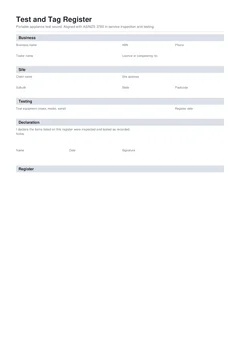
Header. Business and tester details, client or principal contractor, site address, job or project number, PAT instrument and verification date, work environment set to construction (or demolition/mining as applicable), testing basis including AS/NZS 3012 and AS/NZS 3760, default retest interval of three months, tag colour if used, register date.
Rows. Asset ID matching the tag, specific description, serial or model where available, location (building, level, trade package, or gang box), readings, pass or fail, test date, next due roughly three months out for passes, action and detail for fails.
Fails. Immediate removal from service. Construction sites are full of shared gear; a failed lead left in a common pile will be used again before lunch. See test and tag failed equipment records.
Handover. Give the site manager or document controller a PDF the same day. Keep your copy against the project number. On NSW residential packs you may also be asked for HISSP-style forms; see NSW WHS Form 08 test and tag register when that pack is specified.
Running the three-month visit on a live site
Practical tips that keep the cycle honest:
- Book against the previous register's next due dates, not against memory
- Start with high-use leads and tools in active work fronts, then amenities and offices
- Quarantine fails in a labelled bin the site agrees on, not only in the back of your ute
- Do not extend tags because "the pour is this week" without a documented site decision that still meets WHS duties
- If gear arrives mid-cycle from another site, check its tag date against three months from its last test, not from your visit date wishfully
The day-of loop for each item is the same as any environment, just tighter on interval: identify, inspect, test, decide, tag or quarantine, write the row now. Detail in the test and tag register on-site guide.
Multi-contractor reality
Principal contractors often want one coherent electrical file even when five trades bring their own leads. Options that work:
- Each trade keeps a register for its own gear and submits a PDF to document control
- The principal runs a consolidated site register and requires trades to present gear on a test day
- Hire companies supply registers for hire fleets and trades still check tags before use
Whatever model the site uses, failed gear must still come out of service immediately. A register ownership argument is not a reason to leave a damaged lead plugged in.
If you are the visiting tester for several trades on one day, keep separate registers per client or trade package when ownership differs. Mixing five businesses onto one PDF without clear asset ownership makes the next fail conversation impossible. Shared site compound gear can sit on a principal contractor register if that is how the site runs it; say so in the client field so the file trail is clear.
Common construction paperwork failures
Mistake patterns that apply on every site, not only construction, are listed in common test and tag register mistakes.
Build construction registers on site
Tradie Forms lets you set work environment, testing basis, default retest interval (three months for construction rounds), and optional tag colour once, then add each item as you test it. Next due dates follow the interval. Failed items require action detail before download. You preview the PDF and hand it over before you leave the gate. The form is not a government document and is not affiliated with regulators. The competent person still applies AS/NZS 3012 and AS/NZS 3760 correctly for the site.
Start the national test and tag register, browse electrical forms, or open the national RCD test record when construction RCD operating time tests need their own clean list. For interval and push-button detail, go to RCD test intervals and records.
Official references
Check NT WorkSafe safety inspection and testing of electrical equipment on construction sites, SafeWork NSW electrical practices on construction and demolition sites, WorkSafe Tasmania RCDs on construction sites, the Standards Australia spotlight on AS/NZS 3760:2022, and the Safe Work Australia model Code of Practice: Managing electrical risks in the workplace. Confirm the current standard editions and your state or territory WHS rules before you lock a three-month cycle on a signed register.