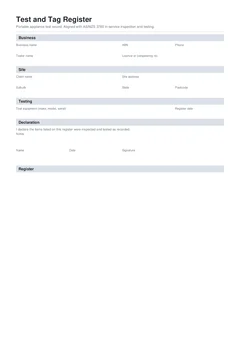
You have just worked through a rack of leads, power tools, and portable RCDs on a site, the pass and fail results are on a clipboard or in your head, and someone wants proof the gear is safe to use. That proof is a test and tag register. It ties every item to a test date, a result, and a next test due date, and it is the record that stands up if a tag gets knocked off or a piece of equipment is questioned later.
This guide covers what a test and tag register records, who is allowed to do the testing, how retest intervals work under AS/NZS 3760, and how to complete the register so it is clean and complete before you hand it over.
If you are writing up a round of testing today, open the national test and tag register. It maps onto the layout of a clean AS/NZS 3760 record. Browse more electrical forms for the rest of your paperwork.
What does a test and tag register record?
Test and tag is the everyday name for the in-service safety inspection and testing set out in AS/NZS 3760:2022. The standard covers low voltage equipment connected to the supply by a flexible cord or a connecting device, including gear that is already in service, has been repaired or serviced, is returning from a second-hand sale, or is available for hire. Visual inspection comes first, then the electrical tests, and a durable tag goes on the item once it passes.
The tag on the appliance is the quick reference on the tool. The register is the durable record behind it. The Safe Work Australia model code of practice accepts records kept as a tag attached to the equipment, or in a logbook, register, or computerised database. A register is what keeps the whole round of testing together in one place, so a lost or damaged tag does not leave you guessing when an item was last checked.
A register groups a set of items tested on the same visit under the business, site, and testing details that apply to all of them, then lists each item with its own identity, readings, result, and dates. Filling it in that order is what keeps every reading tied to the right piece of gear.
Business and tester details
The register starts with who did the testing. That is your business name, the tester's name, and a licence or competency number, plus a contact number so the record has someone to stand behind it.
Testing and tagging is carried out by a competent person. The Safe Work Australia code describes a competent person as someone with the knowledge, training, skills, and experience to do the task safely and correctly. That is the person whose name belongs on the register, because the record is a statement that the inspection and tests were done properly.
Getting this section right once matters because it repeats across every job. Your business and tester details do not change from one round of testing to the next, so they are worth saving and reusing rather than retyping each time.
Site and job details
Next is where the testing happened. The register records the client, a job reference, and the site address. On a busy week you might test at several sites, so tying each register to a client and a job reference is what stops two rounds of testing blurring into one record.
The job reference is also the thread that links the register back to the rest of the job file. Put the same reference on any photos or notes so the register and its supporting evidence do not become a loose collection on someone's phone.
How often do you retest under AS/NZS 3760?
This section sets the rules the whole register runs on. Three fields do the heavy lifting: the test equipment, the work environment, and the testing basis.
The test equipment is the make, model, and serial of the tester you used, plus its last verification or calibration date. A result is only as trustworthy as the instrument behind it, so recording the tester and its verification date gives the readings something to stand on.
The work environment drives how often equipment needs retesting. AS/NZS 3760 takes a risk-based approach, so the interval depends on how hard the gear is used and how likely it is to be damaged. The intervals range widely: hire equipment is on a short cycle of around three months, factory and workshop equipment sits in the middle, and low-risk office equipment can run to as long as five years where a risk assessment supports it. Naming the environment on the register makes the interval you have applied clear rather than assumed.
The testing basis records which standard the round was done to. For most in-service testing that is AS/NZS 3760:2022. On construction, demolition, and mining sites it is AS/NZS 3012, which WHS regulations require construction site electrical equipment to comply with, and which sets a three-monthly test cycle. Those sites often colour-code tags by test period, so the register carries a tag colour field for the ones that do.
The register: every item, reading, and result
This is the body of the record, and it is one row per item. Each item carries its own identity, its readings, a pass or fail result, the test date, and the next test due date.
Item identity. An asset ID or tag number, a description, and a location. The identity is what lets anyone match a row back to the physical item, so a vague description that fits four leads on the same site defeats the purpose.
Test results. The readings that back the result, recorded against the item rather than summarised across the round. Complete readings are what make a pass defensible if the item is ever questioned.
Result and dates. A pass or fail, the test date, and a next test due date. The next due date is set from the retest interval for the environment, which is the point of nominating the environment up front.
Working item by item keeps the register honest. The failure point is almost always the register written up later from memory, where a reading gets rounded or an item gets skipped. Filling each row while the item is in front of you is the fix.
What do you do when an item fails?
Recording the fail properly is its own job. See test and tag failed equipment records for the row detail and client conversation. A fail is not just a missing tag. Any equipment found not to comply is removed from service immediately and marked so it cannot be put back into use until it is repaired or replaced. The register should record what failed, why, and the action taken, whether that is tagging the item out and removing it, sending it for repair, disposing of it, or notifying the client.
Recording the action alongside the failure is what closes the loop. A register that lists a fail with no action leaves an open question about a piece of gear that might still be on site. Capturing the failure detail and the action at the moment you pull the item keeps the record and the site in step.
Declaration and sign-off
The register finishes with a name, a date, and a signature, plus room for notes such as failed items tagged out and the client advised. The declaration is you standing behind the round of testing, so it goes on last, once the items, readings, and results are in and correct rather than before.
Common test and tag register mistakes
These are the ones that turn a completed round into a return trip or a record that does not hold up.
Vague item identity. A description that fits several items on the same site means a row cannot be matched to the gear it covers. Give each item an ID and a description that is specific.
Missing next test dates. A pass with no next due date leaves nobody knowing when the item is up again. Set the interval from the environment and record the due date on every passed item.
A fail with no action. Recording a fail but not what happened to the item leaves a safety question open. Note the action at the moment you pull the item from service.
Most of these trace back to the same habit. The register is written up away from the gear, hours later, from a clipboard or memory. Completing it item by item on site, while each piece of equipment is in front of you, is what keeps it accurate. The full list is in common test and tag register mistakes, and the round-by-round method is in the test and tag register on-site guide.
Build the register on site
Tradie Forms turns the test and tag register into sections you work through one at a time that follow the order of a clean AS/NZS 3760 record. You set the environment, testing basis, and default retest interval once, then add each item with its identity, readings, result, and dates, and the next due date follows from the interval you set.
Your business, tester, and licence details are saved and reused, so they are not retyped on every job. Failed items prompt you for an action and the failure detail before you can finish, which is what catches the open fail before the client does. The form flags missing fields before you download, you preview the entries mapped onto the official PDF layout, then download the finished register to hand over and store with the job.
Tradie Forms maps your entries onto the layout of the record. The competent person still checks the equipment, the readings, and the downloaded PDF before it goes anywhere.
Start the national test and tag register on site, or browse more electrical forms for the rest of your electrical paperwork.
Official references
Check the Standards Australia spotlight on AS/NZS 3760:2022 for the scope of in-service testing, the Safe Work Australia model Code of Practice: Managing electrical risks in the workplace for the competent person and record-keeping requirements, WorkSafe Queensland testing and tagging of electrical equipment for regulator guidance, and the NT WorkSafe bulletin on electrical equipment on construction sites for AS/NZS 3012 on construction work. The standard sets recommendations, and your state or territory WHS regulator and current licence conditions govern how they apply, so confirm the interval and testing basis for the site before you sign the register.