"How often do we test the safety switches?" is the question that starts arguments on site. Someone quotes three months. Someone else quotes six. Someone pulls a five-year office interval from a different type of equipment. The honest answer is that public guidance is environment-based, and construction work is tighter than a quiet office. Your job is to apply the right basis for the site, then write dates on a record the next person can trust.
This guide sticks to what official and regulator-facing sources support. It does not invent a full national interval table. Where the public page is specific, it says so. Where the standard leaves detail inside a paid document, it says that too. Construction three-month equipment cycles, colour tags, and multi-contractor logistics are covered in depth in construction site test and tag every three months. This page stays on intervals, push-button versus trip time, and what the written RCD record must carry.
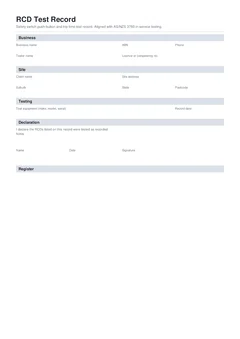
If you are logging RCD tests today, open the national RCD test record. Browse electrical forms. For portable appliances on the same site, use the national test and tag register.
What does AS/NZS 3760 say about RCD testing?
Standards Australia describes AS/NZS 3760:2022 as the standard for in-service safety inspection and testing of electrical equipment and RCDs. The public spotlight notes that it covers inspection procedures, testing procedures, frequency of inspection and testing based on equipment type, environment and usage, documentation and tagging, and competency requirements.
That is the right mental model for intervals: risk and environment drive the cycle. Hire gear in harsh use is not on the same rhythm as low-risk office equipment. The full interval tables live in the standard itself, which is a paid publication. Public regulator pages point you to the standard rather than reprinting every cell.
For portable appliance testing under the same standard, industry practice summarised in test and tag register and AS/NZS 3760 is that intervals range widely, from short cycles such as around three months for hire equipment through to longer periods for low-risk office gear where a risk assessment supports it. RCD intervals sit inside the same risk-based system, with the extra split between simple push-button checks and measured operating time tests.
Construction sites: use the dedicated guide
Construction and demolition are where public material is most concrete, because AS/NZS 3012 sits alongside AS/NZS 3760 methods. NT WorkSafe, SafeWork NSW, and WorkSafe Tasmania all describe short equipment cycles (commonly three months) and more frequent push-button checks for portable RCDs, with operating time tests on a longer construction rhythm.
Do not treat this paragraph as a full dump of NT, NSW, and Tas portable RCD rules. For regulator-by-regulator construction detail, colour tags, multi-contractor registers, and visit logistics, read construction site test and tag every three months. Bring that cycle back here only as the interval you write on the RCD record: testing basis that names construction rules where they apply, visit type (button, trip time, or both), and next due dates that match what you actually did.
General workplaces: stay honest about what is public
Outside construction, state pages often point to local electrical safety regulation and AS/NZS 3760 without reprinting a full interval matrix. WorkSafe Queensland testing and tagging guidance explains who can test and how often in the context of Queensland's Electrical Safety Regulation, and notes that the regulation takes precedence over the standard where they differ. SafeWork NSW electrical inspection and testing pages direct people to AS/NZS 3760 for methods and frequency. The Safe Work Australia model code of practice on managing electrical risks frames inspection and testing as part of managing workplace electrical risk, including by a competent person and with records.
What you should not do is invent a single national number for every fixed board RCD in every office, workshop, and factory and present it as law. What you should do is:
- Identify the environment and whether construction rules apply
- Separate push-button checks from operating time tests
- Apply AS/NZS 3760 and any state regulation or site procedure that governs the workplace
- Write the testing basis and next due dates on the record so the choice is visible
If a client insists on a specific interval in a contract or site safety plan that is tighter than the minimum, use the tighter one and record it. Tighter is fine. Guessing is not.
Push-button versus trip time on the record
Intervals only make sense if the record says which test was done.
Push-button check. Confirms the device responds to its built-in test facility. Construction guidance treats this as frequent, sometimes daily for portable units in use, sometimes monthly for fixed units. The record should show a pass or fail for the button test and a next due date that matches the push-button cycle for that environment if this visit is only a button check.
Operating time (trip time) test. Measures how quickly the RCD disconnects under an applied imbalance. Construction guidance commonly places this on a three-month cycle for portable RCDs and related equipment testing. SafeWork NSW construction material notes tripping time should be less than 300 ms for the tests it describes. Always assess measured times against the limit that applies to the device, test current, installation, and testing basis for the job you are on. Do not copy a limit from a different class of work without checking.
On the national RCD test record, leave trip time blank for button-only visits. Record measured milliseconds when you run the operating time test. If the device does not trip inside the instrument window, record that clearly rather than forcing a pass.
Mixing the two without saying so is a classic paperwork failure. A monthly push-button check on a fixed board is not the same evidence as a measured operating time test. Make the visit type clear in the testing basis or notes.
What must the written record carry for intervals?
A next due date without context is half a story. A useful RCD interval trail includes:
Testing basis. For example AS/NZS 3760:2022, and AS/NZS 3012 where construction rules apply.
Environment or site type. Construction, workshop, office, hire, or the site procedure name. This explains why the interval is what it is.
Type of check. Push-button, operating time, or both.
Test date and next due date. On every pass. Fails need an action, not a fake due date that implies the unit is still in service.
Instrument details. So the readings have a tool history behind them.
Without those fields, the next contractor reinvents the interval from scratch, often optimistically. Log book style habits for keeping this trail readable sit in RCD log book and safety switch testing records. Fill order for capturing them on site sits in the RCD test record on-site guide.
How do you set the next due date?
Practical approach on site:
- Confirm with the client or principal contractor which standard and site procedure apply
- Set a default retest interval on the register for this visit type
- Apply that default to each pass as you go
- Override a row only when a specific device has a different agreed cycle
- Tell the client the next due dates when you hand over, especially if fails mean some circuits need a return visit sooner
If this visit was button-only on fixed boards, do not print next due dates that imply a full operating time test was completed. If this visit was a three-month construction operating time round, say so in the testing basis and notes.
How intervals interact with fails
A fail resets the conversation. The device is not "due in three months". It is out of service or replaced now. The record should show isolation, replacement, or client notification, not a next due date that pretends the failed unit is still protecting people.
After replacement, the new device needs its own identity and a fresh test entry. Do not overwrite the fail row so hard that the history of the failed unit disappears. History is what shows the site acted when the old unit did not perform.
Multi-site and multi-state work
If you test across states, do not assume the construction fact sheet from one regulator is the full story in another. Use the local WHS and electrical safety material for that site, plus AS/NZS 3760 and AS/NZS 3012 where they apply. Queensland's WorkSafe guidance is explicit that local regulation can take precedence over the standard. That is a useful reminder everywhere: standards set methods and recommendations; law and regulation set duties.
Keep each site's register separate. Shared vans and shared portable RCDs still need clear ownership on the record so a three-month construction tag is not treated like an office cycle when the unit moves sites.
When the same portable RCD moves from a construction deck to a workshop, reassess the interval for the new environment rather than blindly keeping the last tag date as if the risk never changed. The record should show where it was tested and on what basis, not only that a sticker exists.
Build interval-aware records on site
Tradie Forms lets you set testing basis and a default retest interval once per RCD record, then carry next due dates onto each passed device as you add it. You still choose the interval from the standard and regulator rules for the site. The form does not replace that judgment. It stops you from leaving passes without dates. Failed items require action detail before download so open fails do not slip out as a clean-looking PDF.
Start the national RCD test record, read the RCD test record on-site guide for fill order, or open the construction three-month guide when the site is a live build rather than a general workplace.
Official references
Check the Standards Australia spotlight on AS/NZS 3760:2022, the Safe Work Australia model Code of Practice: Managing electrical risks in the workplace, SafeWork NSW electrical practices on construction and demolition sites, NT WorkSafe safety inspection and testing of electrical equipment on construction sites, and WorkSafe Tasmania RCDs on construction sites. Confirm the current standard edition, site procedure, and state or territory rules before you lock next due dates on a signed record.