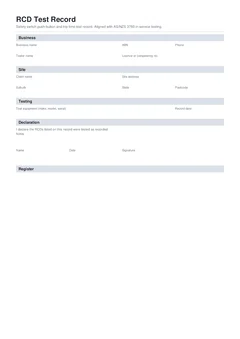
Most RCD testing is straightforward. The push-button either trips or it does not. The instrument either shows a trip time or it does not. The pain starts when the written record is wrong, incomplete, or finished hours later from a photo of a cardboard note. That is when a safety officer asks which board a fail belonged to, or a client finds a circuit still live that the report said was isolated.
This guide is about safety switch and RCD registers. Portable appliance and lead register mistakes live in common test and tag register mistakes. Fill order: RCD test record on-site guide. Client language: RCD log book and safety switch testing records.
Use the national RCD test record as a pre-download check while you are still at the board. Browse electrical forms.
Why do these mistakes matter?
AS/NZS 3760:2022 covers in-service inspection and testing of electrical equipment and RCDs, including documentation. The Safe Work Australia model code on managing electrical risks treats inspection and testing records as part of showing electrical risks are controlled. State pages such as SafeWork NSW electrical inspection and testing and WorkSafe Queensland testing and tagging point workplaces back to the standard and to local regulation.
Most errors share one root cause. The testing was done under pressure, the register was treated as a night job, and the only people who still knew which board was which had already driven to the next site.
Shared traps (and how they show up on an RCD PDF)
Some failures appear on both appliance and RCD paperwork. On a safety switch register they look like this.
Vague identity. Rows say "kitchen RCD" when the site has three kitchens. Later nobody can match the row to a physical device.
Fix on the PDF: RCD ID or circuit reference plus a location a stranger could walk to. On multi-board jobs, include the board name on every row, not only the first.
Writing up later. Three boards done. Register typed in the ute. 24 ms becomes 30 ms. The fail lands on the wrong circuit.
Fix on the PDF: enter the trip time while the tester still shows it. Finish one board before you start the next. Use photos as backup, not as the primary log.
Pass with no next due date. Every device is marked pass. Nobody knows when they are due again.
Fix on the PDF: set a default retest interval for the visit type, then put a next due date on every pass before you sign.
Fail with no action. The register shows a fail. The circuit is still live, or the portable unit is still in the van.
Fix on the PDF: at the moment of fail, record isolated, tagged out, replaced, removed from service, or client advised. Do not download a register that lists a fail with an empty action. Handover habits: RCD test record handover to clients.
Mistakes that are mostly about safety switches
These are the ones that show up on RCD records far more than on lead registers.
Trip times from memory or photos only
The PDF shows neat numbers that never matched the instrument. Supporting photos exist but are not tied to rows, so they do not rescue the register.
Fix on the PDF: capture milliseconds while the screen is live. If you only did a push-button check, leave trip time blank rather than inventing one. If the device did not trip inside the instrument window, record that clearly (for example >300) instead of rounding it into a pass.
Treating push-button and trip time as the same visit
The log looks like full operating time testing was done when only the test button was pressed, or the reverse. Auditors and the next tester then apply the wrong expectation to the next due date.
Fix on the PDF: state the testing basis and visit type in the header or notes. Capture push-button results always. Only fill trip time when you measured it. Set next due dates from the interval that applies to the check you actually did. Interval context: RCD test intervals and records.
Missing type or rating
The register does not say whether the device is fixed, socket, or portable, or what milliamps it is rated for. Assessing a trip result against the right limit becomes guesswork for the next person.
Fix on the PDF: read the device face every time. Record type and rating as fitted, including portable RCDs on lead sets that look the same until you check the label.
One blob of notes instead of per-device rows
The only detail lives in a paragraph at the bottom: "tested all board RCDs, one slow, replaced". There is no row-level trail for which unit, which reading, or which next due date.
Fix on the PDF: one row per device. Notes are for extras, not for replacing the register body. Client-facing "safety switch log" language still needs real rows; see RCD log book and safety switch testing records.
Multi-board sites finished as one blur
Main switchboard looks perfect. Sub-board in the plant room was never opened, but the PDF implies a full site round. Or all boards are written up together so circuit labels collide.
Fix on the PDF: finish one board's rows before moving. Put board name on every row. Note areas you could not access. Run the pre-sign checklist per board, not once at the gate.
Mixing board RCDs into a test and tag list
Board-mounted safety switches are buried among leads and grinders, or portable RCD trip times sit in a notes column nobody reads. Fails get the wrong type of action, and retest cycles get confused.
Fix on the PDF: keep the RCD test record and the test and tag register as separate documents that share a job reference. Link them in handover so the file still feels like one visit.
Wrong or missing tester and instrument details on trip time work
The register has trip times but no clear tester name, or no instrument identity and verification date. When a reading is challenged, there is nobody and no tool history to stand behind it.
Fix on the PDF: fill business name, tester name, contact, and licence or competency details where the site requires them. Record the RCD tester make, model, serial, and last verification or calibration date. A competent person, as described in the Safe Work Australia code, is who should be on the form.
Overwriting a fail so the history disappears
A failed board RCD is replaced. The old fail row is edited into a pass with the new unit's identity, so the site cannot show it acted when the old unit did not perform.
Fix on the PDF: keep the fail history, add a fresh entry for the replacement with its own identity and test results. Notes can cross-reference the old circuit.
Signing before the last sub-board is found
The declaration is signed, then two more devices appear on a sub-board, or a fail action changes after a client conversation. The signed PDF no longer matches the site.
Fix on the PDF: finish every device, close every fail action, set every next due date, then sign. If more gear appears after download, issue an updated register or an addendum rather than editing memory with no trail.
Implying unprotected circuits are fine in handover notes
The PDF lists a fail. The notes say "all good for reoccupation" because the rest of the board passed.
Fix on the PDF: walk fails first in handover. Notes should match isolation reality. Do not let a clean-looking pass majority rewrite a live fail.
Short on-site checklist
- Every RCD has an ID or circuit and a location a stranger could find
- Type and rating match the device face
- Push-button results are filled
- Trip times are filled only when measured, and they match the instrument
- Every pass has a next due date aligned with this visit type
- Every fail has an action and a note
- Tester name and instrument details are complete
- Job reference matches photos and any related test and tag register
- Declaration is last, not first
If the site is large, run the same checklist per board rather than once at the gate.
Build cleaner records by default
Tradie Forms structures the RCD test record so identity, results, and dates sit on each card, and failed items prompt for action before download. It is not a government form and is not affiliated with regulators. The competent person still owns the testing judgment and the isolation decisions.
Open the national RCD test record on site, browse electrical forms, or start from the RCD test record on-site guide if you want the full fill path rather than the mistakes list.
Official references
Check the Standards Australia spotlight on AS/NZS 3760:2022, the Safe Work Australia model Code of Practice: Managing electrical risks in the workplace, WorkSafe Queensland testing and tagging of electrical equipment, and SafeWork NSW electrical inspection and testing. Confirm how your state or territory applies inspection, testing, and record duties on the site you are working.