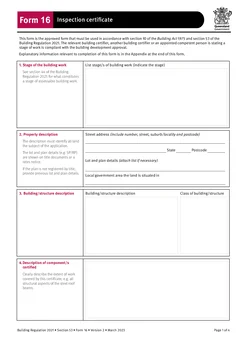
Tradie Forms: complete QLD Form 16 one section at a time after the stage inspection, preview the official PDF layout, then download a clean certificate for the builder, certifier and job record.
A Form 16 that nobody can find is not much of a record. The certificate itself is short, and filling it out is the easy half. The half that causes rework is everything around it: where the PDF lands, what sits beside it, what the builder was told it covered, and whether the office can reconstruct the stage six months later without ringing the person who did the inspection.
This guide is about that half.
Use the QLD Form 16 template to prepare the official PDF layout, or browse QLD building forms.
What should you keep with a Form 16?
Everything the certificate leaned on. The official Form 16 asks for a basis of certification and reference documentation, so the record is only complete when those referenced items are findable. In practice that means storing the finished PDF alongside:
- Building development approval details and certifier reference
- The inspection request or stage notice
- Drawings and revisions relied on
- Inspection photos and site notes
- Any Form 12 or Form 43 aspect certificates relied on
- Test reports or engineering documentation
- Any noncompliance follow-up handled outside this certificate
The official Form 16 appendix says the inspecting person may rely on aspect certificates from appointed competent persons, such as Form 12, or from QBCC licensees, such as Form 43. Where that happened, those PDFs belong in the same job record - not one in email, one as a phone photo and one in the builder's portal. The Form 43 aspect certificate guide covers what that certificate carries if you are chasing one.
Name the file so the office can find it
Filing discipline is unglamorous and it is the thing that pays. Date, property address, stage and form name is enough for most teams. The point is that someone who was not on site can type the address into job software and see which stages have certificates and which do not.
Job software helps here for a second reason: it records when the certificate went out and to whom. A PDF sitting in a downloads folder proves the certificate exists. A PDF attached to the frame stage task, with a send date against it, proves what happened.
Telling the builder what the certificate covers
When you send Form 16, say what it covers in the message, not just in the PDF.
That short note does real work. It stops the certificate being treated as broader than intended, which is the most common way a stage certificate causes an argument later. If the inspection covered one building of three, or excluded a detached structure, the covering note is where the builder sees it first.
When should you hold off issuing a Form 16?
Whenever the record would not be true yet. Speed is not the point if the certificate is wrong. Pause if:
- The stage is not complete enough for the certificate being requested
- The person signing has not confirmed their appointment or role
- The building development approval documents are not available
- A related aspect certificate is missing
- The work inspected does not match the stage description
- A noncompliance issue needs handling before a certificate can be issued
Queensland guidance includes restrictions around who can be appointed and who can sign in some circumstances, and saved business details in any system do not resolve that. Finish the inspection decision first, then use the online form to make the paperwork clean.
Keep the stage boundary visible in the record
A stage certificate is most useful when the file shows its edges. Before the builder moves on, check the certificate says which part of the building work was inspected and what component is certified - the official form asks for a clear description of the extent of work covered.
A short identifier, drawing revision or photo reference in the record adds more than a broad label ever will. If the stage covered only part of a building, the record should say which part, and the photos filed beside it should show that part. That is what makes the certificate readable by someone who joins the job later.
What the office needs months later
Stage records get pulled out for the same handful of reasons: a completion query, a warranty question, a sale, or a dispute about what was inspected. The office should be able to open the job and see the certificate, the stage it covers, the date it was issued, who it went to, and the documents behind it.
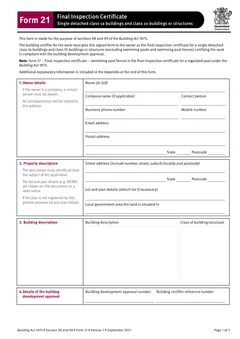
Where a job runs through several stages, keep them in one place rather than one folder per email thread. Aspect certificates such as Form 12 and Form 43 sit under stage certificates, and the Form 21 final inspection certificate sits on top of the lot. The QLD building certificates workflow shows how the set stacks up across a job.
Tradie Forms helps with the preparation end of that: a section-by-section fill, saved licence and contact details, missing-field checks, an official PDF preview and a clean finished PDF you can attach to the job while the inspection is still fresh. It does not inspect, approve or lodge anything. The person signing remains responsible for their appointment, the inspection and the certificate.
Multi-stage jobs and the certificate sequence
On a job with several inspection stages, the individual certificates matter less than the sequence they form.
Someone reviewing the approval trail is looking for a run of certificates that covers the job from footings through to final, with no stage missing and no overlap that suggests two people certified the same work. Gaps in that sequence are what prompt questions, and they are usually filing failures rather than inspection failures. The inspection happened; the certificate went to the builder and never came back to your file.
Keep your set in stage order under one job reference. When a stage needed a re-inspection, file both certificates so the sequence shows what happened rather than only showing the one that passed. A re-inspection in the record is normal. A silent gap where a re-inspection happened is not.
Where more than one certifier worked on a job, note which stages were yours. You are not responsible for the completeness of someone else's set, but you should be able to show where your part started and stopped.
Retention and who holds the master
Several people end up holding a copy of the same Form 16, and it is worth being clear which one is the master.
The certifier or principal contractor holds the copy that feeds the approval trail. The builder holds one for their own records. You hold one as the person who signed it. In practice the one that gets produced later is whichever is easiest to find, which is an argument for yours being well filed.
Retention expectations vary and change, so confirm what currently applies to your licence and the work rather than working to a remembered number. The practical default is to keep digital copies longer rather than shorter, because storage is cheap next to reconstructing a stage inspection from memory.
Keep the certificate with the inspection notes and photographs that support it, not in a separate certificates folder. A certificate pulled out on its own answers less than half the questions anyone will ask about it.
Next steps
Open QLD Form 16 when a stage inspection certificate is ready to prepare, and use the on-site completion guide for the field-by-field detail.
At the end of the job, move to the Form 21 final inspection guide and the matching Form 21 record keeping guide so the closeout record lines up with the stage record.
Official references
For current requirements, check the Queensland Form 16 PDF, the Business Queensland building forms page, the Queensland competent persons newsflash, and Building and Plumbing Newsflash 614.