Start from risk assessment, build the SWMS, then record the toolbox talk.
SafeWork NSW built the Housing Industry Site Safety Pack for small subcontractors in residential construction. Principals and clients often ask for those templates as proof you have a basic WHS system, not a folder of random Word files.
This guide focuses on the three forms that move together day to day: site-specific risk assessment (Form 04), SWMS (Form 05), and toolbox talk record (Form 06). Get that chain right and the rest of the pack is easier to keep honest.
Full form list and downloads live on the Housing industry site safety pack page. Browse live templates on NSW building forms.
What is in the HIISP site safety pack?
SafeWork NSW lists ten core templates:
| Form | Purpose |
|---|---|
| 01 Organisation details | Business identity for the site file |
| 02 Roles and responsibilities | Who does what in the WHS system |
| 03 WHS policy | Policy statement for the business |
| 04 Site-specific risk assessment | Walk the site, record hazards and controls |
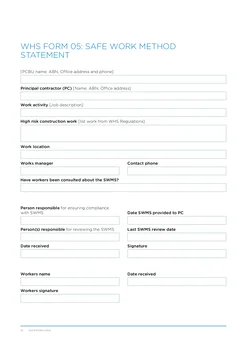
| 05 Safe work method statement | High risk construction work method |
| 06 Toolbox talk record | Record of worker consultation talks |
| 07 Worker training register | Training evidence |
| 08 Electrical test and tag register | Plant and equipment testing record |
| 09 Hazardous chemicals register | Chemicals on site |
| 10 Incident and injury register | Incident records |
Authorities, clients, and principal contractors may require evidence of your WHS system. SafeWork NSW says using the templates as directed helps you provide those documents.
The daily chain: 04 → 05 → 06
Step 1
Form 04, walk the site
Before method statements
Access, voids, services, plant, weather, other trades, storage.
Step 2
Form 05, SWMS
If a high risk item appeared
Only the high risk work. Ordinary site notes stay on Form 04.
Step 3
Form 06, toolbox talk
Consultation record
Who attended and what was covered, without turning the SWMS into minutes.
Form 04 finding a fall risk over two metres is the cue to complete Form 05 before that work starts.
Form 04: site-specific risk assessment
Walk the site. Note access, voids, services, plant, weather exposure, other trades, and storage. Form 04 is where you capture site hazards before you write method statements for the high risk pieces.
If Form 04 shows a fall risk greater than two metres, work near energised services, or another high risk construction work item, that is your cue to complete or update Form 05 before that work starts.
Open the site-specific risk assessment form.
Form 05: SWMS
SafeWork NSW requires a SWMS for high risk construction work before the work starts. Form 05 is the HIISP layout many residential principals expect: PCBU, principal, work, location, consultation, task rows, compliance, worker sign-off.
Do not copy every Form 04 hazard into the SWMS. Keep the SWMS on high risk construction work. Leave ordinary site notes on Form 04 or in toolbox talks.
Open the NSW WHS SWMS form. Deeper guides:
Form 06: toolbox talk record
The toolbox talk is how many crews communicate hazards, SWMS changes, and daily issues. Form 06 records who attended and what was covered. It supports the SWMS consultation expectation without turning the SWMS into a meeting minute.
Open the toolbox talk record.
Example flow for a roofing subcontractor
- Arrive with organisation details already saved from Forms 01 to 03 for the business.
- Complete or refresh Form 04 for this block and stage.
- Identify high risk construction work (for example fall risk more than two metres).
- Complete Form 05 SWMS with site-specific rows and controls.
- Run a toolbox talk covering the SWMS and site changes; complete Form 06.
- Keep the SWMS available on site while the high risk work continues.
- Stop and update Form 05 if the method or site conditions change.
That sequence matches SafeWork NSW timing: plan before high risk work, communicate to workers, keep the document available, review when things change.
How the rest of the pack supports the three
- Forms 01 to 03 stop you retyping business identity on every job.
- Form 07 shows training for people named on high risk tasks.
- Form 08 supports electrical plant used around high risk work.
- Form 09 tracks chemicals that may change site atmosphere or handling risks.
- Form 10 records incidents that should trigger a SWMS or risk assessment review.
Complete them as separate PDFs and keep them in one site file for the principal.
When principals ask for "the pack"
Ask which templates they need for this project stage. Some want the full ten. Others want risk assessment, SWMS, and toolbox records for the active trades only.
If they say "JSA" or "Take 5", clarify whether they still need HIISP Form 05 for high risk construction work. See SWMS vs JSA vs Take 5.
Keeping organisation details consistent
Forms 01 to 03 set the business identity. Forms 04 to 06 reuse that identity in the daily records. When the ABN, phone, or business name drifts between documents, the principal's file looks incomplete even if the safety method is sound.
Save organisation and principal details once, then check them when a licence renews, a trading name changes, or a new principal takes over the project.
Common pack failures
| Problem | Fix |
|---|---|
| SWMS exists but Form 04 is blank for the stage | Walk the site and record hazards before high risk work |
| Toolbox talk mentions a control not on the SWMS | Align the talk with Form 05, or update Form 05 first |
| Full pack emailed as ten scanned photos | Download clean PDFs and name them by form number and site |
| Pack completed after the high risk task finished | Move Form 05 earlier in the job plan |
Related SWMS reading: on-site SWMS guide, when a SWMS is required, common SWMS mistakes, and SWMS vs JSA vs Take 5.
You remain responsible for the content and for following the method on site. These templates do not lodge forms with SafeWork NSW.
Start with the three:
Then add training, test and tag, hazardous chemicals, and incident registers as the site and principal require.
Weekly site file habit
Pick one day each week on longer jobs to:
- Confirm Form 04 still matches the stage
- Confirm Form 05 still matches high risk work in progress
- File Form 06 records for talks held that week
- Replace outdated PDFs in the principal pack
That habit costs less than rewriting the whole pack after a gate rejection.
Who usually owns which form
On many residential sites:
- The subcontractor PCBU prepares the SWMS for their high risk work and keeps it available to their workers
- The principal contractor collects SWMS copies for the project and manages the broader WHS management plan where required
- Supervisors run toolbox talks and make sure the method on the ground still matches Form 05
- Workers need to understand the controls that apply to their task, not just sign a blank page
SafeWork NSW expects consultation and coordination when more than one PCBU is involved. The pack only works when those roles talk to each other before the high risk step starts.
When is the HIISP pack enough?
The pack is enough when you are a small residential subcontractor showing a basic system, and not enough once a principal's full WHS management plan applies. HIISP helps small residential subcontractors show a basic system. Larger projects, asbestos removal, demolition, or work under a principal's full WHS management plan may need extra documents beyond Forms 04 to 06.
Use the pack as the floor for housing work, not the ceiling for every construction type. When in doubt, check the principal's requirements and the current SafeWork NSW construction guidance for your activity before you start the high risk stage. A five-minute check beats a stop-work order mid-task.
Official sources
- Housing industry site safety pack
- Prepare safe work method statement
- Construction work
- HIISP Form 05 PDF
Confirm current SafeWork NSW guidance for your project size and trade before you rely on this pack structure for a compliance decision.