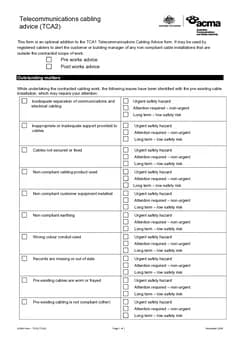
The TCA2 is easy to skip because it is advisory. The mandatory form after customer cabling work is the TCA1. Still, when you find non-compliant cabling that is not what you were booked to fix, a verbal warning rarely survives the next site meeting.
This guide marks the moments a registered cabler should issue a TCA2, and when a TCA1 alone is the right paper.
When is an ACMA TCA2 required?
| Form | Role |
|---|---|
| TCA1 | Mandatory written statement after you finish customer cabling work |
| TCA2 | Advisory outstanding matters advice when you notice non-compliant cabling |
Do not use a TCA2 as a substitute for the TCA1. Do not skip the TCA1 because you also wrote a TCA2. Many jobs need both.
What ACMA says each form is for
TCA1 is the mandatory path after you finish customer cabling work. A registered cabler prepares a written statement that the work complies with the Wiring Rules and gives a copy to the customer.
TCA2 is different. ACMA says to use the TCA2 if you notice any non-compliant cable installations, so the customer can decide what action to take. It flags outstanding matters. It does not certify your completed work.
Under the cabling provider rules, customer cabling work must be carried out by a registered cabler, and work must comply with AS/CA S009 installation requirements for customer cabling (the Wiring Rules). Separation from electrical cabling and proper support are common TCA2 findings on older installs.
Official references:
When is a TCA2 the right form?
Issue a TCA2 when you notice non-compliant cabling that is not fully resolved by the work you were engaged to complete, and the customer or building manager needs a written record to decide next steps.
Examples:
- Quoting a new run and finding power and data sharing a stud without proper separation
- Completing a rack tidy and finding unsupported legacy cable still in service
- Spotting damaged cable, poor terminations, or other Wiring Rules issues outside your scope
- Pre-existing faults the customer wants documented before they approve extra work
The TCA2 is not a quote. It is advice about outstanding matters and priority so the customer can act.
When is a TCA1 enough?
If you completed customer cabling work and you are not flagging separate outstanding non-compliant installations, the mandatory document is the TCA1. TCA2 is not forced when there is nothing advisory to record.
If the customer later asks you to fix outstanding items as a variation, that becomes new work. When that remediation is finished, it needs its own completion path, usually including a TCA1 for the work you completed.
Pre works versus post works
| Advice type | When |
|---|---|
| Pre works | Issues found before your cabling work starts (quote, scope, site walk) |
| Post works | Issues found during or after your work on site |
Pre works makes clear the problem predates your visit. Post works covers what you found while doing the booked work. Pick one type per form so the record reads cleanly.
Compact examples
Data cabler on a refresh. New runs done correctly, TCA1 issued. Old cable hard against power in the ceiling. Issue a TCA2 for that outstanding condition.
Electrician who is also a registered cabler. TCA1 for the customer cabling you finished. TCA2 for separate non-compliant legacy telecoms cabling you noticed.
Quote only visit. No cabling work started yet. Serious separation issues found. Pre works TCA2 documents the find before anyone argues about who created it.
No non-compliant finds. TCA1 may still be required for completed customer cabling work. Skip TCA2 when there is nothing to advise.
NBN / lead-in adjacent mess. You finish customer cabling inside the premises correctly and issue a TCA1. In the pit or MDF area you notice unrelated non-compliant telecoms cabling still in service. Document it on a TCA2 with location and priority so the customer can raise it with the right party.
Multi-tenant floor. Your booked work is one tenancy. You notice shared riser cabling issues in the common shaft. TCA2 still makes sense, but hand it to the building manager who controls the riser, and note the tenancy boundary in the free text so nobody thinks you certified the whole building.
Who completes a TCA2 and who receives it?
A registered cabler completes the TCA2. If you are not the registered cabler for the job, do not invent a TCA2 under someone else's registration.
Give the completed form to the customer or building manager. On strata and multi-tenant sites, hand it to the party who can authorise remediation in common areas when that is who can act. Note in your job file who received the form. Only flag what you actually observed.
Keep advice and commercial offers as separate documents. Photos and job notes support the written advice with location detail.
What does not belong on a TCA2?
Principals sometimes ask for a TCA2 as a tick in a portal even when you found nothing outstanding. If there is nothing to advise, say so in writing on the job note and issue the TCA1 for completed work if that duty applies. Do not invent matters to satisfy a portal field.
How this sits with principal packs
Some site packs say "cabling compliance certificate" when they mean TCA1, TCA2, or both. Ask which ACMA form they want before you leave. If they only want proof of your completed runs, that is usually TCA1. If they want a record of legacy faults you noticed, that is TCA2. If they want both, download both and name the files clearly.
Decision checklist
- Did you finish customer cabling work that needs a TCA1?
- Did you notice non-compliant cabling that still needs customer action?
- If yes to 2, is the advice pre works or post works?
- Can you set a clear priority for each matter you flag?
- Do you have the customer or building manager contact for handover?
If step 2 is yes, open the ACMA TCA2 form. If step 1 is yes, also complete the ACMA TCA1.
The judgement call in practice
The rule is straightforward and the day-to-day decision is less so, because the question is usually how much you noticed rather than whether you noticed anything.
The useful test is whether the condition is something the customer would want to be able to decide about. A legacy installation that is non-compliant and outside the scope of what you were engaged to do is exactly that. A minor cosmetic issue on work you have just completed properly is not.
Issuing a TCA2 for everything devalues it. Issuing none because nothing felt significant enough leaves the customer without a record of something that mattered. The middle is a judgement, and writing down the reason you formed it is what makes it defensible.
When you are not the only cabler on site
On larger fitouts, several registered cablers work the same building, which raises the question of whose advice a condition belongs on.
The answer is that you record what you observed, within your own registration and the work you attended. You are not certifying the building, and describing another cabler's work is not your document to make.
Where the condition clearly belongs to someone else's scope, note what you saw and let the customer take it from there.
Related
- How to fill out the TCA2
- Common TCA2 mistakes
- TCA2 record keeping and handover
- TCA1 and TCA2 record keeping
- When is TCA1 required
- TCA1 on-site guide
- Electrical forms hub
Official sources
- ACMA cabling advice forms
- ACMA Form TCA2
- ACMA cabling provider rules
- ACMA Australian cabling standards
You remain responsible for registration, advice accuracy, and customer handover.