Cabling work can finish quickly, but the advice form is easy to leave until later. You tidy the rack, test the outlet, pack the gear, and tell yourself you will do the paperwork back at the ute.
That is when the small mistakes creep in. The room name gets vague. The customer contact is copied off the wrong job. The registration number comes from an old PDF saved on a phone. On a bigger electrical fit-out, the cabling advice disappears under the rest of the site paperwork.
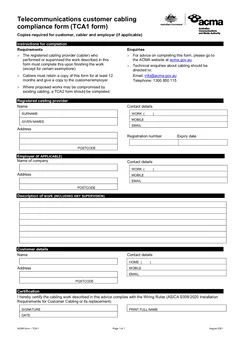
TCA1 is simple when you complete it at the job. You know what you installed or supervised, you know where it is, and the customer is usually still there. This guide runs through the form section by section so you can finish it before you leave.
Open the ACMA TCA1 form if you are filling one now, or browse electrical forms for the wider state library.
What is ACMA TCA1 used for?
TCA1 is the form registered cablers use to give a customer the written certification statement for completed cabling work. It records who carried out or supervised the work, what was done and where, who the customer is, and the statement that the work complies with the Wiring Rules.
ACMA says that if you perform or supervise cabling work, you must prepare a written certification statement every time you complete a job for a customer, as soon as practicable after finishing the work. ACMA also says you can use your own format instead of TCA1, as long as it contains the required details. Most cablers still reach for TCA1 because it gives the job a recognised layout and removes the guesswork of building a statement from scratch.
For the full picture of when the statement is required and which small cabling tasks sit outside it, read when is ACMA TCA1 required.
Registered cabling provider details
Start with the cabler block: name, contact details, address, and the registration number for the registered cabling provider. If you work across several businesses or contracting arrangements, check that the details match this job rather than the last one.

Registration numbers are easy to copy from an old PDF. That is fine when the saved details are current. It is risky when a registration has renewed, a trading name has changed, or a worker is filling from a stale form on a phone.
Saved details make the next TCA1 faster, but the check still belongs to the person issuing the advice. Review them before you download whenever anything about your registration or business has changed.
Employer or contractor details
The employer section matters when someone above you also needs a copy. ACMA guidance says once the certification statement is prepared, you give a copy to the customer who engaged you, and to your employer or contractor if you have one.
For a solo cabler this section may not apply at all. For a crew, a subcontractor, or an electrician doing cabling under a business, it helps the office file the record against the right job. Add the company name, contact person, address and contact details where they apply, do it properly once, and reuse it.
How much detail does the work description need?
Enough that someone who was not there can work out what was done and where. ACMA says the statement should identify the cabling work completed in adequate detail, including where the work was performed, and its guidance gives location examples such as room, floor, section, department and building.
A description that works names the area, room, floor, tenancy, rack or building section; whether you installed, altered, repaired, relocated, tested or supervised; the number and type of outlets or cables where that helps; and the service the cabling supports if it identifies the work.
Customer details
Confirm the customer name and contact details before you leave. The customer might be a tenant, builder, managing agent, business owner or homeowner, and the person who let you in is not always the person who engaged you.
If your job software keeps a billing contact and a site contact in separate fields, pick the right one for the advice form. On commercial jobs, make the site address and customer details clear enough that the form can be matched back to the work order months later. Getting this wrong is one of the most common patterns in common ACMA TCA1 mistakes.
Certification, signature and date
The certification section is where you state that the cabling work complies with the relevant wiring rules. Read it before you sign it. It is not a tick box, and it sits directly against the work description you just wrote.
The date should reflect the statement you are giving for this job. A copied date from an old PDF makes the whole record look careless, and it is the first thing that looks wrong if the record is ever reviewed.
When should you issue TCA2 instead?
Issue TCA2 when you notice a non-compliant cable installation, rather than folding it into the TCA1 description. ACMA says TCA2 can be used for non-compliant issues even if they are pre-existing or outside the contracted scope, and it can be issued before work with a quotation or after the job if something needs attention.
Both forms often come up on the same site. You complete the work you were engaged to do and issue TCA1 for it. You also notice an older problem in the same building and hand over a TCA2 so the outstanding matter is clear and dated.
Do not use TCA1 to quietly cover something you did not fix. Keep each form in its lane, and use the ACMA TCA2 form guide when you need to walk through the matters and priority levels.
After you sign off
A good cabling record is more than the final PDF. Keep the pieces that explain the work together:
- The completed TCA1 PDF
- Any TCA2 given for non-compliant issues
- Test results or certification notes
- Photos of outlets, rack labels or problem areas
- Customer approval or scope notes
- The job or invoice reference
ACMA guidance says the TCA1 copy must be kept for one year after preparing it. If you only hand over a paper copy and keep nothing, you will have a painful afternoon when the customer, employer, contractor or an auditor asks. The TCA1 and TCA2 record keeping guide covers the copy trail in more detail.
How Tradie Forms helps
Tradie Forms turns ACMA TCA1 into sections you work through one at a time instead of a flat PDF you pinch and scroll on a phone. You work through provider details, employer details, work description, customer details and certification in order, and missing required fields are flagged before you download.
You can save provider details so the next TCA1 starts faster, write the work description while the outlets and rack are still in front of you, preview the official PDF layout, and download the finished TCA1 for the customer and your records.
Tradie Forms maps your entries onto the ACMA TCA1 PDF layout. It is not affiliated with ACMA and it does not decide whether your work complies. That judgement stays with the registered cabler responsible for the work.
Next steps
Start ACMA TCA1 on site, or open ACMA TCA2 when you need to record non-compliant cabling issues. Browse electrical forms for the rest of the library.
Official references
Check the ACMA cabling advice forms guidance and the ACMA TCA1 form page for the current form and requirements. The ACMA TCA2 form page covers the outstanding matters form, and the ACMA cabling provider rules and ACMA Australian cabling standards set the registration requirement and the cabling standards. Confirm current requirements on the ACMA site before you issue advice.