Cabling paperwork is easiest when it is finished before the customer has moved on, the ceiling tiles are back in, and the photos are buried in someone's phone.
For registered cablers and electricians doing customer cabling work, TCA1 and TCA2 cover different completion moments, and they have different handover and copy rules. This guide is about that copy trail: who receives what, how long you keep it, and how to store it so the office can produce it later.
ACMA guidance is direct about the record. For completed cabling work, a written certification statement must be prepared as soon as practicable after finishing the work. Copies go to the customer and, where relevant, the employer or contractor. A copy must be kept for one year after preparing it.
Start ACMA TCA1 for customer cabling advice, use ACMA TCA2 for outstanding cabling matters, or browse electrical forms by state for the full library.
| Record | TCA1 | TCA2 |
|---|---|---|
| What it records | Completed customer cabling work and the cabler's compliance statement | Non-compliant cabling or another outstanding matter |
| Who receives it | Customer, plus the employer or contractor where relevant | Customer or building manager |
| Cabler copy | Keep for one year after preparing it | ACMA does not require the cabler to keep a copy |
| When both apply | Certifies the work you performed or supervised | Separately records the outstanding issue |
Who gets a copy of the TCA1?
The customer who engaged you, and your employer or contractor if you have one. ACMA is specific that once the certification statement is prepared, copies go to both, and that you keep a copy as well. That is three destinations on a subcontracted job and two on most direct ones.
The trap is the word customer. On a fit-out, the party who engaged your business is often the builder rather than the tenant who let you in. On a strata or managed site, it might be the managing agent. Confirm who engaged you before you hand anything over, because a record naming the wrong customer entity is difficult to match to the job later.
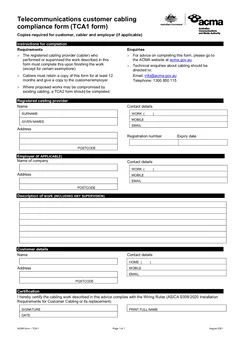
For what the statement itself has to contain, ACMA says it identifies the completed cabling work, includes your name, contact details and registration number, states whether you performed or supervised the work, and states that the work complies fully with AS/CA S009:2020 Installation Requirements for Customer Cabling. The TCA1 on-site guide walks through those sections field by field.
How long do you keep the certification statement?
One year after preparing it, according to ACMA guidance. That is the retention period the business needs to plan around, and it is why a sent email is a weak record. Email folders get archived, staff leave, and phone galleries fill up.
Store the finished PDF with the job record instead. A stored copy answers the question directly when a customer asks what was certified, when an employer needs the record, or when a request lands months after the job.
If you are not sure whether the work needed a certification statement at all, ACMA lists some small cabling tasks that sit outside the requirement. When is ACMA TCA1 required covers that boundary and what still applies to small jobs.
Do you have to keep a copy of the TCA2?
No. ACMA says you give the completed TCA2 to the customer, and that you are not required to keep a copy. That is a genuine difference from TCA1 and it catches people out in both directions.
Most trade businesses keep one anyway. A stored TCA2 shows the office what was handed over, connects the outstanding matter to a quote or follow-up, and gives you something to point at if the same fault resurfaces later with your name on the last job. ACMA TCA2 record keeping and handover goes further into how to handle that side.
What TCA2 records and when it applies
ACMA says to use TCA2 if you notice non-compliant cable installations, and to give it to the customer or building manager even where the issue is pre-existing or outside the contracted scope. It can be issued before you begin work, with a quotation, or after you complete the job if something needs attention.
The form asks you to show which issues you noticed and to decide how urgently the customer should address each one. That priority is the part that makes the advice actionable, and it is the part most often left blank.
TCA2 does not replace TCA1 for completed work. It sits beside it. When both apply, issue both and keep the completion clear.
Building the record before you leave site
The handover only works if the details were captured while the job was live.
Registered cabling provider details. Capture the cabler's name, address, contact details, registration number and expiry date. Saved details help on repeat forms, but registration details still need checking, particularly after a renewal or a change of entity.
Work description. ACMA says the statement should identify the cabling work completed in adequate detail, with location examples such as room, floor, section, department or building. "Data points" is thin. "Installed and tested four Cat 6 outlets in reception and comms cabinet patching for tenancy 2" is a record.
Customer details. Add the customer name and contact details while you are still with the customer or building manager, and check business names, site names and addresses.
Certification, signature and date. Sign and date after checking the work description and registration details. The signature sits directly against the compliance statement.
Outstanding matters. If you notice existing non-compliant cabling, record it on TCA2 with a clear issue and priority rather than leaving it in conversation.
Record keeping that works back at the office
The office does not need a perfect filing system. It needs a record it can find. Use a file name that still makes sense in a year:
- Date
- Customer or site
- Form type
- Suburb or job number
- Cabler initials where that helps
Keep the TCA1 with the job record, invoice, quote, test results, photos and the customer copy email. If a TCA2 was issued, store it with the same job even though ACMA does not require you to keep it.
Common handover mistakes
Step 1
Complete on site
Registered cabler
While the room, floor and outlet count are still in front of you.
Step 2
Customer copy
Given or sent
TCA1 for completed work, TCA2 for anything outstanding.
Step 3
Business copy stored
Kept for one year
A sent email is not storage. The kept copy is a separate obligation.
Completing the form and handing it over are two steps. Keeping it is a third.
The customer copy is sent but the business copy is lost. ACMA requires the kept copy for one year. Sent email is not storage.
Registration details are stale. Saved cabler details should not hide an expired or changed registration. Check the number and expiry before you download.
TCA2 issues stay in conversation. A spoken warning or a buried text message is hard for the customer, building manager or office to track later. Common ACMA TCA1 mistakes covers the equivalent patterns on the certification side.
TCA1 and TCA2 get mixed up. One certifies completed work, the other records outstanding matters. Using the wrong form leaves the customer unclear about what has actually been certified.
How Tradie Forms helps
Tradie Forms turns the ACMA cabling forms into sections you work through one at a time. For ACMA TCA1 you work through registered cabling provider details, employer details, work description, customer details, certification, signature and date. For ACMA TCA2 you choose the advice type and tick the outstanding matters that apply, including the priority level shown on the official form.
You can save provider details, catch missing fields before you download, preview the official PDF layout, download the finished PDF, and attach it to the job record. That keeps cabling completion tied to the work while the details are still fresh.
Tradie Forms maps your entries onto the official PDF layouts. It does not lodge anything with a regulator. The registered cabler remains responsible for the work, the outstanding matters, the customer copy and the finished documents.
Next steps
Start ACMA TCA1 when you need to prepare customer cabling advice for completed work, use ACMA TCA2 when outstanding cabling matters need recording, or browse electrical forms for more live templates.
Official references
Check the ACMA cabling advice forms guidance for the copy and retention requirements, and the ACMA TCA1 form page and ACMA TCA2 form page for the official forms. The ACMA cabling provider rules and ACMA registered cabler guidance cover registration. Confirm current requirements on the ACMA site before you issue advice.