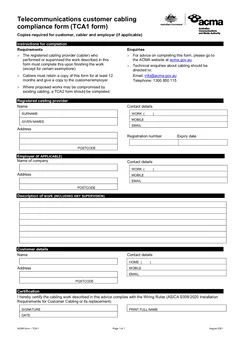
"Do we need a TCA1 for this?" is a van-door question. The install may be finished, the customer wants the keys back, and the paperwork decision still hangs between a full certification statement, a genuine small-task exception, or a TCA2 for leftover issues you did not fix.
ACMA's cabling advice rules give a clear structure once you separate three ideas:
- A written certification statement for completed customer cabling work
- TCA1 as an approved form for that statement
- TCA2 as advice about non-compliant installations that still need attention
This guide answers when TCA1 is required, when it is not, and how TCA2 sits beside it. For filling the form on site, use the TCA1 on-site guide. For copies and storage, use the TCA1 and TCA2 record keeping guide. For error patterns, use common ACMA TCA1 mistakes.
Browse electrical forms for state electrical certificates and the live cabling templates.
The short answer
You generally need a written certification statement, and TCA1 is the usual form for it, when:
- You are a registered cabling provider, and
- You performed or supervised customer cabling work, and
- The work for the customer is complete, and
- The job is not only a small cabling task listed by ACMA as outside the certification statement requirement
You should prepare that statement as soon as practicable after finishing the work, give the customer a copy, give an employer copy where applicable, and keep a copy for at least 12 months.
If you notice non-compliant cabling that is pre-existing or outside the contracted scope, that is a TCA2 moment. It can happen before, during or after the job, and it can sit beside a TCA1 for the work you did complete.
What TCA1 is for
ACMA explains that registered cablers who perform or supervise cabling work must understand the rules for preparing a written certification statement for completed cabling work.
In plain terms, the statement should identify:
- What cabling work was completed
- Your name, contact details and registration number
- Whether you performed or supervised the work
- That the cabling work complies fully with AS/CA S009:2020 Installation Requirements for Customer Cabling, as required by the certification content ACMA describes
TCA1 is an approved ACMA form for that statement. ACMA also says you can use your own format if it contains the required details, for example as an attachment to an invoice or receipt. Many trade businesses still prefer TCA1 because the layout already holds the expected fields and reduces guesswork.
Tradie Forms maps entries onto the TCA1 Attach A PDF layout. The registered cabler remains responsible for the work, the statement and the downloaded PDF.
When the certification statement is required
ACMA guidance says a written certification statement is required every time you complete cabling work for a customer, unless the work is only a small cabling task.
That covers common jobs such as:
- New data or voice outlets
- Structured cabling in a home, shop, office or workshop
- Cabling alterations during a tenancy fit-out
- Fibre or copper customer cabling runs that form part of the finished install
- Work you supervised for another worker on a customer job
- Additions or changes where the customer needs a clear completion record
If the customer, builder or facilities manager will later ask "what was certified on this site?", that is a strong signal to finish TCA1 before you leave.
Timing
Prepare the statement as soon as practicable after finishing the work. Same-day completion at the rack or in the van is the clean habit. Leaving it until Friday admin invites wrong room names and stale registration details.
Copies
The TCA1 form instructions say copies are required for the customer, the cabler and the employer if applicable. Retain a copy for at least 12 months and give a copy to the customer or employer as required.
When a certification statement is not required
ACMA says a certification statement is not needed if the work involved only a small cabling task. Examples given in ACMA guidance include:
- Running, transposing or removing jumpers on distribution frames
- Replacing a piece of minor cabling equipment such as a plug, socket, module or overvoltage unit
That exception is narrow. It does not turn a normal customer install into "small work" because the invoice is low value or the visit was short.
Important: all other requirements under the Cabling Provider Rules still apply to small cabling jobs. The work must still be performed or supervised by a registered cabler and comply with the Wiring Rules. Skipping TCA1 does not skip registration or workmanship rules.
If you are unsure whether the visit is only a listed small task, check the current ACMA guidance before deciding whether a certification statement is required.
TCA1 versus TCA2
These forms answer different questions.
| Question | Form |
|---|---|
| What completed cabling work am I certifying? | TCA1 |
| What non-compliant cabling still needs attention? | TCA2 |
| Can both be needed on one site visit? | Yes |
| Does TCA2 replace TCA1 for completed work? | No |
TCA1
Use TCA1 for the compliance advice on cabling work you completed or supervised. It is the customer-facing certification statement for the finished scope.
TCA2
ACMA says to use TCA2 if you notice non-compliant cable installations. Complete it and give it to the customer or building manager even where the issue is pre-existing or outside the contracted scope of work. ACMA also says TCA2 can be issued before you begin work, with a quotation, or after you complete a cabling job if something needs attention.
The TCA1 form instructions also note that where proposed works may be compromised by existing cabling, a TCA2 form should be completed.
Real job examples
Example A: clean install, no leftover issues
You install new outlets in an office fit-out and everything in scope is complete and compliant. Issue TCA1. No TCA2 needed.
Example B: completed scope plus old problems
You complete the contracted outlets, but you notice legacy non-compliant cabling in the same riser that was outside scope. Issue TCA1 for your completed work and TCA2 for the outstanding matters.
Example C: quote stage discovery
Before starting, you find non-compliant existing cabling that will affect the proposed works. Issue TCA2 with the quote so the customer understands the outstanding issues. Later, when your contracted work is finished, issue TCA1 for the completed work.
Example D: only a minor replacement
You replace a single socket as minor cabling equipment and the visit fits ACMA's small-task examples. A certification statement may not be required. Registration and Wiring Rules still apply. If you also notice wider non-compliant installations, TCA2 can still be the right advice tool for those issues.
For TCA2 detail, see the TCA2 how-to and outstanding matters guide.
Who must act
Registered cabling provider
The registered cabler who performed or supervised the work described on the form completes the certification statement. Registration details on the form must match that provider.
Supervised workers
If work is done under supervision, the statement still needs to reflect the registered provider's role correctly. Do not put a registration number on a form for work that was not performed or supervised under that registration story.
Employers and contractors
Where an employer or head contractor arrangement applies, the form instructions provide for employer copies. Keep the business record aligned with the customer copy so audits and callbacks are not a treasure hunt.
Customers and building managers
They receive the advice. They do not fill TCA1 for you. On TCA2, they are the people who need to understand outstanding issues and urgency.
Decision path before you open a form
- Was customer cabling work completed today? If yes, continue. If you only inspected and quoted, you may need TCA2 without TCA1 yet.
- Was it only a listed small cabling task? If yes, a certification statement may not be required; still follow registration and Wiring Rules. If no, prepare a certification statement.
- Will you use TCA1 or your own compliant format? Most crews use TCA1 for consistency.
- Did you notice non-compliant existing cabling or out-of-scope issues? If yes, prepare TCA2 as well.
- Who gets copies, and where is the 12-month retained file? Decide before you leave site.
- Open the form and finish it while the work is fresh.
That path stops the two common wrong turns: skipping TCA1 on a full customer job, and using TCA1 as a dumping ground for defects you did not fix.
Jobs where people often get the trigger wrong
Electrical fit-outs with a cabling portion
The electrical certificate or state form does not automatically replace telecommunications customer cabling advice. If customer cabling work was completed, handle the cabling statement on its own rules.
Multi-day projects
Certification belongs with completed work. If the project hands over in stages, make sure each completed customer cabling package has a clear statement trail rather than one vague form at the end with missing locations.
Service calls that grow
A visit that starts as a minor replacement can grow into new runs or relocations. Once the work is more than the small-task list, the certification statement requirement comes back into play.
Facilities contracts with many small sites
Do not invent a monthly bulk TCA1 that does not describe the actual work and locations. Each completed customer job needs a statement that identifies the work done.
"The builder said they do not need paperwork"
Customer preference does not rewrite ACMA rules. If a certification statement is required, prepare it and keep your retained copy even if the builder is casual about filing.
What the statement must make obvious
Whether you use TCA1 or another compliant format, the finished advice should answer:
- Who is the registered cabling provider?
- What is the registration number and contact path?
- Was the work performed or supervised?
- Who is the customer?
- What work was completed and where?
- When was the statement prepared and signed?
- Where are the customer, employer and retained copies?
If any of those answers are fuzzy, the form is not ready for handover.
How this interacts with electrical and builder paperwork
Customer cabling often lands inside a larger electrical or construction pack. That is where people assume another certificate already covered the cabling advice.
It usually has not.
A state electrical compliance certificate records electrical installation work under that state's rules. A builder's practical completion pack records handover for the project. Neither automatically becomes an ACMA written certification statement for telecommunications customer cabling.
Keep the cabling advice in its own lane:
- Complete TCA1 for finished customer cabling work that needs a certification statement
- Complete TCA2 when outstanding non-compliant cabling needs its own advice
- Store both with the job pack beside electrical certificates, as-builts and photos
- Use clear file names so the cabling statement is findable without opening every PDF
If a head contractor asks for "all compliance paperwork", include the TCA1 rather than assuming the electrical form is enough. If they only want defects, that still does not remove your retained-copy duty for completed cabling work you certified.
Quick checklist: do we need TCA1 now?
- Customer cabling work was performed or supervised by a registered provider
- The work for the customer is complete
- The visit is not only a listed small cabling task
- Provider registration details are current
- Work description and location can be written clearly today
- Customer copy path is known
- Retained copy location is known for at least 12 months
- Any outstanding non-compliant issues are handled with TCA2 where needed
If those boxes are ticked, open TCA1. If the only open item is leftover non-compliant cabling outside your completed scope, open TCA2. If both are true, open both.
Next steps
Start ACMA TCA1 for completed customer cabling advice. Start ACMA TCA2 when outstanding non-compliant matters need their own record.
Read the on-site TCA1 guide, common TCA1 mistakes, TCA1 and TCA2 record keeping, and digital records guide. Browse electrical forms for more live templates.
Official references
Check current requirements on the ACMA cabling advice forms page, the ACMA TCA1 form page, the ACMA TCA2 form page, and the ACMA registered cabler guidance before relying on this guide for a live job.