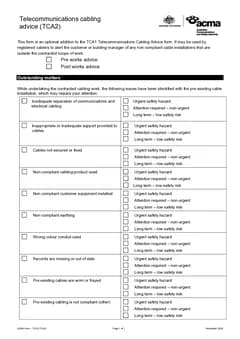
You are running a new data outlet and you find the old comms cable sharing a stud with the power run, no separation, no support, and it is nothing you were booked to fix. A verbal heads-up to the customer gets lost the minute they ring the landlord. The ACMA TCA2 is the form that puts that advice on paper: what you found, and how urgent it is. Fill it out properly and the customer has a record they can act on. Skip it and the next cabler inherits the problem with your name nowhere near it.
This guide walks through the TCA2 field by field: choosing pre works or post works advice, ticking the outstanding matters that apply, and setting the right priority on each one.
If you are writing one up now, open the ACMA TCA2 cabling advice form. It pairs with the ACMA TCA1 telecommunications cabling advice form for the work you actually completed, and the ACMA TCA1 and TCA2 record keeping and handover guide covers how the two forms sit together in your job file. Browse more electrical forms for the rest of your job paperwork, and see common ACMA TCA2 mistakes before you hand one over.
What is an ACMA TCA2 form?
The Australian Communications and Media Authority publishes two cabling customer advice forms. The TCA1 is the mandatory one: after finishing customer cabling work, a registered cabler prepares a written statement certifying the work complies with the Wiring Rules and gives a copy to the customer. The TCA2 is different. ACMA says to use the TCA2 form if you notice any non-compliant cable installations, so the customer can decide what action to take.
That makes the TCA2 advisory rather than mandatory. It is not a certificate for your work and it is not a quote to fix anything. It is a record of existing cabling that does not meet the standard, handed to the person who can do something about it.
The rules behind this sit with ACMA. Under the cabling provider rules all customer cabling work must be carried out by a registered cabler, and work must comply with AS/CA S009:2020 Installation requirements for customer cabling, known as the Wiring Rules. Those rules cover things like keeping telecommunications cabling separated from electrical cabling and supporting cables properly, which is exactly the sort of thing a TCA2 flags when an old install got it wrong.
Is it pre works or post works advice?
The first thing the TCA2 asks is when the advice is being issued. There are two options, and you pick one.

Pre works advice is for matters you spot before your cabling work starts. This is the box to use when you are quoting or scoping a job and you notice existing cabling that is not compliant. It tells the customer the problem was there before you touched anything.
Post works advice is for matters you find during or after your work on site. You have gone into the ceiling or the rack, done what you were booked for, and along the way confirmed an issue that is outside your scope.
The distinction matters because it separates what you inherited from what you are responsible for. A TCA2 marked pre works makes clear the fault predates your visit. Get this right at the top of the form and the rest of the record reads cleanly.
The outstanding matters you can flag
The body of the TCA2 is a list of common non-compliant conditions. You tick every one that applies on the job. The form covers:
Separation and support faults. Inadequate separation of communications and electrical cabling, inappropriate or inadequate support provided to cables, and cables not secured or fixed. These are the classics on older installs and the ones that most often come back to bite.
Non-compliant products and equipment. Non-compliant cabling product used, non-compliant customer equipment installed, and non-compliant earthing. This is where a cheap cable, an unlabelled bit of gear, or a bad earth gets recorded.
Product presentation and records. Wrong colour conduit used, and records that are missing or out of date. Small on their own, but they still sit outside the standard and belong on the form.
Rounding it out are pre-existing cables that are worn or frayed, and a catch-all line for pre-existing cabling that is not compliant in some other way. Only tick the matters you actually observed. The form is a record of what you saw, not a checklist to fill for the sake of it, and every tick needs to stand up if the customer or a later cabler asks about it.
Setting the priority on each matter
Ticking a matter is only half the job. The TCA2 asks you to set a priority against each one, and there are three levels.
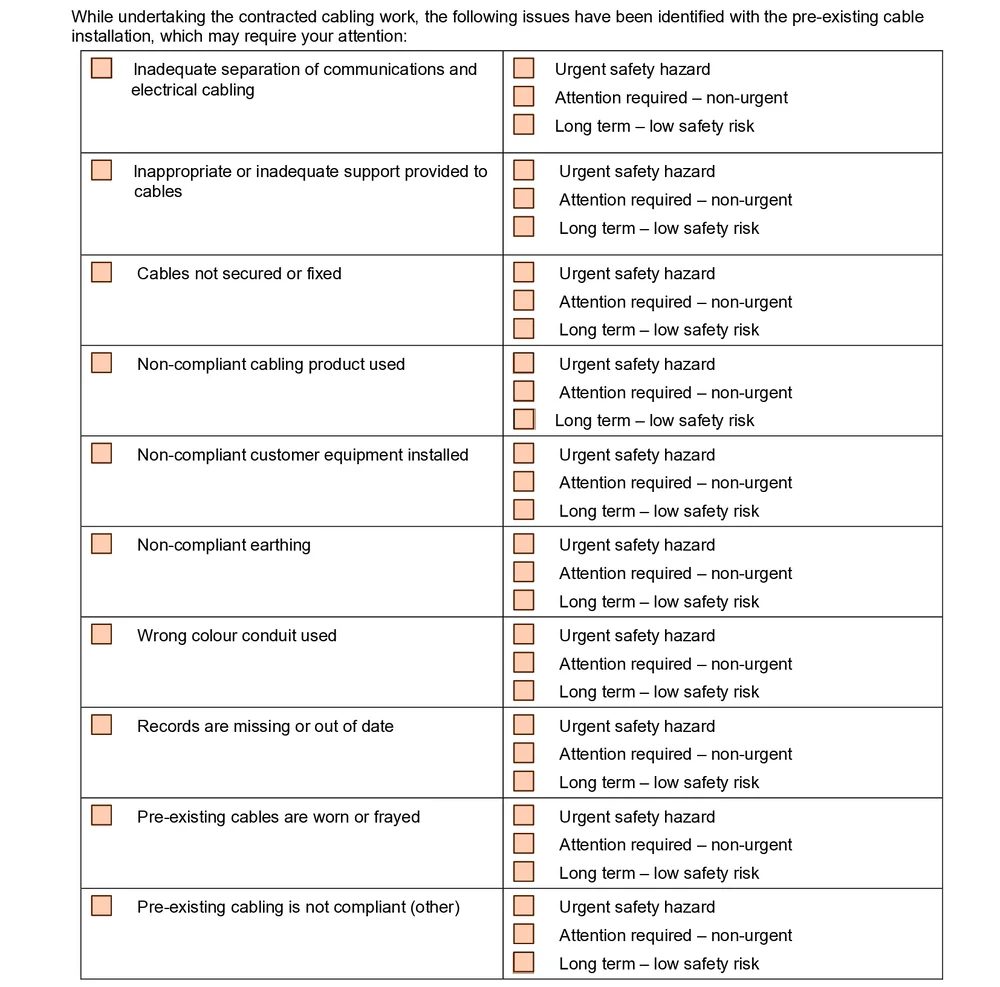
Urgent safety hazard. The issue needs attention straight away because it presents a safety risk. This is the level that tells a building manager to stop waiting and act.
Attention required, non-urgent. The matter is real and needs fixing, but it is not an immediate danger. It should be planned and dealt with rather than left indefinitely.
Long term, low safety risk. A genuine non-compliance with a low safety risk, worth noting so it is on record and can be tidied up when the cabling is next worked on.
Pick one priority per matter. The priority is your read of how quickly the customer needs to move, so base it on what you saw, not on how awkward the conversation might be. An urgent hazard marked as long term is worse than useless if something goes wrong later.
Who do you give the TCA2 to?
Once the advice type, the matters, and the priorities are set, the TCA2 goes to the person who can act on it. ACMA is clear that the point of the form is to let the customer decide what action to take, so the completed form belongs in the customer's or building manager's hands, not just filed away.
On a tenanted or strata site that person is often the building manager rather than the tenant who booked you, because the outstanding cabling is part of the building, not the tenancy. Work out who owns the infrastructure before you hand it over.
Keep a copy with your own job records too. A TCA2 you issued is evidence that you spotted a problem and advised the right person, which is worth having if the same fault surfaces down the track. It sits alongside the TCA1 for the work you completed, so the two together tell the full story of what you did and what you flagged.
Getting the TCA2 right the first time
A few things turn a useful advice form into one that gets ignored or argued over.
No priority set. A ticked matter with no priority leaves the customer guessing how urgent it is. Every matter you flag needs one of the three levels against it.
Wrong advice type. Marking pre-existing damage as post works advice blurs the line on what you inherited. Set pre works or post works to match when you actually saw the issue.
Vague handover. Giving the form to whoever happens to be on site, when the building manager is the one who owns the cabling, means the advice never reaches the person who can act. Confirm who should receive it.
Filling it out from memory. Written up in the ute hours later, a form loses the detail that made it worth issuing. Complete it while the fault is in front of you.
Most of these come back to the same habit. The TCA2 is strongest when you fill it out on site, at the fault, while you can still see what you are describing.
How Tradie Forms helps
Tradie Forms turns the TCA2 into sections you work through one at a time that follow the official form. You choose pre works or post works advice, tick each outstanding matter that applies, and set its priority as the row opens, so no ticked matter is left without a level. Your registered cabler and business details are saved and reused, so you are not retyping them on every advice form.
The form flags anything missing before you download, which is what catches the matter with no priority or the advice type left blank. You preview your entries mapped onto the official ACMA TCA2 PDF layout, then download the finished form to hand to the customer or building manager and keep with the job.
Tradie Forms maps your entries onto the official layout. The registered cabler still checks the observations, the priorities, and the downloaded PDF before it goes to the customer.
Start the ACMA TCA2 cabling advice form on site, or open the ACMA TCA1 telecommunications cabling advice form for the work you completed.
Official references
Check the ACMA cabling customer advice forms TCA1 and TCA2 page and the ACMA Form TCA2 - Telecommunications cabling advice publication for the current form and its status. The ACMA cabling provider rules and ACMA Australian cabling standards set the registration requirement and the AS/CA S009 Wiring Rules, and ACMA find a registered cabler explains who is authorised to do the work. Confirm the current form and rules on the ACMA site before you issue advice.