Cabling jobs turn up problems nobody booked you to fix. You are installing a new outlet and find poor separation. You are cleaning up a rack and spot unsupported cable, worn cabling, or an old issue well outside the quoted scope.
A verbal warning vanishes the moment the customer rings the landlord. A form filled out after hours misses the priority or the location. ACMA TCA2 is the recognised way to put outstanding cabling matters on paper, and this guide is about the judgement side of it: what belongs on the form, when to issue it, and how to write it so someone acts.
Open the ACMA TCA2 form if you are writing one up now, or browse electrical forms for the wider library.
What counts as an outstanding matter?
A non-compliant cable installation you noticed and are not fixing as part of this job. ACMA says to use the TCA2 form if you notice any non-compliant cable installations, and to complete it and give it to the customer or building manager even where the issue is pre-existing or outside the contracted scope of work.
That framing is deliberately wide. It does not matter who installed it, when, or whether you were paid to look at it. If you saw it and it does not meet the standard, TCA2 is the tool for telling the person who can do something about it.
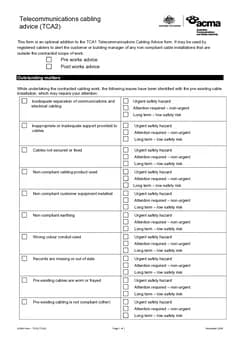
The TCA2 layout groups these into rows you tick, covering things like separation and support faults, non-compliant product or equipment, and pre-existing cabling that is worn or otherwise non-compliant. For a row-by-row walkthrough, use how to fill out the ACMA TCA2.
When should you issue one?
ACMA says TCA2 can be issued before you begin any work, with a quotation, or after you complete the cabling job if something needs attention. That covers most of the situations where it actually comes up:
- You inspect before quoting and find existing cabling that needs attention
- You start the booked job and identify an issue outside the contracted scope
- You finish the new work and notice an older installation problem nearby
- A building manager needs a written record before approving remedial work
- A customer needs something to pass to the landlord, strata manager, builder or office
The strongest TCA2 is issued while the issue is still visible. You can point at the rack, riser, tenancy, ceiling space or cable route and write the advice against what you are looking at. When is ACMA TCA2 required sets out the trigger in more detail.
How is TCA2 different from TCA1?
TCA1 and TCA2 sit close together on the same job but do opposite things. TCA1 is the certification statement for cabling work you completed or supervised. It identifies the completed work, your registration details, whether you performed or supervised it, and states that the work complies with the Wiring Rules.
TCA2 is advice about work you did not do. It is not a certificate, not a defect repair, and not a quote.
On a real site you might issue both: TCA1 for the cabling work you completed, and TCA2 for a separate pre-existing issue that needs the customer's attention. Do not use TCA1 to bury a problem you did not fix, and do not use TCA2 as the completion statement for the work you did. The TCA1 and TCA2 record keeping guide covers how the two records sit together afterwards.
Write it so the customer can act
The best TCA2 is useful to a non-technical person. A customer or building manager may not follow cabling shorthand, but they can understand a clear issue, a location and an urgency level.
When you complete the form, think about the person deciding what happens next. They need to know:
- What you found
- Where it is
- Whether it is urgent, needs non-urgent attention, or is a longer-term matter
- Whether it affects the current job or sits outside the booked scope
- Who to talk to if they want remedial work quoted
Keep the wording plain.
Another cabler might follow your shorthand, but the person signing off on the repair probably will not.
Setting the priority
ACMA's TCA2 instructions ask you to show which issues you noticed and to decide how urgently the customer should address each one. That urgency column is what turns an observation into advice.
Set it on what you actually saw, not on how awkward the conversation might be. An urgent hazard recorded as a long-term matter is worse than not raising it, because now there is a written record showing you judged it low risk. Every matter you tick needs a level against it before the form leaves your hands.
Tradie Forms flags rows that are missing a priority before you download, so the PDF does not go out half finished. Common ACMA TCA2 mistakes covers the other patterns that undermine a good form.
Handing it over and keeping the trail
Give the completed form to the customer or building manager. On a tenanted or strata site that is often not the person who booked you, because the cabling belongs to the building rather than the tenancy.
ACMA says you are not required to keep a copy of TCA2. Your business may still want one, and most do. Keeping these together makes follow-up work much easier:
- The completed TCA2 PDF
- Photos of the issue and its location
- The related TCA1 for completed work, where one was issued
- Quote notes or scope exclusions
- Customer approval or refusal notes
- Building manager or strata contact details
That record helps when the customer calls two weeks later, when the office prepares a quote, or when another cabler returns to site. ACMA TCA2 record keeping and handover goes into the storage side.
How Tradie Forms helps
Tradie Forms turns ACMA TCA2 into checks instead of a dense PDF table. You choose pre works or post works advice, mark the outstanding matters, set the priority level as each row opens, preview the official PDF layout, and download the finished form.
You can complete it on a phone while the issue is still visible, keep issue rows and priority levels together, catch missing priorities before you download, and store the finished PDF with photos, quote notes and the related TCA1 where your job software supports attachments.
Tradie Forms maps your entries onto the ACMA TCA2 layout. It is not affiliated with ACMA and it does not decide whether cabling is compliant. The registered cabler remains responsible for the observation, the priority and the finished document.
When the customer disputes the advice
A TCA2 describes work you were not engaged to do, which occasionally lands badly with a customer who reads it as an upsell.
The way through is to be clear about what the form is. It is advisory. It records non-compliant cabling you noticed so the customer can decide what to do, and it does not oblige them to engage you or anyone else. Saying that plainly usually defuses the reaction, because the objection is almost always about being sold to rather than about the finding.
Keep the language factual. A description of what is there and where it is carries better than a characterisation of how bad it is.
When conditions change on a later visit
Cabling gets altered between visits, sometimes by other people, and a TCA2 you issued last year may no longer describe the site.
If you re-attend and the condition has changed, issue a new dated TCA2 rather than editing the old one. Keeping both gives the customer and any later cabler a readable history, and it avoids the problem of a single document that quietly says something different to what it said when it was handed over.
Note which document is current when you hand the new one over. Customers file both and then cannot tell which applies.
Next steps
Start ACMA TCA2 when you need to record outstanding cabling matters, or use ACMA TCA1 for the certification statement covering work you completed. Browse electrical forms for electrical and telecommunications paperwork you can fill on site.
Official references
Check the ACMA cabling advice forms guidance and the ACMA TCA2 form page for the current form and instructions. The ACMA cabling provider rules and ACMA Australian cabling standards set the registration requirement and the cabling standards, and ACMA registered cabler guidance explains who is authorised to do the work. Confirm current requirements on the ACMA site before you issue advice.