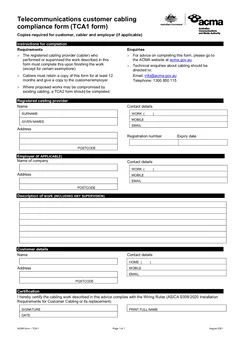
TCA1 mistakes rarely look dramatic on site. The rack is tidy, the outlet tests clean, and the customer is happy. The form is where the job goes soft: wrong registration number, work description that only the cabler understands, customer email copied from another fit-out, or outstanding cable issues left unspoken because nobody opened a TCA2.
This guide is a field checklist for registered cablers and electricians doing customer cabling work. For the on-site fill workflow, use the ACMA TCA1 on-site guide. For archive and customer copy habits, use the TCA1 and TCA2 record keeping guide. For the trigger question, use when is ACMA TCA1 required.
Browse electrical forms for state certificates and other cabling templates, including ACMA TCA2.
Mistake 1: treating TCA1 as optional if the invoice looks detailed
ACMA guidance is that registered cablers who perform or supervise cabling work need to understand the rules for preparing a written certification statement for completed cabling work. A written certification statement is required every time you complete cabling work for a customer, unless the work is only a small cabling task. It should be prepared as soon as practicable after finishing the work.
ACMA allows your own format if it includes the required details, but many businesses still use TCA1 so the required content is not reinvented under pressure.
If the job needs a certification statement, finish one. Do not assume the quote PDF covers it.
Mistake 2: relying on the small-task exception for ordinary customer work
ACMA lists small cabling tasks that do not require a certification statement, such as running, transposing or removing jumpers on distribution frames, and replacing minor cabling equipment such as a plug, socket, module or overvoltage unit.
That exception is narrow. It is not a free pass for a tenancy fit-out, a new run, a rack rebuild or supervised work that the customer expects on the record.
Even on small tasks, registration, supervision and Wiring Rules requirements still apply. If you are unsure, check current ACMA guidance before skipping the statement.
Mistake 3: stale registered cabling provider details
Registration numbers and business details are the classic copy-paste failure.
Common versions:
- Old registration after renewal or provider change
- Trading name that no longer matches the job paperwork
- Mobile number from a former employee still saved in the template
- Employer block left blank when the form and job arrangement need it
- One cabler's details used while another person supervised the work
TCA1 should identify the registered cabling provider who performed or supervised the work described on the form. Check the live details before download, even when saved profiles make the form fast.
Mistake 4: performed versus supervised is wrong or unclear
The certification statement needs to show whether you performed or supervised the work. Crews blur this when an open registration holder signs for work another person did without a clear supervision story, or when the form is filled by office staff who were not on site.
Fix it on the day:
- Name the registered provider correctly
- State performed or supervised honestly
- Keep the worker and supervision notes in the job file if more than one person touched the install
If the certification does not match how the work was actually controlled, the PDF is a liability, not a closeout.
Mistake 5: work description too vague to find later
"Data cabling as quoted" helps nobody in twelve months.
ACMA's TCA1 completion guidance asks cablers to describe the type and location of the work, for example room, floor, section, department or building. That level of detail is what makes the customer copy useful when a facilities manager opens it later.
Better descriptions usually include:
- Building or tenancy name
- Floor or area
- Room names or grid references where known
- What was installed, altered or tested
- Copper, fibre or mixed scope in plain words
- Any related patching or termination locations
If the official field is short, keep a matching job note and photo set with the retained copy so the office can explain the work later.
Mistake 6: customer details copied from the wrong job
Fit-out weeks are full of similar site names and CC'd builder contacts. The TCA1 customer block then goes to:
- The builder only, when the end customer also needs the advice
- An accounts payable inbox that never reaches the site owner
- A previous tenancy contact still in the phone
- A site supervisor who has already demobilised
Confirm who the customer is for this certification statement before you leave. If the builder, owner and occupier are different parties, make sure the copy path matches the job contract and ACMA's customer copy expectation.
Mistake 7: using TCA1 to bury outstanding non-compliant issues
TCA1 is the completion statement for work you completed or supervised. TCA2 is the form ACMA points to when you notice non-compliant cable installations, including pre-existing issues or matters outside the contracted scope.
If proposed works may be compromised by existing cabling, the TCA1 form instructions note that a TCA2 should be completed. Do not certify completed work in a way that quietly implies the whole building is fine when you left known issues unfixed.
On real jobs both forms can apply:
- TCA1 for the work you finished
- TCA2 for outstanding matters the customer or building manager still needs to address
Read the TCA2 outstanding matters guide and the TCA2 how-to when the site has leftover problems.
Mistake 8: signing before the work description is final
People sign early so they can "finish the PDF later". Then the later version never matches the signed story, or the customer already received a half-empty draft.
Order of operations:
- Confirm the work is complete
- Write the description and location
- Confirm registration and customer details
- Complete certification, signature and date
- Preview the PDF
- Hand over copies
If something changes after signature, issue a corrected record through a controlled process. Do not keep multiple conflicting PDFs with the same date and no note.
Mistake 9: missing customer or employer copies
The TCA1 form instructions say copies are required for the customer, the cabler and the employer if applicable. Cablers must retain a copy for at least 12 months and give a copy to the customer or employer as required.
Common failures:
- Photo of the form stays on the cabler's phone only
- Customer is told "the builder has it"
- Employer copy never reaches the contracting company file
- Email send has no subject, job number or site address, so it is unsearchable later
Make the send part of leaving site or same-day closeout. If the customer wants paper, print or PDF-handover before you pack the last cable box.
Mistake 10: no 12-month retained copy in a findable place
Keeping a copy for at least 12 months only helps if someone can find it.
Avoid:
- Drafts and finals mixed in Downloads
- Forms named
TCA1-final-final2.pdf - Storage only inside a personal chat thread
- No link between the TCA1 and the job number, address or invoice
Store the final PDF with the job record, customer name, site address and date. If a TCA2 was also issued, keep both in the same job pack even when ACMA does not require you to retain TCA2. Many businesses still keep TCA2 for their own trail. See the record keeping guide.
Mistake 11: digital records that are not actually complete
A scanned half-filled form in a cloud folder is not the same as a complete certification statement. Digital is fine. Incomplete is not.
If you use Tradie Forms or another form tool, still check:
- All required sections present on the downloaded PDF
- Signature and date visible
- Work description readable
- Registration number correct
- Customer copy actually sent, not only saved
For broader digital habits around cabling compliance records, see ACMA cabling compliance digital records.
Mistake 12: downloading without reading the PDF as the customer will
The form can catch empty required fields. It cannot catch a room name that only your apprentice understands, or a customer company name missing "Pty Ltd" when the contract uses the full legal entity.
Before handover, preview the official layout and read:
- Provider name and registration number
- Performed or supervised selection
- Work description and location
- Customer name and contacts
- Certification wording, signature and date
That short read prevents awkward callbacks after the ceiling tiles are back in.
A same-day closeout rhythm that prevents most of these mistakes
Most TCA1 errors come from finishing the form after the site is cold. A simple closeout rhythm keeps the details honest.
Before you pack the last tools:
- Confirm the contracted cabling scope is actually complete.
- Walk the rooms or racks once more and write the work description from what you can still see.
- Check registration, performed or supervised, and customer contacts on the draft form.
- Decide whether any leftover non-compliant cabling needs TCA2 as well.
- Sign and date only after the description is final.
- Preview the PDF.
- Send or hand over the customer copy before you leave if you can.
- Save the retained copy against the job number the same day.
If the customer is not on site, still finish the form before you drive off. Send the PDF as soon as you have signal, then file the retained copy when you are back in the van or office. Waiting until the end of the week is how room names and registration numbers go wrong.
Office staff can help with filing and employer copies. They should not invent the work description from an invoice line. The person who performed or supervised the work owns the certification content.
Pre-download TCA1 checklist
- This job needs a certification statement, or you have confirmed a genuine small-task exception.
- Registered provider details and registration number are current.
- Performed or supervised matches the real control of the work.
- Work type and location are specific enough for a stranger to understand later.
- Customer details are for this job.
- Outstanding non-compliant issues are handled with TCA2 where needed, not hidden inside TCA1.
- Certification, signature and date are complete after the description is final.
- Customer copy path is ready.
- Employer copy path is ready if applicable.
- Retained copy will live with the job record for at least 12 months.
- PDF has been previewed on the official layout.
Run the list while you are still on site when you can. Cabling details fade fast once the next call-out starts.
Related forms and guides
- ACMA TCA1 for completed customer cabling advice
- ACMA TCA2 for outstanding non-compliant matters
- TCA1 on-site guide
- When TCA1 is required
- TCA1 and TCA2 record keeping
- TCA2 how to fill out
- TCA2 outstanding matters
Next steps
Start ACMA TCA1 before you leave the rack. Open ACMA TCA2 if the site still has non-compliant cabling that needs its own advice. Browse electrical forms for the wider trade library.
Official references
Check current requirements on the ACMA cabling advice forms page, the ACMA TCA1 form page, the ACMA registered cabler guidance, and the ACMA TCA2 form page before relying on this checklist for a live job.