Cabling paperwork is a completion task, not a back-office puzzle. The customer is on site, the outlet or rack is labelled, the work location is fresh, and any pre-existing cabling issue can still be explained in plain words.
That is the moment to finish the record. Leave it and the detail thins out. Room names get guessed, employer details get copied off an old invoice, and outstanding matters end up buried in a phone gallery.
This guide is about the workflow rather than the fields: what a complete cabling record contains, the order to build it in, and how to file it so the office can find it later. For the fields themselves, use the TCA1 on-site guide.
Use ACMA TCA1 for completed customer cabling advice and ACMA TCA2 when outstanding cabling matters need recording. You can also browse electrical forms by state for CCEW, CoTC, NT certificates and the cabling templates.
What ACMA says about cabling advice
ACMA says that if you perform or supervise cabling work, you must prepare a written certification statement every time you complete a job for a customer, as soon as practicable after finishing the work. The statement must be given to the customer who engaged you, and to your employer or contractor if you have one, and a copy must be kept for one year after preparing it.
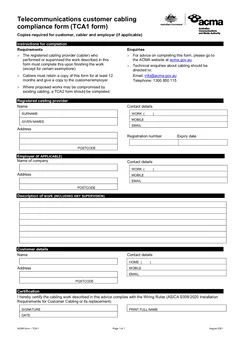
ACMA also says you can use the approved TCA1 and TCA2 forms or your own format, as long as it includes the required details. For TCA1, that means completing all sections, describing the type and location of the work, giving the customer a copy, giving the employer a copy where applicable, and keeping a copy for at least 12 months.
For TCA2, ACMA says to use it if you notice any non-compliant cable installations, including pre-existing issues or matters outside the contracted scope, and that it can be issued before work with a quotation or after completion if something needs attention.
What should a digital cabling record contain?
Everything a future reader needs to understand the job without ringing you. A complete cabling completion record captures:
- Registered cabling provider details
- Employer or contractor details where they apply
- A description of the work
- The location of the work, such as room, floor, section, building or department
- Customer details
- The certification statement, signature and date
- Any outstanding matters and their priority
- The copy sent to the customer
- The copy kept with the job
Tradie Forms maps your entries onto the official PDF layouts. It does not decide whether work complies with the Wiring Rules or whether a matter needs a TCA2. The registered cabler remains responsible for the work, the advice, and the finished document.
A clean cabling completion rhythm
The order matters more than the tooling. Work through it the same way every time and the record builds itself:
- Complete the cabling work and your checks.
- Fill TCA1 while the work location is still in front of you.
- Issue TCA2 if outstanding matters need recording.
- Preview the official PDF layout.
- Give the customer their copy.
- Give the employer or contractor a copy where applicable.
- Store the PDF with the job record for the required period.
- Attach photos, diagrams or notes where they explain the work.
That habit keeps cabling advice tied to the job instead of rebuilt from memory on a Friday afternoon.
Why does the work description matter so much?
Because it is the part of the record that decays fastest. ACMA says the certification statement should identify the cabling work completed in adequate detail, including where it was performed, with location examples such as room, floor, section, department and building. That detail is obvious on site and almost impossible to reconstruct a week later.
Apply the same discipline to TCA2. If there is an outstanding matter, describe the location and the issue plainly enough that a customer or building manager can act on it without a technical translation. Common ACMA TCA2 mistakes covers what usually goes wrong there.
Recording outstanding matters without making the job awkward
TCA2 can feel uncomfortable because it usually points at work outside your scope, or at somebody else's earlier install. Keep it practical. The form exists to give clear advice, not to assign blame.
State what you noticed, mark the urgency, hand the completed form to the customer or building manager, and keep any related notes with the job. If the issue leads to a quote, link the quote to the TCA2 so the paper trail holds together. When is ACMA TCA2 required sets out the situations where it applies.
Naming records so they can be found later
Use a file name or job title that carries the customer, the site and the form type. Something like "TCA1 - Smith Office - Level 2 data outlets" is far easier to find than a default download name. For TCA2, include a reference to outstanding matters so the office can tell at a glance what the file covers.
Small naming habits matter here because cabling advice records are often needed long after the work is finished. The retention side of this, and who gets which copy, is covered in the TCA1 and TCA2 record keeping guide.
Sole traders and crews
For a sole trader the record may be a PDF attached to the job or invoice, and that is enough. For a crew, the same job might need copies going to the customer, the employer, the project manager and the office.
Either way, set one rule for the business and stick to it:
- Customer copy sent
- Employer or contractor copy sent where applicable
- PDF stored with the job
- Photos or diagrams attached
- TCA2 outstanding matters linked to any quote or follow-up
That rule matters because copies can be asked for. The person who performed or supervised the work should not be scrolling a phone gallery looking for a signed form from months ago.
How Tradie Forms helps
Tradie Forms turns TCA1 and TCA2 into sections you work through one at a time that work on a phone, tablet or laptop. For TCA1 you fill provider, employer, work description, customer and certification details. For TCA2 you choose pre works or post works advice, tick the outstanding matters that apply, and set the priority level shown on the official form.
Missing-field checks catch the gaps before you download. The official PDF preview shows what the customer will receive. The finished PDF can then be downloaded and attached to the job, invoice, quote or completion email.
Cabling advice is one piece of a wider paperwork problem, and the same crew is often handling electrical certificates, fire forms and service reports too. The pattern is the same: fill it in one section at a time, reuse business details, catch missing fields, preview the official layout, download the finished record.
What changes when the records go digital
The obligations do not change. What changes is how often a record goes missing.
Paper cabling records fail in familiar ways: the book stays in the van, the customer copy is never handed over, the office copy arrives illegible. Digital removes those and adds its own smaller risks around devices and access. The trade is usually worth it, but planning for the new failure modes is part of making the move.
Keeping records findable across jobs
Cabling work generates records that are needed years later, usually by someone else.
Store them against the site rather than the job number, because site is how they will be searched for. Name files so the site and date read without opening them. On multi-tenancy buildings, include the tenancy, since a building-level record does not answer a tenancy-level question.
Next steps
Start ACMA TCA1 for completed customer cabling advice, or use ACMA TCA2 for outstanding cabling matters. Browse electrical forms for the wider trade paperwork library.
Official references
Check the ACMA cabling advice forms guidance and the ACMA cabling provider rules for the current requirements. The ACMA TCA1 form page and ACMA TCA2 form page carry the official forms, and ACMA Australian cabling standards covers the cabling standards behind the certification statement. Confirm current requirements on the ACMA site before you issue advice.