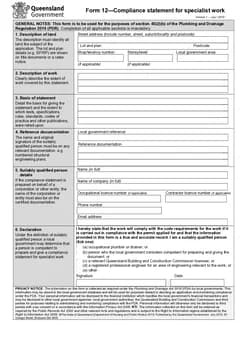
Tradie Forms: complete Queensland Form 12 specialist work compliance statements on the official PDF layout before attaching them to a permit application. Capture property, work scope, basis, references, and qualified person details on site.
Form 12 is not a tick-and-flick. It asks for the property, the specialist work scope, the technical basis for the statement, supporting references, and the suitably qualified person giving it.
This is the field workflow. If the first question is whether the permit needs this statement, read when a QLD plumbing job needs Form 12. For the error list, see common QLD Form 12 mistakes. If you are not sure which Form 12 the job needs, start with PDR Form 12 vs building Form 12.
Use the QLD Form 12 template, or browse QLD plumbing forms.
What is QLD Form 12 for?
Queensland Form 12 is a compliance statement for specialist plumbing or drainage work under the Plumbing and Drainage Regulation 2019, used where a suitably qualified person gives a statement supporting specialist work as part of the permit process. The official PDF identifies it as being used for section 45(2)(b) of that regulation.
Business Queensland lists it among the plumbing and drainage forms lodged with local government, which is why the permit pack is the right starting point.
Start with the permit pack, not a blank PDF
Gather the current drawings, specifications, reports, and local government correspondence before you type anything. Check the document revision, issue date, and project name on each one - a document can look familiar while belonging to an earlier design change or a different stage of the same project.
The form does not need the whole project file copied into it. It needs a clear statement connecting the land, the specialist work, the basis, and the person giving it. Keep the source documents beside the finished statement so the record still makes sense in a year.
Identify the land the statement covers
Complete the address fields from the current permit material, including the local government area. Where the site has a tenancy, shop, or storey level, use those details.
This matters most on multi-unit sites and staged jobs. A delivery address gets the crew to the right gate while leaving the statement vague about which part of the development is covered. The work description should support the land details rather than substitute for them.
Before moving on, compare the completed property section against the permit - spelling, suburb, postcode, local government area. Then ask whether someone who never attended site could tell which land and which part of the job the statement relates to.
Write a work description that matches the specialist scope
The work section is not a general project summary. Describe the extent of specialist plumbing or drainage work covered, in terms that match the current design documents. Clear and bounded beats broad.

Explain the basis for giving the statement
The basis section is where the suitably qualified person records the basis for the statement and the publications relied on. Use the material actually used for the job: current drawings, specifications, reports, and the relevant laws, codes, or standards.
Be accurate rather than exhaustive. A long copied list of standards is less useful than a short list that genuinely relates to the specialist work. Where you name a drawing or report, include enough identifying information to distinguish it from older versions. If there is uncertainty about the technical basis, resolve it with the appropriate person before the statement is signed.
An online form can keep this in its own section so it is not buried in a notes field, but it cannot verify that a publication applies. The licensed person giving the statement owns that judgement.

Record references and supporting documents
Use the references section for the local government reference and supporting documentation details. Copy the reference from current correspondence or permit paperwork rather than memory.
This is the point to make the digital record tidy. Save the finished statement in the same folder as the document versions named in it, with a filename carrying the site and date. When a later question comes from the office, the local government, or the qualified person, the statement should not be separated from the material it relies on.
Do not invent a reference where the information is not yet available. Save a draft and confirm it through the permit process - a nearly complete form is easier to finish correctly than a sent PDF with a guess in it.
Make the qualified person check meaningful
The qualified person section captures name, company where applicable, licence information, and contact details. The declaration records qualification, signature, and date. Those details belong to the person actually giving the statement.
Use saved licence details as a starting point only, and check them against current records. That catches an old phone number, a changed company name, or a licence detail carried over from another staff member. It also gives the signer a genuine chance to confirm the scope and basis rather than signing a form they have not read.

The handover is simple: the person preparing the statement gathers the site, work, and document references; the suitably qualified person reviews the finished document against the permit material, confirms their declaration option, then signs and dates it.
The on-site order
- Check the current permit pack, drawings, and specifications
- Complete the land details, including tenancy or level where needed
- Describe the exact specialist work covered
- Record the actual basis and publications relied on
- Add the local government reference and supporting documents
- Have the suitably qualified person review, sign, and date the final version
The QLD Form 12 template follows that order one section at a time, reuses saved qualified-person details, catches missing required fields, and previews the official layout. Check the finished document before attaching it through the process the local government requires.
Completion checks
- Property description covers the full application land
- Work scope matches the specialist design
- Basis and publications are listed clearly and currently
- Local government reference is included
- Qualified person qualification, signature, and date are complete
What to check before you leave site
The form is short enough that it gets completed in the ute, which is where the avoidable errors come from.
Complete it while the work is still in front of you. The description is more accurate, the extent of what you did is fresh, and anything you need to check is a few steps away rather than a phone call tomorrow.
Confirm the property and permit references against the job record rather than from memory. On a job with several lots or a staged permit, those are the fields most likely to be wrong and the ones that cause the pack to be sent back.
When the scope changed during the work
Specialised work gets varied on site more often than the paperwork suggests, and the statement should describe what was actually done.
If the work differed from what was planned, describe the work as carried out rather than as designed. A statement that matches the plan but not the installation is worse than one that visibly records a variation, because the mismatch surfaces at the worst possible moment, which is usually during a later inspection.
Where the variation is significant enough to affect the approval, that is a conversation with the certifier rather than something to resolve in the description.
Keep Form 12 with the next records
The statement is one part of the project record. Store it with the permit application, the current specialist design documents, and the later records that apply to the work - a QLD Form 1 permit work application, QLD Form 5 testing or commissioning report, QLD Form 14 compliance declaration, or QLD Form 19 final inspection certificate, depending on the job.
For the wider sequence, see the QLD plumbing forms list or browse QLD plumbing forms. Form choice and lodgement requirements depend on the work and the local government process, so check current official information before you submit. The plumbing forms hub has the national set if you work across borders.
Official references
Business Queensland publishes Form 12 as the compliance statement for specialised work and lists it as a form lodged with local government. Check the Business Queensland plumbing forms page, the current Form 12 PDF, and the Plumbing and Drainage Regulation 2019. Tradie Forms maps your entries onto the official PDF layout; it does not lodge the form or replace the qualified person's check.