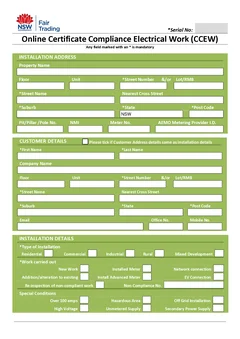
Current CCEW process: record the test details at the board, then complete and submit the certificate in the BCNSW eCert portal. Tradie Forms does not currently provide or lodge the new CCEW.
Electrical testing is easier to document while the job is still in front of you. Wait until later and circuit labels, RCD results, and photos turn into guesswork, and the certificate becomes harder to defend.
Use this as a field prompt for NSW electrical work. It is a prompt, not a substitute for the current wiring rules, the RCD testing standard, equipment instructions, or job-specific engineering information.
Record test results in the job record while you are still on site, then complete the current certificate in the BCNSW eCert portal. Browse other Australian trade forms or the NSW CCEW guides.
Before you switch the tester on
Preparation prevents the rework loop.
- Review the scope of work and any variations from the original plan
- Confirm test gear is calibrated and suitable for the installation voltage
- Isolate or disconnect equipment that must not see test voltage
- Note ambient conditions where they could affect readings
- List every circuit you will certify and how it is labelled on the board
Keep calibration certificates accessible. When a result is questioned, that is the first thing anyone asks for.
Insulation resistance
Insulation resistance testing shows whether cabling and equipment insulation is intact. For many low-voltage circuits up to 500 V, a minimum of 1 MΩ is the figure commonly applied, unless a particular standard allows otherwise for that circuit or equipment. Confirm it against the current edition before you rely on it - minimum values depend on the circuit and the standard that applies to it.
Record the test voltage used, the circuit or zone tested, the measured value, and whether equipment was disconnected or isolated. The test voltage is not optional context - a resistance figure without it is incomplete.
Low readings usually mean moisture, damaged insulation, or a connection problem. Investigate on site before you enter a pass.
Temperature affects readings on long runs. Note the conditions if you are working in cold storage, plant rooms, or other extreme environments.
Earth continuity and earthing
Verify the earthing system, not just a single resistance number. That means the main earthing conductor size and its connection to the earthing terminal, earth electrode connections where accessible, equipotential bonding to water, gas, or structural steel where required, and supplementary bonding in wet areas, pools, and special locations.
Record earth fault loop impedance or continuity results as required for the circuit type, and check final subcircuit values against the limits that apply to the protective device actually installed.
RCD and safety switch testing
This is where certificates most often come back.
Verify manual test button operation first, then run the electrical sequence. For a general-purpose 30 mA device the commonly applied figures are no trip at half rated sensitivity (15 mA), trip within 300 ms at rated sensitivity (30 mA), and trip within 40 ms at five times rated sensitivity (150 mA) where that test applies. Socket-outlet circuits may carry tighter expectations, and selective (Type S) devices are allowed longer. Confirm the limits against the current standard for the device type in front of you.
Record actual trip times rather than "pass". Device type matters as much as rating - some circuits with electronic loads require a device type that handles the leakage those loads produce, and fitting the wrong type passes a trip test while leaving the circuit inadequately protected.
Installations with solar PV need extra care, because DC equipment can affect RCD behaviour. Follow the manufacturer and standard requirements for the combined system, and document any special tests you performed.
The full sequence and the failure modes are covered in safety switch testing for CCEWs.
Circuit protection and polarity
Check that protective devices match the installation: correct current rating and breaking capacity for the fault level, RCD protection where required, correct polarity on single-phase circuits, and correct phase sequence on three-phase motor circuits.
Document adjustable device settings where breakers have dials or DIP switches. A mismatch between the label and the actual setting is an easy audit failure and an easy fix while you are standing there.
Voltage drop and load checks
Where voltage drop limits apply, record the calculations or measurements for long runs and heavy loads.
Note harmonic-rich loads where they affect your readings - LED drivers, variable speed drives, and switch-mode supplies are standard on modern sites. If connected equipment has a tighter voltage tolerance than the general installation limit, record that you checked compatibility.
What makes a test record another electrician can follow?
The number on its own is rarely enough. A usable record links the reading to the circuit, the method, and the state of the installation at the time.
Use the circuit identifier actually visible at the switchboard. Where the job has temporary labelling or a variation from the drawings, note it rather than making the certificate look tidier than the site. For each reading, keep enough context to answer a later question: what was tested, which instrument, which setting where it matters, and whether connected equipment was isolated.
Retain the tester record, photo, or field sheet in the job folder under the same job reference. That is useful when the office is preparing a customer pack, and far more useful when a result is queried months later.
Treat an unusual result as a stop point
A result that does not look right needs investigating before it becomes an entry on a certificate. Do not select a pass because the job needs to finish, or because the equipment passed on a previous visit.
Recheck the setup, examine the circuit, and resolve the cause in line with the standards and manufacturer instructions for the job. Some installations need tests well beyond a domestic final - three-phase equipment, medical or hazardous locations, solar, batteries, EV equipment, pools, and complex commercial controls each bring their own requirements.
Keep testing and certification separate in your head
Testing establishes the facts. The certificate records the certification information required for the job. The eCert portal cannot tell you that a test was appropriate or that the installation is compliant. Read the completed record against your field notes before you make a declaration.
NSW's electrical compliance requirements say electrical work must be done by, or under the supervision of, a licensed electrician. From 1 July 2026, all CCEWs must be submitted through the BCNSW eCert portal, and the person who carries out the electrical test must submit as soon as practical but no later than seven days after the test is completed. Portal copies can then go to the distributor where required, the customer where their email is provided, and the electrician's employer or principal contractor where their email is provided. Keep the submission confirmation with the job record and do not treat a downloaded copy as the submission itself. See NSW electrical licence and CCEW responsibilities for who can certify what.
A close-out checklist for the van
- Match every recorded reading to a real circuit or item of equipment
- Check labels, work description, and site address against the installation
- Save the tester output, notes, and photos under the same job reference
- Review the certificate before the responsible person submits it
If a circuit, label, or reading cannot be tied back to the installation, the record is incomplete. Go back to the source, resolve it, and record the correction as part of the job evidence before the certificate is finalised.
If a customer asks what the figures mean, explain the outcome in plain language and leave the technical record intact. Explaining a CCEW to your customer covers how to do that without overpromising what the certificate proves.
Keeping current with standards
Standards change, and amendments affect device types, cable selection, and special locations. Check you are working from the current edition cited on the job, follow SafeWork NSW and industry association updates for NSW-specific process changes, and get refresher training when new equipment types start appearing on your jobs.
Tradie Forms does not currently provide or lodge the new NSW CCEW. You remain responsible for choosing the correct tests, verifying results against the standards in force and entering the current details in eCert.
Next steps
Run the tests, record the numbers at the board, then complete the certificate in the same visit. Open the BCNSW eCert portal or browse other Australian trade forms.
Official references
For the current NSW certification and portal requirements, see NSW electrical compliance requirements, the BCNSW eCert portal, Service NSW submit a CCEW, SafeWork NSW electrical inspection and testing, and the Standards Australia Wiring Rules.