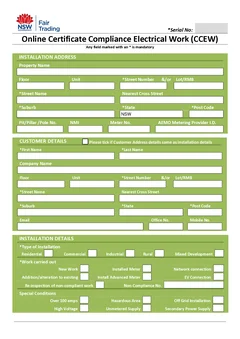
Most CCEW mistakes happen after the electrical work is done: a missing test result, a vague circuit label, an old licence detail, or an address copied from the wrong job. The fix is not more paperwork. It is a better check while you are still standing at the board.
Use this as your on-site review before the certificate leaves your hands.
Use your job and test records as the on-site checklist. The NSW CCEW lodgement rules set out what the certificate has to carry, then complete it in the BCNSW eCert portal. More context sits in the NSW CCEW guides.
Why does CCEW accuracy matter so much?
Because the cost of an error is never just the correction. The certificate is the record that the work was completed and tested, and it gets read by people who were not there - customers, certifiers, insurers, and whoever inspects the property years from now.
Step 1
Test and certify
You, at the board
The only point where a wrong number is cheap to fix.
Step 2
Lodge
eCert portal or Service NSW
Errors surface here as a rejection, not a question.
Step 3
Read by others
Customer, certifier, insurer
None of them were on site and none can ring the board.
Step 4
Kept as the record
Your business
Produced years later when someone asks what was done.
Every step after the first one costs more to correct than the step before it.
An error found late means a delayed sign-off and a delayed payment, time pulled away from the next job, and a harder conversation with a client who thought the job was finished. Repeated errors do slower damage to the relationships that generate the work in the first place. An incomplete or inaccurate certificate also carries a professional exposure that no amount of good field work cancels out.
The mistakes below are the ones that generate return visits.
1. Incomplete testing documentation
What goes wrong
Missing insulation resistance, earth continuity, or RCD results - the most common reason a certificate cannot stand on its own.
How to avoid it
Use a testing checklist per installation type and record results as you test, not back at the ute.
Why it happens
- Rushing testing under time pressure, then reconstructing results later
- Test equipment that does not capture or store all the required measurements
- Uncertainty about which tests apply to a specific installation type
- Results living in a notebook, a photo, or a head instead of the certificate
How to avoid it
Build a testing checklist for the work types you actually do, so the required set is a habit rather than a recall exercise. A domestic checklist typically covers insulation resistance, earth continuity, RCD operation, and polarity. Commercial work usually adds earth fault loop impedance, phase sequence, and load testing where relevant. Industrial installations add equipment-specific requirements on top.
Know the acceptance values you are working to. The figures commonly applied are insulation resistance of at least 1 MΩ for circuits up to 500 V, earth continuity at or below 0.5 Ω for final circuits, and RCD operation within 300 ms for general use. Check them against the current edition of the applicable standard rather than the numbers you memorised during your apprenticeship - editions change, and a threshold recalled from a decade ago is not a defence.
Record as you test, while the instrument is still connected. Note the test voltage alongside insulation results, and if a circuit could not be tested, write down that it was not tested and why. A blank looks like a pass.
2. Circuit descriptions that do not match the board
What goes wrong
Descriptions that do not match the installed board, wrong circuit numbers, or generic labels like "power points".
How to avoid it
Describe circuits to match the distribution board as installed, and update the record when the job changes in the field.
Why it happens
- Working from plans that stopped matching reality halfway through the job
- Field changes never making it back into the circuit schedule
- Generic descriptions chosen for speed
- On larger jobs, two people labelling the same board differently
How to avoid it
Be specific enough that the description locates the circuit. Include circuit numbers that match the labelling actually installed, not the numbering on the original drawing.
The same test applies to lighting: "lighting" could be anything, "bedroom 1 and 2 LED downlights" is one circuit.
The job details table is where those descriptions and meter records land, one row per meter.
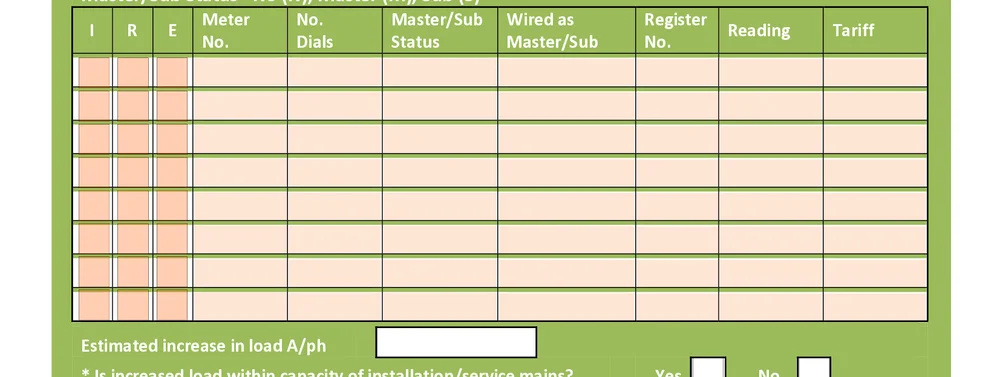
Reconcile changes when they happen rather than at certificate time. The gap between the plan and the installation is easiest to close while you are still holding the screwdriver.
Where several people work the same job, agree on one numbering convention across the schedule, the board, and the certificate before anyone starts labelling.
3. Test values recorded wrong
What goes wrong
Values that do not meet the requirements of the current standard, results recorded in the wrong units, transcription errors between the instrument and the form, or tests run under the wrong conditions.
Why it happens
- Uncertainty about the currently acceptable values
- Calibration drift producing readings nobody questions
- Copying numbers by hand from a screen into a form later
- Testing with loads still connected when the test requires them disconnected
How to avoid it
Work from the current standard for acceptance values rather than memory, and keep the test conditions with the result - a reading without its conditions is hard to defend.
Keep test equipment calibrated and keep the calibration certificates where you can produce them. Instruments that record and store results remove a whole class of transcription error.
On complex installations, have a second person verify critical measurements before the certificate goes out. It costs minutes and prevents return visits.
4. Defects described too vaguely to act on
What goes wrong
Existing defects not identified, or identified in language nobody can quote, price, or find.
Why it happens
- Time pressure at the end of a job
- Genuine uncertainty about what is reportable
- Reluctance to write something that complicates completion
- No systematic inspection routine, so findings depend on what caught the eye
How to avoid it
Run the same inspection route every time: connections for tightness and condition, cable insulation for damage, earthing and bonding, then the safety devices.
Write findings that name the component, the location, the observed condition, and the required action.
The full method is in reporting electrical installation defects on a CCEW.
Record minor defects too. An item written down and deferred by the customer is a documented decision; an item noticed and never written down is exposure.
5. Wrong installer or tester details
What goes wrong
Incorrect licence numbers, missing supervisor details, or contact information that prevents anyone verifying who did the work.
Why it happens
- Details copied forward from an older certificate
- Confusion over who is the responsible person on the job
- Details never updated after a licence renewal or business change
- Supervision requirements not reflected on the document
These are the four boxes that carry it, and the certificate needs one pair or the other filled in correctly.

How to avoid it
Confirm licence status and expiry before the job rather than at certificate time. Where apprentices or trainees are involved, record the supervising electrician correctly and make sure the supervision actually happened as recorded.
Update your saved details immediately after a renewal, business name change, or contact change, so the next certificate does not inherit the old ones. See NSW electrical licence and CCEW responsibilities for who can sign what.
6. Address, signature, and equipment details
Small errors, large delays.
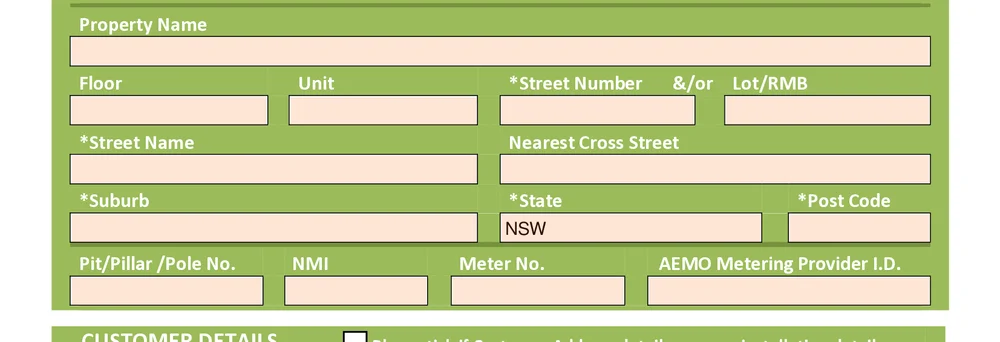
Addresses: missing unit numbers, wrong postcodes, and vague rural descriptions make a certificate hard to match to a property. Verify against a reliable address source before you finish, and include lot and plan numbers on new estates.
Signatures and dates: unsigned documents, wrong completion dates, and a name that does not match the licence holder all block sign-off. Sign after testing, use the real completion date, and never pre-sign a blank.
Equipment and cable specs: wrong RCD ratings, missing model numbers, and vague cable descriptions create questions later. Record nameplate details during the install and photograph labels you will not be able to reach afterwards. Note cable type, conductor size, and installation method while the ceiling is still open.
7. Skipping the final review on site
Submitting without a last pass is how several small errors stack into one rejection.
Before you leave, read the certificate the way a stranger would: address, scope, circuits, tests, licence numbers, signature, date. If it needs a phone call from you to make sense, it is not finished. On complex commercial boards, a second pair of eyes is cheaper than a callback.
Quick reference: CCEW completion checklist
What does manual CCEW admin actually cost you?
The visible cost is the rework. The invisible cost is retrieval - hunting equipment serial numbers, rebuilding an address from a text message, and running a correction loop after you have left site.
That cost is worth measuring rather than guessing. For one month, track how long each certificate takes end to end, including gathering details, filling the document, corrections, and finding old certificates when someone asks for one. Most electricians are surprised by the retrieval time rather than the filling time.
NSW requires electrical certification records to be kept, and paper folders and email threads work fine until someone asks for last month's certificate. Keep the eCert confirmation, test results, photos, and job notes together against the job reference. The CCEW workflow guide covers how to structure that, and digital vs paper CCEWs explains the move to the portal.
Staying current with NSW requirements
Requirements change, and certificates written from a stale mental model are a slow-building risk. Watch SafeWork NSW and NSW Government electrical compliance updates, keep current copies of the standards you rely on, and use industry association membership and training to hear about changes before they reach your paperwork.
Next steps
Before the certificate leaves site, run one last check: address, work description, licence details, tester details, test results, signature, and date. If the document cannot stand on its own without a phone call, fix it while you are still there.
Tradie Forms does not currently provide or lodge the new NSW CCEW. Complete it in the BCNSW eCert portal, or browse other Australian trade forms.
Official references
Check NSW electrical compliance requirements, the BCNSW eCert portal, Service NSW submit a CCEW, SafeWork NSW electrical inspection and testing, and the Standards Australia Wiring Rules for current requirements and acceptance values.