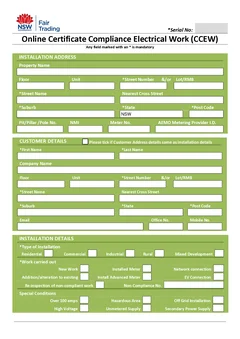
Customers rarely know what a CCEW proves or why a missing test result matters. Explain it in plain English while the job is fresh and you reduce arguments, speed up sign-off, and make the finished certificate feel useful instead of like padded paperwork.
This guide is about the conversation, not the form fields. For the technical side, see the NSW CCEW on-site testing guide and common CCEW mistakes.
Tell the customer what a certificate is before you send one. How the NSW CCEW works now covers the lodgement path in plain terms, and the certificate itself goes through the BCNSW eCert portal. Browse other Australian trade forms or read more in the NSW CCEW guides.
What is the customer actually worried about?
Most homeowners and small business owners are not across electrical compliance, so the certificate arrives loaded with assumptions. The four concerns that surface most often are extra cost if you find problems, delays before they can use the power, whether the certificate is legally required or optional, and whether you are padding the job with paperwork.
Address those early. A thirty-second explanation at the switchboard beats a defensive email a week later.
Set expectations before you open the board
The best handover starts before the work does. At booking, tell the client the job includes testing and certification steps. You do not need a speech: "once the work is finished I will test it, explain anything that needs attention, and send through the certificate record" is enough.
That small warning does real work later. It covers you when the job runs long because a fault turned up, and it makes the certificate feel like a normal part of the trade rather than a document that appeared after the invoice.
Explain the certificate in plain language
Start with what the document is for, not with clause numbers.
"A Certificate of Compliance Electrical Work is the record that your electrical work was installed and tested to the applicable standards. It is what councils, insurers, and future buyers expect to see when someone asks whether the job was done properly."
Then walk through what you actually did:
- Visual check - looked for obvious damage, correct labelling, and safe terminations
- Testing - used calibrated gear to check insulation, earthing, and safety switches where required
- Documentation - recorded the results on the official NSW certificate
- Handover - checked the customer email and explained how they receive their eCert copy
Translate test names into outcomes. Instead of "insulation resistance at 500 V DC", say "we checked that the cabling will not leak current in a way that could cause a fire or a shock."
How should you talk through test results at the board?
Show your working before you submit the eCert. Customers trust electricians who point at the thing they tested, and the explanation takes under a minute if you keep it to three moves: point to the RCD or safety switch and say whether it tripped in time, give insulation and earth results in plain terms, and confirm the address and work description match what they expect on the invoice.
If everything passed, keep it short: "all required tests are recorded, and the installation is safe to use." If something failed, explain the severity in your own words before they see the formal record. The written finding should never be the first time they hear about a problem.
Raising defects without losing the room
Hard conversations go better when you lead with safety and specifics. Start with what you found and where: "the RCD protecting the outdoor power points did not trip within the required time. That means the safety switch may not protect someone if there is a fault."
Then give priority in order:
- Must fix now - shock or fire risk, exposed live parts, failed safety switch on a critical circuit
- Fix soon - non-compliant but not an immediate danger
- Note for later - minor items to schedule with the next upgrade
Expect pushback. "It has worked for years" is the standard reply, and your answer can stay factual: "older installations often worked day to day but do not meet current standards. The certificate records what we found today so you can decide what to fix and when."
You are required to document non-compliant work honestly. That protects the customer and your licence. For the detail on how findings get recorded, see reporting installation defects on a CCEW.
Match the explanation to the audience
A homeowner wants to know whether the work is safe to use and what they should keep. A builder wants the job reference, work description, and delivery timing. A strata manager needs the site detail and a copy for their records.
Ask one question before you start explaining: "who needs this record after today?"
Then match the conversation to that person. For a homeowner, do not turn a five-minute handover into a standards lecture. For a project manager, say what is complete, what is outstanding, and who owns the next action. If a defect is unresolved, be precise about location and urgency, and follow your business process for making the installation safe.
Do not promise what the certificate does not prove
Clients can read a lot into a document with an official name. Avoid describing the certificate as a general warranty for the whole property, an insurance approval, or proof that unrelated older work has been inspected. Explain the scope actually covered by the work description and the testing you carried out.
The same caution applies to submission. Do not tell a customer the certificate has been lodged with the regulator because you downloaded or emailed a copy. NSW advises that CCEWs are submitted through the BCNSW eCert portal. The responsible person completes the current required process and keeps the confirmation with the job record. Customer handover and regulator submission are two separate steps, and conflating them in front of a client creates a promise you have not kept.
Closing out the certificate
Complete the customer handover while you are still on site where you can:
- Review the eCert details on your phone or tablet
- Confirm the customer email before submission
- Tell them where to store it: with settlement papers, strata files, or the job folder for a commercial tenant
For builders and project managers, ask who else needs a copy - certifier, site supervisor, or office admin. Sending copies the same day prevents "can you resend the cert?" calls three weeks later.
Before you leave, confirm the recipient and job reference, and save the sent copy alongside the test records, photos, and final certificate. A subject line like "Electrical work record, 14 King Street, 10 July" makes the file findable a year later when a conveyancer asks for it.
Two scripts you can reuse
For an uncomplicated completed job:
"The work we did today has been tested. This record identifies the job and the checks we completed. Keep the copy with your property paperwork. If you are sending it to a builder or strata manager, use this job reference so it stays with the right site."
For a job with further work required:
"I cannot treat this part as complete until the issue at [location] is resolved. I have recorded what I found and will send the next step in writing."
Do not soften a safety issue to make the conversation easier. The customer is better served by a clear description and a clear plan.
Follow-up that does not feel like a sales pitch
A short check-in a few days later works for jobs with remedial work outstanding. "Did you have any questions about the RCD replacement we quoted?" is enough. You are not chasing work for its own sake; you are closing the safety loop.
Keep a note in the job file if the client chose to defer non-critical items. That documents the conversation if the issue resurfaces.
Does completing the certificate on site change the conversation?
Yes, and mostly in your favour. Preparing the certificate details at the board means you can check the record while the job is still in front of you. Filling it in the van at 7pm means reconstructing the conversation from memory and hoping the customer remembers it the same way.
Useful habits: enter test results while the tester is still connected, attach defect photos to the job record rather than the camera roll, review the eCert before submitting, and close out from site so the conversation and the certificate land together. The comparison in digital vs paper CCEWs covers the workflow trade-offs in more detail.
Tradie Forms does not currently provide or lodge the new NSW CCEW. Use your job records to check the technical details, then complete and submit the certificate in the BCNSW portal.
Next steps
Talk through the result before the customer receives the certificate. Point out the work completed, the tests recorded, and any follow-up actions. Then complete the eCert in the same visit where you can.
Open the BCNSW eCert portal or browse other Australian trade forms. If you also work Queensland jobs, the QLD CoTC vs NSW CCEW comparison explains why the customer conversation differs across the border.
Official references
See NSW electrical compliance requirements, the BCNSW eCert portal, Service NSW submit a CCEW, and SafeWork NSW electrical inspection and testing for the current certification and testing process.