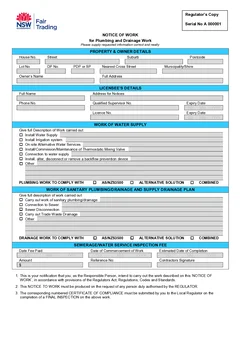
NSW plumbing closeout often needs more than one document. The Combined Notice of Work and Certificate of Compliance records who did the work, what was done, and the compliance statement at completion. A Sewer Service Diagram records where the private sewer pipes sit on the property.
Those jobs sound related because they often finish in the same week. They are not the same document.
If you treat the Combined Notice as "the drainage paperwork," the SSD gets forgotten, drawn late, or left as a phone photo that never becomes a usable diagram. If you treat the SSD as proof of compliance, the certificate and notice duties still sit unfinished.
This guide separates the two so plumbers and drainers can hand over a complete pack without mixing purposes.
For form completion, use the Combined Notice on-site guide. For timing, use when to submit a NSW Combined Notice. Browse NSW plumbing forms for live templates.
How is a Combined Notice different from an SSD?
The Combined Notice is the compliance paperwork that says the work was notified and complies. The sewer service diagram is the drawing that shows where the drainage actually runs. One is a statement, the other is a map.
| Document | Main job | Typical question it answers |
|---|---|---|
| Notice of Work | Tell the pathway what work is planned and who is doing it | What is about to be carried out, and by whom? |
| Certificate of Compliance | Certify completed plumbing and drainage work against the Act, Regulation, PCA, and AS/NZS 3500 DtS requirements | Was the finished work compliant, and who is responsible? |
| Sewer Service Diagram | Show the location of private sewer pipes on the property | Where are the drains, boundaries, building outline, and key drainage features? |
The Combined Notice form can hold the notice and certificate sides together. It does not replace the SSD.
What the Combined Notice is for
Building Commission NSW publishes the Combined Notice of Work and Certificate of Compliance with copies for the licensee, owner, and regulator.
NSW plumbing inspection documents explain the two halves:
- A Notice of Work outlines plumbing and drainage work to be carried out and the person carrying out the work.
- A Certificate of Compliance confirms the work complies with the Act, Regulation, Plumbing Code of Australia, and Deemed-to-Satisfy requirements of AS/NZS 3500, and identifies the plumber or drainer as the responsible person.
That makes the Combined Notice a people-and-compliance record:
- Property and owner details
- Licensee details
- Water supply and sanitary plumbing or drainage work types
- Fee, dates, and references
- Certification statement and completion date
- Copies for the parties who need them
It is text and declaration heavy. It is not a scaled plan of the private sewer.
Tradie Forms maps those fields onto the official Combined Notice layout. It does not create an SSD for you.
What a sewer service diagram is for
NSW Government guidance says a Sewer Service Diagram shows the location of private sewer pipes on a residential, commercial, or industrial property.
That is a different job from saying the work complies. The SSD is the drainage map later readers use when they need to know what is in the ground.
NSW guidance says plumbers and drainers must:
- provide a copy of the SSD to the person that arranged the work, and
- submit a copy to Building Commission NSW via MyInspections for listed metropolitan inspection work at completion of the drainage work, or
- submit a copy to the local plumbing regulator for the relevant local pathway
Regional inspections guidance also says submit the SSD to the local plumbing regulator and provide a copy to the owner of the land or the owner's agent.
So the SSD has its own audience and its own closeout moment. Completing the Combined Notice certificate does not automatically discharge the SSD duty.
Why the two documents get mixed up
They get mixed up because both often appear at the end of drainage work.
The trench is ready to close. The inspector has been or is booked. The owner wants paperwork. The office wants the job closed. Someone says "send the cert and the drawing" and the team treats that as one vague task.
They also get mixed up because both can travel to the same people:
- Owner or person who arranged the work
- Regulator or local plumbing regulator
- Licensee job record
Shared recipients do not make shared documents. One is a compliance certificate process. One is a drainage location diagram.
When do you need both documents?
Not every plumbing job needs an SSD. Not every job uses the same notice pathway. The practical rule is still to check the work type and current NSW guidance for the site.
You are more likely to need both when:
- Drainage work is part of the job
- The pathway requires an SSD at completion of drainage work
- The owner or builder needs a property drainage record as well as a CoC
- The job is a duplex or multi-dwelling site where drainage layout matters later
You may still need a Combined Notice or CoC path on jobs where an SSD is not the main issue, such as some water supply only work. Decide from the actual work and the official pathway, not from habit.
SSD quality rules that the Combined Notice cannot fix
NSW sets quality expectations for SSDs submitted to Building Commission NSW. Guidance includes requirements such as:
- Use a Building Commission NSW SSD template
- Keep the diagram legible and readable
- Draw using black pen
- Fill the title block with accurate information
- Draw to scale and proportion showing drainage, building outline, and property boundaries
- Use correct symbols and abbreviations
- Include existing drainage where relevant
- Show street frontage
- Indicate north point
- Scan appropriately; photos are not accepted
If a diagram fails a quality assurance check, NSW guidance says you can be issued a Written Direction to Comply notice to rectify and re-submit.
None of those drawing standards live inside the Combined Notice form. A perfect CoC will not rescue a messy photo of a napkin sketch.
NSW also notes that all duplex or triplex properties, whether torrens or strata titled, require only one SSD showing all dwellings and associated sanitary drainage for each dwelling. That is another reason to treat the SSD as its own careful document.
Templates and supporting SSD resources
NSW publishes SSD templates and support material, including symbols, legends, and A3 or A4 landscape and portrait templates. Use the current official templates and requirements pages rather than inventing a private format for regulator submission.
Useful official starting points:
If you are outside networks that hold historical drawings for purchase, contact the relevant local plumbing regulator for how existing SSDs are handled in that area.
How the documents work together in one job pack
A clean drainage closeout pack often includes:
- Notice of Work record submitted before start where required
- Inspection notes and outcomes where inspections applied
- Finished Combined Notice and Certificate of Compliance PDF
- Sewer Service Diagram where required
- Photos taken before covering work
- Product or fixture notes that support the description
- Owner or builder send confirmations
The Combined Notice answers who, what work, and compliance. The SSD answers where the private sewer is. Photos support both if something is queried later.
Store them under the same job number. Do not leave the SSD in a separate camera album and the CoC in a different email thread.
Timing differences that matter on site
Notice first
If a Notice of Work is required, it belongs before work starts. The SSD is not a substitute notice.
Draw while open
The best time to measure and draw the SSD is while the drainage is still open and you can see junctions, inspection openings, and connections. Waiting until after backfill forces guesswork.
Certificate at completion
The Certificate of Compliance belongs when the plumbing and drainage work being certified is finished. That may be after the drainage inspection and after water supply stages are complete, depending on the job.
SSD at drainage completion
NSW guidance points to submitting the SSD at completion of the drainage work through the relevant pathway. That can land earlier than the final occupation-stage plumbing certificate on a long build. Keep both calendars in view.
Common mix-up mistakes
Writing "see SSD" and skipping drainage detail on the Combined Notice
The certificate still needs a clear work description. The SSD does not fill the sanitary plumbing and drainage fields for you.
Attaching a photo and calling it an SSD
Where NSW says scans are required and photos are not accepted, a site photo is supporting evidence at best, not the submitted diagram.
One CoC for a duplex and no multi-dwelling SSD detail
NSW expects one SSD showing all dwellings and associated sanitary drainage for duplex or triplex properties. Check the diagram covers the full drainage story.
Owner gets the CoC, nobody gets the SSD
If both documents are required, both need a planned handover. The owner or person who arranged the work may need the drainage map as much as the compliance certificate.
Regulator receives one document and the office assumes both duties are done
Track notice, certificate, and SSD as separate checklist items. Closing one does not close the others.
Who needs which copy?
Use this as a practical matrix, then confirm the pathway for the site.
| Recipient | Combined Notice / CoC | SSD |
|---|---|---|
| Person who arranged the work | Yes, CoC copy at completion | Yes, where an SSD is required |
| Owner or owner's agent | Often the same person, or required under regional SSD guidance | Yes where required |
| Building Commission NSW / MyInspections | Where the metro inspection pathway requires notice or CoC submission | Where metro drainage completion requires SSD submission |
| Local plumbing regulator | Where the local pathway requires the Combined Notice | Where the local pathway requires the SSD |
| Licensee job record | Always keep the finished PDF | Always keep the finished diagram with the job |
The exact send method can differ by pathway. The record-keeping rule does not: keep your own copies with the job.
A practical two-document closeout checklist
Before you call the drainage job closed:
- Confirm whether an SSD is required for this work and site.
- Confirm the Combined Notice or CoC pathway for the same site.
- Finish drainage measurements and draw the SSD on the accepted template.
- Complete testing and final plumbing checks for the certificate side.
- Fill and preview the Combined Notice PDF.
- Provide the person who arranged the work with the required CoC copy.
- Provide the required SSD copy to the owner, agent, or arranger as applicable.
- Submit regulator copies for CoC and SSD through the right channels where required.
- Attach both finished files to the job record with clear names.
- Keep pre-cover photos and inspection notes with the same pack.
If any line is missing, the pack is not finished even if one PDF looks complete.
Related reading and next steps
Start the NSW Combined Notice of Work and Certificate of Compliance for the notice and certificate paperwork, and browse NSW plumbing forms. See the plumbing forms hub for the rest of the Australian set.
Related articles:
- NSW Combined Notice on-site guide
- Record keeping and handover guide
- When to submit a NSW Combined Notice
- Common Combined Notice mistakes
For official SSD templates and drawing rules, use the NSW Government SSD pages linked below rather than improvised drawings.
Official references
For current requirements, check the NSW plumbing inspection documents guidance, Sewer Service Diagram requirements, SSD templates, the regional inspections guidance, and the Combined Notice form page.