Smoke alarm service day on a rental is a small job that goes wrong in predictable ways. You arrive between other work, the tenant is home, one alarm is behind a door that will not open, and by the time you are back in the ute you are not certain whether the hallway alarm got cleaned or just tested. The record you write from that memory is the one an agent relies on.
The fix is a fixed route. Servicing a property room by room, in the same order every time, is what turns a scattered job into a record you can sign without hedging. This guide sets out that route and what to capture at each stop.
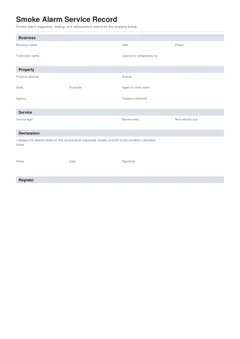
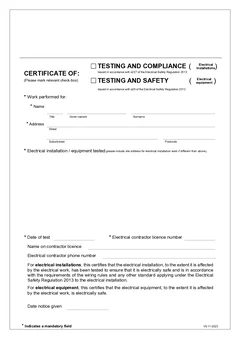
Write the record as you go in the smoke alarm service record. For the field-by-field detail behind each entry, see the smoke alarm service record template guide. Browse more electrical forms for the rest of the job paperwork.
Before you knock
Two things are worth confirming before you are standing in someone's hallway.
Access and notice. Someone lives here. Confirm the entry arrangement with the agent, and expect to work around a tenant who is home, working, or asleep after night shift. An alarm you could not reach because a room was occupied is a note on the record, not a silent gap.
The alarm count from last time. If a previous service record exists, take the alarm count and locations with you. A property that had five alarms and now has four is telling you something, and it is much easier to notice on site than three weeks later.
If neither exists because this is the first service, the walk you are about to do is what builds the schedule for every service after it. Take the extra ten minutes.
The route
Follow the building, not the noise. The order below covers a standard single or double storey dwelling and adapts easily.
- Furthest bedroom first. Start at the far end and work back toward the entry. It is the opposite of how people naturally move through a house, which is exactly why it works.
- Every other bedroom in sequence. Do not skip a room because the door is shut. A closed door is where a missed alarm hides.
- Hallways serving the bedrooms. These are the alarms that matter most and get the least attention.
- Every other level. Stairwells and landings on the way.
- Any remaining storey or area without a bedroom, so the whole dwelling is covered rather than only the sleeping end.
The point of a fixed order is that a gap becomes obvious. If your record jumps from bedroom 1 to the hallway with no bedroom 2, you know before you leave.
What to capture at each alarm
Do this at the alarm. Not in the hallway, not in the ute.
Where it is, in words someone else can follow.
How it is powered. Hardwired, hardwired with battery backup, or a 10-year non-removable battery unit. This drives what you are allowed to do about a failure and who has to do it.
The manufacture date on the unit. This is the field most often left blank and most often needed. An alarm manufactured more than 10 years ago must be replaced regardless of whether it sounds today. If you did not read the date off the back, you cannot make that call.
The result, and what you did. Passed, cleaned, replaced, or could not access. Each of those is a real outcome. A blank is not.
How do you test an interconnected system?
Press and hold the test button on one alarm and confirm the others sound. That is the test that proves the interconnection rather than the single unit, and it is the one most often skipped because testing each alarm on its own is quicker.
Test from more than one alarm. A system can fail in one direction, where alarm A triggers the rest but alarm C triggers nothing, and testing only from the hallway unit will not surface it. Two or three trigger points across the property is usually enough on a standard dwelling.
The National Construction Code requires alarms in a new dwelling to be interconnected where there is more than one. In Queensland, all homes need interconnected photoelectric alarms in every bedroom, hallway, and on every level by 1 January 2027, and rentals have been under that requirement since 1 January 2022. Requirements differ between states and between new and existing dwellings, so confirm what applies to the property rather than assuming.
Failures on the day
An alarm that does not operate when tested must be replaced. So must any alarm manufactured more than 10 years ago, even if it sounds.
Carry replacements. A service visit that produces a list of things to come back for is worse for everyone than one that fixes what it finds, and a second visit to a tenanted property is harder to arrange than the first.
Record both units when you swap one. The alarm that came out and the alarm that went in, with the new unit's manufacture date. That pairing is what makes the next service straightforward, because the person reading it knows exactly what is up there.
Installing or replacing a hardwired alarm is electrical work and needs a licensed electrician. A 10-year non-removable battery alarm can be installed without one. Know which type you are looking at before you start, because it decides whether the fix is yours to make.
Alarms you could not reach
Sometimes a room is occupied, a ceiling is too high for the ladder you brought, or a unit is behind a tenant's stored belongings.
Record it as not accessed, with the reason. An honest gap that is visible is a problem someone can solve. A silent gap reads as a completed service and nobody follows it up. Tell the agent before you leave the property rather than letting them find it in the PDF, and agree who is arranging the return visit.
Do not mark an alarm as passed because it probably is. The whole value of the record is that it says what actually happened.
Before you leave
Four checks, standing at the front door.
- Does the alarm count on your record match what the property should have, and match the previous service if there was one?
- Does every alarm have a location, a power source, a result, and a manufacture date?
- Is every replacement recorded as a pair, old unit and new unit?
- Is anything you could not access written down, with the reason and the next step?
If the answer to all four is yes, the job is closed. If not, the fix is a two-minute walk back inside, which is a much better option than a phone call next month.
Where the form helps
The smoke alarm service record follows the same order as the route above, so the record builds as you move through the property rather than being reconstructed afterwards. Each alarm is entered with its location, power source, manufacture date, and result, and a failure prompts you for the action before the record can be finished.
Your business and licence details are saved and reused across properties, so they are not retyped for every service. The form flags missing fields before download, you preview the entries on the record layout, then download the finished PDF for the agent or landlord file.
Tradie Forms maps your entries onto that layout. The licensed person doing the work remains responsible for the testing, the replacements, and checking the downloaded PDF before it goes to the agent.
Related reading: the smoke alarm service record template guide for the detail behind each field, and the six-monthly emergency lighting checklist for the commercial equivalent.
Official references
Check the Queensland Government smoke alarms guidance and Queensland Fire Department smoke alarms for the alarm type, interconnection, and replacement rules, the Residential Tenancies Authority smoke alarms page for the landlord and renter testing obligations, and National Construction Code Part 9.5 for smoke alarm requirements in dwellings. Tenancy and smoke alarm rules differ between states and territories, so confirm the current obligations for the property before treating a service as complete.