You have walked a rental, pressed the test button on every alarm, swapped one that would not sound, and now the agent wants proof the property is right. That proof is a smoke alarm service record: a list of every alarm, where it sits, how it is powered, whether it passed, and what you did about the ones that failed. Get it down while you are still standing under the last alarm and the job is closed. Write it up from memory in the ute and you are guessing at a location or a manufacture date.
This guide covers what a smoke alarm service record captures, how each field maps to the alarm in front of you, and the AS 3786 and interconnection rules that sit behind the work.
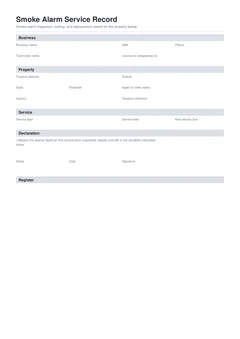
If you are writing up a service today, open the smoke alarm service record and work through it at the property. Browse more electrical forms for the rest of your job paperwork. For another building electrical service record, see the emergency lighting test register guide.
What is a smoke alarm service record?
The record is not the compliance job. The compliance job is the inspection, the test, and the replacement. The record is the evidence that the work happened, and it is what an agent or landlord keeps on file to show the property met its obligations on the day you attended.
Because it stands as proof, it has to be specific.
Written that way, one page answers the questions before they are asked.
Requirements differ by state, so treat the record as the constant and the local rules as the layer on top. AS 3786 is the national product standard every alarm has to meet. The National Construction Code sets where and how alarms go into a dwelling. Then each state and territory adds its own tenancy and existing-dwelling rules on top, with Queensland the furthest ahead.
Business and technician details
The first section is who did the work. The record needs your business name, the technician who attended, and your licence number where the work you carried out is licensed electrical work.
This matters most when the visit included replacing a hardwired alarm. Swapping a hardwired smoke alarm is electrical work, so a licensed electrician does it, and the licence detail on the record is what shows the right person was on the tools. A 10-year non-removable battery alarm can be installed without an electrician, but the record still names who attended and stands behind the result.
Enter these once and they carry across every job. There is no reason to retype a business name and licence number on each property when the same person and business is doing the round.
Property and agent details
Next is where the work happened and who receives the record. The property address is what the record hangs on, so it has to be the full, correct address rather than the short version an agent uses in a booking. The agent or property manager details are who the finished record goes back to.
For a rented property this section is doing double duty. It ties the service to the tenancy, which is where the smoke alarm obligation actually lives, and it names the agent who has to keep the record on file. Getting the address and agent right is what lets the record be matched back to the property months later without anyone digging.
Service type and date
This section frames the visit. The service type separates a routine test and clean from an install or a replacement, because the two are different pieces of work with different expectations. A between-tenancy test is a check that everything still sounds; a replacement means an alarm was changed out and the new one has to comply with AS 3786.
The service date is the anchor for everything that follows. Tenancy rules are built around dates: in Queensland a landlord must test and clean each alarm within 30 days before a tenancy starts, and renters test and clean at least once every 12 months. The record captures the legislation basis for the visit so the reason you attended is on the page, not held in your head.
Within 30 days
Landlord test and clean, QLD
Before a tenancy starts.
Every 12 months
Renter test and clean, QLD
At least once.
10 years
Replace the alarm
An alarm manufactured more than 10 years ago must be replaced, as must any that fails a test.
Check the tenancy rules in your own state as well: these three are Queensland's.
The alarm register
This is the heart of the record, and it is a register because a property has more than one alarm. You add a row for each alarm on site and complete it against the unit in front of you.
For every alarm the register captures:
Location and type. Which room or hallway the alarm is in, and whether it is photoelectric, ionisation, or another type. Location has to be precise enough that the next technician finds the same alarm. Photoelectric is the type new and replacement alarms are required to be in Queensland, and recording the type is how a swap from an old ionisation unit is documented.
Power source and replace-by date. Whether the alarm is hardwired with battery backup or a 10-year non-removable battery unit, and the date it is due for replacement. An alarm manufactured more than 10 years ago must be replaced, so the replace-by date is what turns "looks fine" into a scheduled action.
Interconnection result. Whether the alarm triggers the others when it sounds. Interconnection is a National Construction Code requirement for new dwellings with more than one alarm, and the Queensland rules extend it to every home. Testing that one alarm sets off the rest is a separate check from testing that the alarm sounds at all, so it gets its own result.
Overall result and test date. The pass or fail for the alarm and the date it was tested. A passed alarm needs a next-due date so the property owner knows when the next service falls. A failed alarm needs the action you took and the failure detail, because a fail with no action is an open loop that lands back on you.
Working the register alarm by alarm, rather than as one summary, is what keeps a result tied to the right unit. It is also what catches the alarm that was tested but never had its interconnection confirmed, or the one that passed but sat past its replace-by date.
Signing off the record
The declaration is the last section and it is you standing behind the record. It carries any notes from the visit, your name, the date, and your signature.
Sign it once the register is complete and correct, not before. The declaration says the alarms listed were inspected and tested as recorded, so a blank interconnection result or a missing replace-by date should be resolved first. Notes are where anything the register does not have a field for goes: an alarm the tenant had removed, access you could not get, or a follow-up booked to replace a unit. The signature closes the record and makes it the document the agent files.
What the rules actually require
The record is only as good as the standard behind it, so it helps to know what the alarms themselves have to meet.
Every domestic smoke alarm has to comply with AS 3786, the product standard that sets how an alarm is designed, built and tested. The National Construction Code Part 9.5 requires alarms in a new dwelling to comply with AS 3786, to be powered from the consumer mains where mains is supplied, and to be interconnected where there is more than one. It also sets the minimum locations: on any storey with bedrooms, in the hallway serving those bedrooms, and on each other storey.
Existing dwellings are governed by state legislation on top of the NCC. Queensland is the clearest example. Existing alarms manufactured more than 10 years ago, and any that do not operate when tested, must be replaced with photoelectric alarms complying with AS 3786-2014. From 1 January 2022 landlords have had to install interconnected alarms in rentals, and by 1 January 2027 every home needs interconnected photoelectric alarms in every bedroom, every hallway and on every level. A hardwired alarm that needs replacing has to be replaced with a hardwired photoelectric alarm, which is why the licensed electrician detail sits on the record.
Other states set their own timeframes and locations, so confirm the current rules where the property is before you certify the work. The service record stays the same; the local requirements it is proving change.
How Tradie Forms helps
Tradie Forms turns the service record into sections you work through one at a time that follow the order of the work. You fill the business and technician details once and reuse them, enter the property and agent, set the service type and date, then build the register alarm by alarm with location, type, power source, replace-by date, interconnection result, overall result and test date.
The form holds the register logic for you. A passed alarm prompts for its next-due date, and a failed alarm asks for the action and the failure detail before you can move on. It flags missing fields before you download, which is what catches the blank test date or the alarm with no interconnection result while you are still on site. You preview your entries mapped onto the official PDF layout, then download the finished record to hand the agent and store with the job.
Tradie Forms maps your entries onto the layout. The licensed person still checks the alarms, the test results and the downloaded PDF before it goes to the agent or landlord.
Start the smoke alarm service record at the property, or browse more electrical forms for the rest of your job paperwork.
For the route through a rental on service day, see landlord smoke alarm service day.
Official references
Check the Queensland Government smoke alarms guidance and Queensland Fire Department smoke alarms for the current testing, replacement and interconnection rules, National Construction Code Part 9.5 for the AS 3786, mains power and interconnection requirements in new dwellings, and the Standards Australia Wiring Rules (AS/NZS 3000) for hardwired electrical work tied to smoke alarm replacement. Requirements differ by state and change over time, so confirm the rules where the property is and your own licence conditions before you certify the work.