The emergency lighting service is one of those jobs that quietly becomes your problem. A contractor walks the building, cuts the supply to each fitting, times the batteries, and leaves. Six months later an insurer, an auditor, or a fire safety consultant asks for the records, and what you have is a one-page invoice that says "emergency lighting tested, all compliant" with no fitting list behind it.
This checklist is written for the person arranging the service rather than the electrician performing it. It covers what to agree before the contractor arrives, what happens to the building during the test, and how to tell a register that will survive an audit from one that will not.
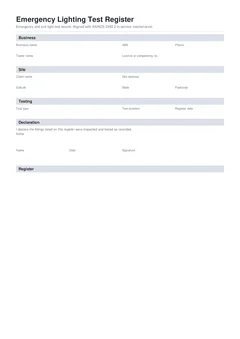
If you engage contractors who need somewhere clean to record the round, point them at the emergency lighting test register. For the field-level detail of how the register is filled in, see the emergency lighting test register and AS 2293.2 guide. Browse more electrical forms for adjacent building records.
What is the six-monthly emergency lighting test?
It is a routine service in which every emergency and exit fitting in the building is inspected and electrically re-tested, including a discharge test that runs each fitting on its own battery for its full rated duration. The National Construction Code requires the systems to be installed to AS/NZS 2293.1, and AS/NZS 2293.2 sets the inspection, testing, and maintenance procedures that keep them in a state of readiness.
The discharge test is the part that matters and the part most easily faked. Switching a fitting on and confirming the lamp works proves the lamp. Interrupting the normal supply and confirming the fitting stays lit at the required level for the full rated duration proves the battery, which is the component that actually degrades. WorkSafe Victoria describes that as maintaining the required level for at least one hour after the loss of normal lighting.
A battery that holds for fifteen minutes will pass a lamp check and fail an evacuation. That is the whole reason the interval exists.
Before the contractor arrives
Most of the friction in this job comes from things nobody agreed in advance.
Confirm the fitting schedule. Ask what list the contractor is working from. If the answer is "we will find them as we go", the register you get back will be whatever they happened to walk past. A building with a known fitting count gives you something to check the register against. If no schedule exists, the first service is the one that builds it, and you should expect to pay for that.
Agree the timing and the affected areas. During the discharge test the affected part of the building is running on emergency lighting only. In a tenanted office, a childcare centre, or a medical suite that is not something to discover at 10am on a Tuesday. Book it outside occupied hours or stage it floor by floor.
Name the person who can authorise a supply interruption. Someone has to be reachable if a circuit does not come back cleanly, or if a fitting in a critical area fails and needs isolating.
Ask what happens to failures. A service that only tests is half a service. Find out whether the contractor is quoting to test, or to test and rectify, and what the process is for a fitting that fails on the day. This single question prevents most of the follow-up arguments.
Which areas need checking first
Emergency lighting exists to get people out of the building, so the fittings that matter most are the ones on the escape path. When you walk the building before or after a service, these are the places worth your attention.
- Exit doors and the paths that lead to them, including the final discharge point outside the building
- Stairwells, especially the lower flights that people use least and where fittings are checked least
- Change of direction points and level changes in corridors, where a dropped fitting leaves a dark turn
- Plant rooms, switchboards, and fire services equipment, which need light for someone to work in an emergency
Fittings in back-of-house areas and rarely used stairwells are the ones that quietly fail. They are also the ones a hurried contractor is most likely to skip, so they are worth spot-checking against the register when the paperwork comes back.
What the register must show you
This is where most handover packs fall down. The register is not a certificate, it is a list, and the value is in the per-fitting detail.
Every fitting on the schedule should appear with an identity you can find again. The identity is what turns a failure into a work order.
Each fitting needs its own result, including the ones that passed. A register that lists only failures gives you no evidence that the rest were tested at all, and no baseline to compare against next cycle. The test date belongs on the record, and where fittings were tested across more than one visit the dates should reflect that rather than being backfilled to a single day.
Anything that failed needs an action recorded against it. "Battery did not hold rated duration, fitting tagged, replacement quoted" tells the next reader what happened. A blank next to a fail tells them nothing, and leaves you holding an open safety item you did not know about.
Finally, the register should name the person and business who did the work. Records of testing should be kept on site and made available for auditing, and an anonymous record is hard to stand behind when someone asks who performed the service.
How do you spot a thin service?
You do not need to be an electrician to see the gaps. A few patterns give it away.
The register arrives as a summary. One line saying "48 fittings tested, all compliant" is a claim, not a record. Ask for the itemised list.
The fitting count does not move between cycles in a building that has had works done. New fitouts add and remove fittings. A register that reports the same count for three years in a building that has been altered is being copied forward.
Every fitting passes, every time, for years. Batteries have a service life. A building of any size will produce failures eventually, and a register with no failures across multiple cycles is either a very new installation or a very light touch.
The test dates cluster impossibly. If the register shows a hundred fittings discharge-tested in a two-hour window, the durations do not add up, because each fitting has to run for its rated duration.
Filing it so it is there when asked
The pattern that works is boring and reliable. One folder per building, one subfolder per service date, the register PDF named so the building and date are readable without opening it. Something like emergency-lighting-register-<building>-2026-09.pdf survives a staff change in a way that scan_0043.pdf does not.
Keep the register with the rest of the building's essential safety records rather than in an email thread, because the request for it rarely comes from the person who received it. When a failure is rectified, file the rectification record alongside the register that reported it, so the open item and its closure sit together. An auditor following a failed fitting from one document to the next is the moment a well-filed set pays for itself.
State building and workplace safety rules turn ongoing inspection and testing into an obligation for the building, and the Queensland fire safety inspection and maintenance guidelines are one example of how the service and its records are treated. Requirements vary by state and by building classification, so confirm what applies to your site rather than assuming a national rule.
A short pre-acceptance check
Before you approve the invoice, run the register past four questions.
- Does the fitting count match the building schedule, and can you find any three fittings from the register on a walk?
- Does every fitting have a result and a date, not just the failures?
- Does every failure have an action, and do you know who owns the follow-up?
- Is the tester and business named, with a way to contact them?
If any answer is no, ask before you pay. It is a much easier conversation the week of the service than the week of an audit.
Where the form helps
The emergency lighting test register gives contractors a structure that produces the record described above. Fittings are entered one at a time with their identity, result, and dates, so the per-fitting detail exists by default rather than depending on how much someone felt like writing. Business, tester, and licence details are saved and reused across jobs, and the form flags missing fields before download.
The result is a preview of the entries mapped onto the register layout, then a finished PDF to hand over and store with the building records. Tradie Forms maps the entries onto that layout. The competent person performing the service remains responsible for the testing, the results, and checking the downloaded PDF before it is treated as the record.
Related reading: the emergency lighting test register and AS 2293.2 guide for the field-by-field detail, and the smoke alarm service record guide for residential alarm servicing.
Official references
Check AS/NZS 2293.2:2019 at the Standards Australia store for the routine service and maintenance standard, the National Construction Code Part E4 for how emergency lighting and exit signs are required and referenced to AS/NZS 2293.1, WorkSafe Victoria on emergency lighting for the six-monthly test and record-keeping expectations, and the Queensland fire safety inspection and maintenance guidelines for how the service and its records are treated. Requirements and building conditions vary, so confirm the current standard and the obligations for your specific building before accepting a service as complete.