A Queensland certificate of testing and compliance is easy to leave until the end of the day. The switchboard is back together, the customer wants to lock up, the apprentice is loading the ute, and the next job is already ringing.
That is exactly when small certificate mistakes creep in.
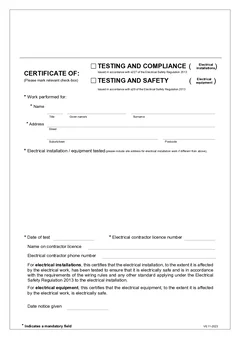
For Queensland electricians, the certificate is not just a receipt. WorkSafe Queensland says electrical contractors and workers completing work on behalf of an electrical contractor must provide either a certificate of testing and safety for work on electrical equipment or a certificate of testing and compliance for electrical installation work. The certificate needs the customer details, the installation or equipment tested, the test date, the electrical contractor licence number and the right certification wording.
This guide is about the common on-site mistakes that slow completion, confuse the customer or make the job record harder to defend later. Use it alongside the QLD CoTC template when you want a section-by-section fill, saved licence details, PDF preview and a cleaner completion. You can also browse QLD electrical forms or read the companion QLD CoTC on-site guide.
Picking the wrong certificate type
The WorkSafe Queensland example certificate covers two different jobs. It has a certificate of testing and compliance for electrical installations, and a certificate of testing and safety for electrical equipment.

That choice matters because the certificate statement changes. Installation work needs the statement that the electrical installation, to the extent affected by the electrical work, has been tested to ensure it is electrically safe and in accordance with the wiring rules and other standards applying under the Electrical Safety Regulation. Equipment work needs the statement that the electrical equipment, to the extent affected by the work, is electrically safe.
On site, the mistake often happens when a saved PDF or old invoice wording is reused. A domestic switchboard upgrade, a new circuit or installation work is not the same paperwork moment as equipment work.
Tradie Forms starts with the certificate type so you choose it before the rest of the form is finished. That does not make the compliance call for you, but it does stop the certificate heading being treated as an afterthought. For when a CoTC is required, see when is a QLD CoTC required.
Writing the wrong person in the customer block
WorkSafe Queensland says the certificate must include the name and address of the person for whom the work was performed. Their guidance explains that this is usually the person or organisation that engaged the licensed electrical contractor to perform the work, and usually the person or organisation you would invoice.
That sounds simple until the job has a builder, property manager, tenant, owner, body corporate or real estate agent involved.
If you were engaged by the builder for a renovation, WorkSafe Queensland says you would give the certificate to the builder unless you were engaged directly by the owner. If your job software has the site contact in one field and the bill-to contact in another, do not copy the wrong one into the certificate without checking.
Before download, check who engaged your electrical contracting business, the name you will invoice, the address tied to that person or organisation, and whether the work site address differs from the customer address. The QLD CoTC template separates the customer block from the work tested block so the site details do not have to be squeezed into the wrong field.
Describing the work too thinly
WorkSafe Queensland says the certificate must include details of the electrical equipment or electrical installation tested. Their guidance says to provide as much detail as possible about the work done, such as the number and type of electrical equipment installed, because the certificate copy can serve as a useful job record.
Better descriptions name the affected installation or equipment and give enough site context to understand the job.
Keep it factual. Do not turn the certificate into a quote, a whole job diary or a promise about work you did not touch. The point is to make the tested work clear.
Leaving the test date or notice date loose
The certificate must include the day the electrical equipment or installation was tested. On a busy run, it is easy to use the job booking date, invoice date or the date the office sends the PDF. Use the test date.
This is especially important when work spans more than one visit. If rough-in, fit-off, testing and completion happen on different days, the certificate should not be filled from memory after the week has moved on. Finish it while the test result, job notes and scope are still fresh.
The WorkSafe Queensland example certificate also includes a Date notice given field. The guidance says you must give a certificate to the customer as soon as possible after completing the work. Leaving this date blank weakens the completion record. Make the notice date part of your site close-out: finish testing, fill the certificate, preview the official PDF layout, give or send the PDF to the person the work was performed for, and store the finished PDF with the job record.
Using an old or wrong licence number
WorkSafe Queensland says the certificate must include the electrical contractor licence number under which the installation or equipment was tested.
This is one of the fields that should be easy, but it is also one of the fields that gets copied from old paperwork without a second look. If a business has multiple licences, a subcontracting arrangement, or changed details after renewal, stale licence information can follow the team around.
Saved licence details help when they are current. Tradie Forms lets you reuse contractor licence details, name on licence and phone details so the electrician is not typing the same block on every job. The habit is still to check those details before download, especially after renewals, new entities or changes in who performed or supervised the work.
Treating testing notes as someone else's paperwork
WorkSafe Queensland's testing guidance says testing is electrical work under the Electrical Safety Act 2002. It lists testing work such as detecting faults, locating faults, measuring performance, verifying compliance with the wiring rules, determining whether equipment is energised, fulfilling test and tag requirements, and checking electrical work before connection or reconnection.
The certificate does not need every test reading. It does need the right certificate details, the tested work description and the certification statement. Your job file can carry the supporting test notes, photos, SWMS records where relevant and other completion material.
Do not let the certificate drift away from the testing record. If the certificate says one thing and your job notes say another, the office has a mess to clean up.
Not keeping a findable copy
WorkSafe Queensland says electrical contractors must keep a copy of these certificates for five years. Their FAQ also says that once the certificate is issued, the licensed electrical contractor under whose licence number the certificate was issued must keep a copy for at least five years after it is given to the person for whom the work was performed.
That copy should be findable. Not buried in a camera roll. Not sitting as scan0007.pdf on one laptop.
Use a file name the office can search later. Include the date, customer or builder, site suburb and certificate type. Attach the PDF to the job in your job software or shared drive. If the customer rings six months later, the record should take seconds to find. For longer filing habits, see QLD CoTC record keeping for five years.
How Tradie Forms helps before download
Tradie Forms does not replace the electrician's judgement. It maps your entries onto the official PDF layout and helps catch missing fields before you download.
For QLD CoTC work, the form keeps the job in clear blocks: certificate type, work performed for, electrical installation or equipment tested, test and contractor details, and certification and notice date.
You can save licence and business details for reuse, fill the certificate at the switchboard or in the ute, preview how the official PDF will look, and download the finished PDF on site. The licensed electrician or contractor still needs to check the form before sending it.
Before you give the customer the certificate, read the PDF like a future reader would. Is the certificate type right? Is the customer or builder name the person the work was performed for? Is the address clear? Does the work tested description say what was actually tested? Is the test date right? Is the contractor licence number current? Is the notice date filled? Has the PDF been stored with the job record?
That check takes a minute. It can save the office a chase, and it gives the customer a cleaner completion.
Next steps
Start the QLD Certificate of Testing and Compliance when you need to fill the official PDF layout online, or browse QLD electrical forms for more paperwork as coverage expands.
For a broader walkthrough, read the QLD CoTC on-site guide. For when the certificate is required, open when is a QLD CoTC required. For five-year filing, see QLD CoTC record keeping. Cross-border sparkies may also want QLD CoTC vs NSW CCEW.
Official references
For current requirements, check WorkSafe Queensland's issuing certificates of compliance guidance, the WorkSafe Queensland certificate of testing PDF, WorkSafe Queensland's testing guidance, and Business Queensland electrical contractor safety duties.