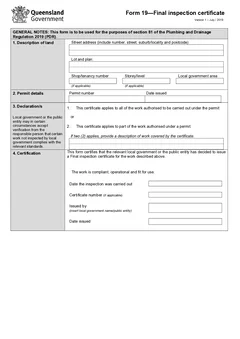
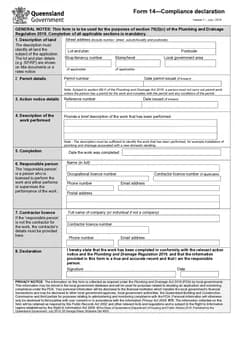
Form 19 problems almost always come from a mismatch: the certificate says all work is covered when only part was inspected, or the permit number points at a version of the job that no longer exists.
Use this alongside the Form 19 certificate guide and the Form 19 record keeping guide.
Use the QLD Form 19 template as your review checklist, or browse QLD plumbing forms. The plumbing forms hub covers the other states.
Start with the right person and the right job moment
Form 19 is used by the local government or public sector entity for a final inspection certificate. It is not the plumber's own declaration of completion.
The Queensland inspection certificates guidance says the certificate can be issued when all permit work, or a distinct part of it, is complete and the authority is satisfied it is compliant, operational, and fit for use. That distinction prevents the most common office mistake: asking a contractor to sign off a Form 19 as though it were a Form 14 or Form 5.
Before anyone opens the form, confirm the job is actually at final inspection. Where an action notice is unresolved, an appeal is running, or a required permit amendment has not happened, a local government cannot issue the certificate. That is a job-status problem, not a wording problem in the PDF.
Mistake 1: Certifying the wrong scope
Recording all work when only part of the permitted work was inspected creates a record that does not match the site, and it is the error most likely to surface years later during a sale or a fault.
Declare the scope actually inspected. Where coverage is partial, say so plainly and link the declaration to the specific part.
Mistake 2: Confusing Form 19 with Form 21
Similar completion-related forms in the Queensland set get mixed up, particularly by offices working across several jobs at once.
Confirm which certificate the job requires against the current forms page before filling anything in. The Form 21 final inspection guide covers where that one applies.
Mistake 3: Using old permit details
On a long job, an amendment can change scope, address detail, or work description. A copied permit number still looks believable while pointing at the wrong version of the job.
Put the current permit and every amendment in front of whoever prepares the certificate. Compare the permit number, issue date, land description, and the work being certified. Where the certificate covers a distinct part, make the link to that part explicit.
Mistake 4: Treating a distinct part as a vague partial job
Queensland guidance gives one or more townhouses in a complex as an example of a distinct part. "Stage one" or "rear works" makes sense to the crew and means nothing to an owner, a council officer, or a service team five years from now.
Use an identifier from the permit pack: dwelling number, building, level, lot, unit, or an attached plan reference. Store the supporting plan or inspection note with the certificate. The form should never make a reader guess which finished portion was certified.
Mistake 5: Weak property identification
A street number is useful on site, but the certificate has room for a fuller description of land. On new estates and multi-unit work, lot and plan details are what separate the right record from the one next door.
Check title or permit information rather than relying on a GPS pin or a builder's shorthand. Where the certificate covers part of a property, identify the land first, then the completed part of the permit work.
Mistake 6: Assuming Form 19 is the first inspection record
Permit work has its own inspection process during the job. The responsible person must request inspection, and Queensland guidance indicates work generally needs inspection before it is covered, or within a short window after a stage is reached.
A final certificate at the end does not replace the records needed along the way. Keep the inspection booking, site notes, Form 3 or Form 5 where relevant, and any authority correspondence in the job folder so the final inspection meets a clean trail rather than a reconstruction.
Mistake 7: Marking work fit for use in the wrong place
Queensland guidance says plumbing or drainage resulting from permit work must not be used unless an inspection certificate or final inspection certificate states it is operational and fit for use.
Do not treat an internal handover email, a work order status, or an unsigned draft as that certificate. Check the issued Form 19 itself before the job is marked complete, confirm the issuing authority, issue date, and the wording in the certification block, then keep the issued copy with the permit.
Mistake 8: Issuing authority copied from another council
Authorities and public entities vary by local government area, and details carried over from the last job are wrong more often than they are right.
Use the issuing authority details for the current permit, every time.
Mistake 9: Letting the certificate number become an afterthought
Where the issuing process provides a certificate number, record it exactly and make it searchable in the job file. Do not create an internal number that looks like the authority's number, and keep the two references clearly separate if you use both.
When a builder asks for a copy, a readable filename, a permit reference, and the issued certificate number beat a folder of unnamed PDFs.
Mistake 10: Sending a draft as the owner copy
The guidance indicates the permit holder and owner receive copies. A preview is useful for checking blank fields and scope, but it is not the final record, and a draft saved on a phone gets attached to an email by mistake more often than anyone admits.
Use a release check: preview the document, confirm the certification details against the issued record, name the final file with the site and permit reference, then save it to the job folder before sharing. Log who received it if your business records handover.
Mistake 11: Ignoring a conflicting site record
Where the date in the inspection note, the permit record, and the draft certificate do not line up, do not pick the one that looks most likely.
Find the source record, clarify the discrepancy with the issuing authority or job lead, and save the answer with the file. A quiet correction now beats an explanation after copies have gone out.
The five-minute review
Put the permit, site notes, and issued certificate details beside the document preview. Read the property and permit blocks out loud. Check all-work or distinct-part scope. Then check date, authority, and certificate number, and confirm this is the final version before it goes in the job folder.
It is short enough to use every time, and it keeps the certificate connected to what was actually inspected.
The pattern behind most of these
Almost all of these errors happen at handover, when the certificate is needed immediately and gets completed from memory or from a previous job.
Preparing it at the inspection, while the work and the job record are both in front of you, removes the majority. The description is accurate, the references are checkable, and anything outstanding is visible rather than assumed.
Scope is the field worth slowing down on
If one field repays attention it is the description of what was inspected.
A thin description invites the assumption that the certificate covered everything, which is the assumption behind most later disputes. A description naming what was inspected and where the boundary sat is short to write and is the part that protects you.
Next steps
Gather the current permit, any amendments, inspection notes, and the issued certificate, then compare property, permit, and scope once rather than trusting a previous draft. Make one final PDF the source of truth for the office, permit holder, and owner.
QLD Form 19 in Tradie Forms saves the usual property and authority details one section at a time, flags missing fields, and shows the official layout before you download. It does not inspect work, issue a certificate, or decide that a certificate is available. See the QLD plumbing forms list for how Form 19 sits with the rest of the set.
Official references
Use the Business Queensland plumbing and drainage forms page to find the current Form 19, and read the inspection certificates guidance with the current Plumbing and Drainage Regulation 2019 for the job.