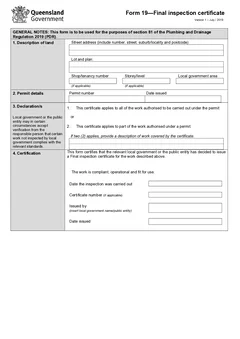
Tradie Forms: prepare QLD Form 19 on the official PDF layout, then keep the final inspection certificate with the permit, inspection notes, and owner completion record.
A Form 19 is most useful when it is easy to find later. The certificate may be wanted by the owner, permit holder, builder, local government, public sector entity, office admin, or a future service crew - and rarely by the person who filed it.
Saved as a loose PDF, the job story gets hard to follow. Stored with the permit, inspection record, scope evidence, and completion notes, anyone can see what was certified and when.
This covers what happens after the certificate exists. For preparing it, see the Form 19 certificate guide.
Prepare QLD Form 19, or browse QLD plumbing forms. Browse the plumbing forms hub for job and safety paperwork that travels with you.
Why the scope is the record keeping problem
Business Queensland says Form 19 is used by the local government or public sector entity to certify that permit work is compliant, operational, and fit for use, and that it can be issued when all work under the permit, or a distinct part of it, is complete.
That distinction is the whole filing challenge. On staged work - a development with several dwellings, a commercial job handed over by area, a permit reaching completion in pieces - an unlabelled part-work certificate reads exactly like a whole-job one.
Get it right and the owner understands what was certified, the permit holder can show what stage was reached, the builder can close out a dwelling, the office can answer certificate questions, and future work starts from the right permit history.
What should you keep with the Form 19?
Permit and amendments
Keep the original permit and any amendment with the certificate, and check that the permit number and date issued match.
Where an amendment changed the scope, read the certificate against the final permit record rather than an earlier one, and add a short note pointing to the right version. The note does not need to repeat the permit - it needs to stop someone reading the wrong one.
Inspection details
Keep inspection booking records, outcome notes, and correspondence from the issuing authority. The certification section records the inspection date, certificate number where applicable, issuing authority, and date issued, and where those came from council or a public sector entity the source email or portal note belongs with the file.
The certificate tells you the result. The inspection notes explain how the job got there. Keep both.
Evidence for a part-work scope
Where the certificate applies to part of the work only, keep enough context to show which part: stage plans, unit or townhouse numbers, area descriptions, photos or inspection notes, builder completion notes, and any authority correspondence about partial certification.
That way "part of the work" does not become a mystery.
Related certificates and declarations
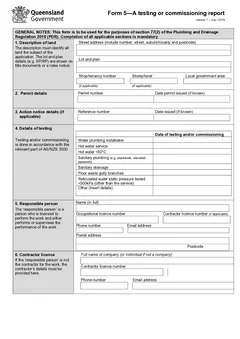
Depending on the job, related records may include QLD Form 3, QLD Form 5, QLD Form 9, QLD Form 14, or QLD PDR Form 12. Keep them together so the job history reads in order.
How should you name the file?
Use a filename that tells the story without anyone opening it.
Include the form, the site or permit reference, the scope, and the date. Then add one short completion note - "issued for all work under permit 12345", "issued for townhouse 3 only", "received from council and attached to job" - so the next person understands status without opening every file.
The close-out check
Before the job is marked complete:
- The certificate is in the correct job folder
- Permit number and issue date match the permit
- Inspection date and issue date are both correct and not transposed
- Issuing authority is correct, and the certificate number is included where applicable
- All-work or part-work scope is clear in the document, the filename, and the job note
- Part-work descriptions are backed by notes, plans, or correspondence
- Owner, permit holder, and builder received it where the job process requires
- Related forms, photos, and inspection notes are stored nearby
This is practical admin rather than legal advice - check current Queensland and local government requirements for the job.
Wording the owner and builder copy
Keep it plain. Identify the site, the permit reference, whether the certificate covers all work or part of the work, and attach it. Use the same wording for both recipients:
- "Attached is the QLD Form 19 final inspection certificate for all work under permit 12345."
- "Attached is the QLD Form 19 final inspection certificate for townhouse 3 only under permit 12345."
Short, direct wording avoids the worst kind of paperwork problem: two people reading the same certificate differently.
Before you archive the job
Open the final certificate beside the permit and the inspection note. Check the address, permit reference, all-work or distinct-part description, and authority details agree. Save the source email or portal confirmation showing where the issued certificate came from, and keep the issued version clearly separated from any drafts.
That check lets a new office contact see what was certified, which part of the permit it covered, and who received it, without relying on the original crew's memory.
Who asks for it after the job closes
The certificate stops being your document the moment the job finishes, and the people who ask for it later are rarely the people you dealt with.
A buyer's conveyancer wants it during a sale, often years afterwards, and usually with a settlement date attached. An insurer asks for it after a claim, wanting to establish that the work was inspected and certified. A subsequent builder doing further work on the property wants to know what was signed off and by whom before they open anything up. Occasionally the owner themselves asks, because their own copy went missing in a house move.
None of those people will accept "it was definitely done". They want the document, and they want it quickly. That is the whole argument for filing it properly at the time rather than trusting that it can be reconstructed.
It is also the argument for keeping your own copy rather than relying on the builder or the certifier holding one. Businesses close, staff leave, and email archives get purged. Your copy is the one you control.
When the certificate is queried later
Occasionally the document itself comes into question, usually because something was found that the certificate appears to cover.
The certificate on its own rarely settles that. What settles it is the supporting material: the inspection notes, the photographs, and the scope wording that shows what was and was not included. A certificate with a precise scope and a photo set behind it answers the question. A certificate with a one-line description and nothing behind it invites an argument you cannot win on paper.
This is why the scope wording matters more than it looks. "Final inspection" is a label. A description that names what was inspected, and where the boundary sat, is a defence.
If a query does arrive, resist the urge to reissue a corrected certificate quietly. If something genuinely needs amending, do it as a dated amendment that explains what changed and why, and keep the original. A file with a visible correction trail reads as honest. A file where the only copy has been edited reads as something else.
Next steps
Tradie Forms organises Form 19 into property, permit, declaration, and certification sections, saves issuing authority details for repeat work, flags missing fields, and previews the official layout. It does not inspect the work, issue the certificate, or decide whether a certificate can be issued - the licensed tradie, permit holder, owner, and issuing authority still check the work, the process, and the finished document.
See common Form 19 mistakes for the errors worth catching before filing, or the QLD plumbing forms list for the wider set.
Official references
Check the Business Queensland inspection certificates guidance, the Business Queensland plumbing forms page, the current QLD Form 19 PDF, and the Plumbing and Drainage Regulation 2019.