Most switchboard condition reports are written to win an upgrade job. That is a fair reason to write one. But the reports that end up mattering most are the ones read months later, by someone who was not there, after something went wrong.
An assessor working a claim is trying to establish two things: what condition the board was in, and what the owner was told about it. Everything they read is aimed at those two questions. Writing your report knowing that makes it better at its original job too, because a report that survives scrutiny is also more persuasive to a hesitant client.
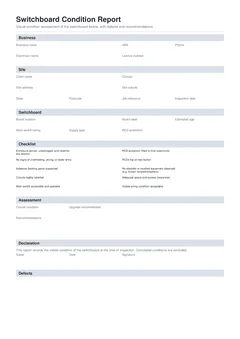
Build the report on site in the switchboard condition report. For the field-by-field walkthrough, see the switchboard condition report template guide. Browse more electrical forms for the rest of your job records.
The date and the board identity
A condition report is a statement about one board on one day. Both halves of that need to be unambiguous.
The date is checked first because it anchors everything. A report dated the week before a fault carries different weight to one dated eighteen months earlier. Where an inspection ran across more than one visit, the dates should reflect that rather than collapsing to whichever day the report was typed up.
Board identity matters just as much on any site with more than one board.
Record the location, the designation used on site, and the rating plate details where they exist.
If the labelling on site is wrong or missing, that is itself worth recording. An unlabelled board is a real finding, not an inconvenience to work around.
As-found condition, before you touch anything
The most useful section is the one describing the board as you found it.
That means before covers came off, before anything was reset, and before any make-safe work. Once you have worked on a board, the original state exists only in your record, and reconstructing it later is exactly the kind of evidence that does not hold up.
Practical detail belongs here: whether the board was accessible, whether it was locked or open, whether the enclosure was intact, whether there were signs of heat, moisture, rodent activity, or previous unqualified work. Signs of overheating around terminations are worth their own line, because they are the single most common thread running back from a later fault.
Older boards carry their own hazard. WA Government guidance covers asbestos safety in switchboard panel repair work, and where a board is old enough that asbestos-containing panel material is possible, the fact you identified and handled that is part of the record too.
Are defects and recommendations separated?
This is where most reports go soft, and it is the thing an assessor notices immediately.
A defect is something wrong with the installation as it stands. A recommendation is work you propose to improve it. When the two are blended into one list, the client cannot tell what needs attention now from what would be nice eventually, and later nobody can tell what they were actually warned about.
The separation should be visible in the document, not just implied by wording. A defect list and a recommendations list, each with its own items. A defect that is also urgent should say so plainly rather than relying on the reader to infer it from technical language.
Blending has a cost in the original job too. Clients who cannot see the difference between urgent and optional tend to treat the whole report as a sales document and defer all of it.
Photos as evidence
A described defect is a claim about what you saw. A photographed defect is something a third party can assess without going back to site.
The set worth capturing on any board of consequence is small. The board as found, before work. Each significant defect close enough to be legible. The rating plate or labelling. Anything you are recommending replacement of. A wide shot showing the board in its surroundings, which answers questions about access and environment that written descriptions handle badly.
Photos need to be tied to the report rather than living separately in a camera roll. A photo that cannot be connected to a specific board on a specific date is very close to no photo at all. Naming them against the job reference at the time is the habit that makes this work.
What the client was told
For anything that ended in a dispute, this is the section that carries the most weight.
The question is rarely whether the electrician noticed a problem. It is whether the owner was told, in a form they could understand, and whether that can be shown. A verbal warning delivered in a driveway is real, and it is also nearly impossible to demonstrate a year later.
Write the recommendation in language the client can act on. "Board does not comply with current requirements" is technically true and practically useless to a landlord deciding whether to spend money. "No residual current protection on the power circuits. Recommend upgrade. This is the protection that reduces the risk of electric shock from faulty appliances or damaged leads" gives them something to decide about.
Then make sure the report actually reaches them and that you keep a copy. Handing over the document, and having a record that you handed it over, is the part people skip.
Scope: what you did not look at
A report says as much by what it excludes as by what it covers, and the exclusions have to be written down.
On a site with a main board and two sub-boards, a report that inspected only the main board and does not say so reads as a statement about the whole installation. If a fault later appears in a sub-board you never opened, the silence works against you.
The same applies within a single board. If covers could not be removed because the board could not be isolated, or because a tenant refused an outage, that is a limit on what you assessed. Write it as a limit rather than leaving the affected section blank, because a blank cell reads as nothing found rather than nothing checked.
Access conditions belong here too. A board behind stored goods in a tenancy, or one that could only be reached by ladder in a stairwell, is a board you inspected under constraints. Recording that protects the report and gives the client a reason to fix the access.
Environment and what sits around the board
Assessors ask about the surroundings because a lot of switchboard failures start outside the enclosure.
Note whether the board is exposed to weather, whether there is water ingress or evidence of past ingress, and whether the location is subject to dust, salt air, or vibration. In agricultural and coastal work these are the conditions that explain deterioration that would otherwise look like neglect.
Note what is stored near it. Boards in cupboards that have become storage, boards behind stock in a retail tenancy, or boards with combustible material stacked against them are all findings worth writing down, and all of them are cheap for the client to fix once they know.
Clearance and access for safe working is the last piece. If someone cannot stand in front of the board and work safely, that is a defect in its own right rather than an inconvenience.
The gaps that weaken a report
A few patterns undermine an otherwise reasonable report.
Everything marked as compliant, with no detail. A report with no findings and no supporting observation reads as a form that was filled in rather than an inspection that happened.
Technical shorthand with no plain-language equivalent. If the person who has to act on the report cannot understand it, the report has not done its job regardless of its accuracy.
Undated recommendations with no priority. A list of six items with no indication of what matters most invites the client to do none of them.
No statement of scope. If you inspected the main board and not the two sub-boards, saying so protects both parties. Silence on scope reads as a claim about the whole installation.
Where the form helps
The switchboard condition report walks the inspection in the order above, so the as-found condition is captured before the defect list rather than after it. Defects and recommendations are separate sections, which is what keeps the two from blurring, and photos attach against the job rather than sitting loose on a phone.
Your business and licence details are saved and reused, the form flags missing fields before download, and you preview the entries on the report layout before producing the finished PDF for the client and your own records.
Tradie Forms maps your entries onto that layout. The licensed electrician remains responsible for the inspection, the findings, the recommendations, and checking the downloaded PDF before it goes to the client.
Related reading: the switchboard condition report template guide for the field detail, and the electrical defect notice template guide for recording an unsafe installation.
Official references
Check AS/NZS 3000:2018 at the Standards Australia store for the Wiring Rules, AS/NZS 3019:2022 for periodic assessment of electrical installations, the WA Government switchboard panel repair and asbestos safety fact sheet for the hazard in older boards, and the Energy Safe Victoria electrical safety checklist for inspection points. Requirements and licence conditions vary by state, so confirm what applies to your work before issuing a report.