You are on a job, you open a switchboard or pull down a light fitting, and you find something that is not yours to fix today but is not safe to leave without a word. Deteriorated rubber cabling, no RCD protection, a board that was never earthed properly. You did not cause it, but you have seen it, and once you have seen it you carry some of the risk if nothing is written down. An electrical defect notice is how you put that fault on the record, tell the client in plain terms, and close your part of the job cleanly.
This guide covers what an electrical defect notice does, what belongs on it, and how to complete one on site so the client is left with a clear document and you are left with a copy that stands up later.
If you need to write one up today, open the electrical defect notice form. Browse more electrical forms, read how defects tie back to certification in the electrical installation defects and CCEW reporting guide, or use the switchboard condition report guide when the job starts with a visual assessment of the board.
What is an electrical defect notice?
A defect notice is a written statement that an electrical installation, or part of it, is unsafe or does not meet the standard. It is not a certificate that the work is compliant. It is the opposite. It says something is wrong, here is where it is, here is how serious it is, and here is what needs to happen next.
The measuring stick is AS/NZS 3000, known as the Wiring Rules. Standards Australia describes it as the technical rules that help electricians design, construct, and verify electrical installations, setting the minimum requirements for safety of persons from fire and electric shock. Because state and territory electrical safety legislation references the Wiring Rules, they are legally enforceable, not just good practice. When you write that an installation is non-compliant, that is the document you are measuring it against.
Regulators treat the same idea in their own paperwork. Energy Safe Victoria splits installation defects into technical and unsafe, and an unsafe defect is one where the installation has to be isolated from supply or a circuit disconnected. That two-way split, safe enough to note versus dangerous enough to isolate, is the same judgement you are making when you rate a defect on this notice.
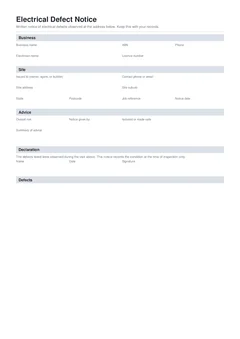
Business and electrician details
The notice starts with who is issuing it. Your business name, ABN, the electrician's name, licence number, and a contact phone number go at the top. This is not filler. If the client acts on your notice, gets a quote, or has an inspector look at the work later, the first question is who found this and are they licensed to say so.
The licence number matters most. A defect notice is a licensed person's assessment of an installation, so the number is what backs your name against the finding. Put your logo on it if you have one, so the client can see at a glance whose document it is when it turns up in their file months later.
Because these details are the same on every job, they are worth saving once and reusing rather than retyping the licence number from memory each time.
Who should receive the defect notice?
The site section records who the notice is issued to and where the defects were found. Issued-to is the owner, the property manager, the head contractor, or whoever is in control of the installation. Add a contact name and number, a job reference if you use one, and the full address of the site.
Getting the issued-to right is what makes the notice actionable. State electrical safety laws place obligations on the person in control of unsafe electrical equipment, so the notice needs to name the person who can actually do something about the fault. Handing an unsafe-wiring notice to a tenant who cannot authorise repairs is not the same as putting it in front of the owner or manager who can.
The address ties the notice to a specific installation. If a property has multiple boards, meters, or buildings, be specific enough that anyone reading the notice later knows which installation you are talking about.
Recording each defect
This is the core of the notice, and where a vague entry causes the most trouble. Each defect gets its own line with four things: what it is, where it is, a risk rating, and where the risk is high, a recommendation.
Energy Safe Victoria's guidance on documenting defects is a good rule to borrow. Descriptions should be accurate, legible, and in plain English, and should name the defective item, its location, and the detail of the defect.
The risk rating is the part that drives everything downstream. This notice uses four levels:
Low. A minor non-compliance worth noting but not urgent. Record it so it is on file and does not get forgotten.
Medium. A fault that should be repaired but does not present an immediate danger, such as an installation with no RCD protection on power circuits.
High and extreme. A fault that carries a real risk of fire or electric shock. These are the ones that usually need the circuit isolated, and on this notice a high or extreme defect requires a recommendation before you can finish. That rule exists so a serious fault never leaves site without a written next step attached to it.
Photos carry weight here. A picture of the perished cabling or the unearthed board attached to the defect line means the client, the next electrician, and an inspector all see the same evidence instead of relying on your description alone.
Overall risk and made-safe status
After the individual defects, the advice section pulls the job together. You record the overall risk for the installation and, just as important, the made-safe status: what state you left it in when you walked away.
The made-safe options map to the real decisions you make at the board:
Isolated and tagged out. You cut supply to the unsafe circuit and tagged it so no one re-energises it before repair. This is the expected outcome for an unsafe defect.
Made safe, repair required. You did enough to remove the immediate danger but the installation still needs proper repair.
Left in service, monitor. The installation is still live. If you choose this against a high or extreme defect, you are making a decision that needs checking before you issue the notice, because you are recording that a serious fault was left energised.
No immediate hazard. The defects are noted but nothing needed isolating on the day.
Write a short advice summary in your own words. This is where you tell the client, plainly, what you found and what to do about it. Energy Safe Victoria's sample defect letter takes the same approach: it names the unsafe wiring or equipment, urges correction by a licensed electrical contractor, and asks for a certificate of electrical safety once the repair is done. Record how the notice was given, whether that was in person on site or sent through afterwards, so there is no argument later about whether the client was told.
Signing the notice
The declaration is you standing behind the assessment. Your name, the date, and your signature go on last, once the defects, ratings, and advice are all filled in and correct. Signing first and filling in later is how a rating gets missed or a recommendation gets left off a high-risk defect.
The signature is a licensed person's statement that this is what was found and this is the risk. It should only go on when you are prepared to defend every line above it. If a defect is left in service, be doubly sure the record is complete before you sign, because that is the notice most likely to be looked at again.
How Tradie Forms helps
Tradie Forms turns the defect notice into sections you work through one at a time that follow the order above. You add each defect with its location, risk rating, recommendation, and photos, set the overall risk and made-safe status, then complete the declaration, all on your phone at the board.
Your business, electrician name, and licence details are saved and reused, so the top of every notice is filled without retyping. The form checks the completion rules before you download: it holds you to a risk rating on every defect, a recommendation on any high or extreme defect, and a name, date, and signature before the notice is finished. You preview your entries mapped onto the official PDF layout, then download a signed PDF to hand the client and keep with the job.
Tradie Forms maps your entries onto the layout and catches missing fields. The licensed electrician still checks the installation, the risk ratings, the advice, and the downloaded PDF before it goes to the client.
Start the electrical defect notice form at the board, or browse more electrical forms for the rest of your paperwork.
If you are also pricing the fix, see electrical defect notice or quote for keeping the two documents apart.
Official references
Check the Standards Australia Wiring Rules (AS/NZS 3000) page for the standard electrical work is measured against, Energy Safe Victoria electrical installation defects for how defects are categorised and documented, the Energy Safe Victoria sample installation defect letter for how a defect is communicated to a client, and SafeWork NSW electrical inspection and testing for how that state frames inspection and testing. Electrical safety law and the responsible regulator vary by state and territory, so confirm the requirements that apply where you work and your own licence conditions before you issue a notice.