You have walked a site cutting the supply to each emergency and exit fitting, timing the batteries, and marking which ones held and which ones dropped out early. The building manager wants proof the routine service was done and that the failures are being dealt with. That proof is the emergency lighting test register, and it needs every fitting on it with a result, a date, and a next step. Get it complete on site and the job is closed. Leave it as scribbles on a job card and you are back at a desk hours later trying to remember which fitting in the back corridor failed.
This guide covers what AS/NZS 2293.2 asks of the six-monthly service, and how to fill the register field by field so the record holds up when someone audits it.
If you are writing up a service today, open the emergency lighting test register and work through it fitting by fitting. Browse more electrical forms for the rest of your job paperwork. For residential alarm servicing, use the smoke alarm service record guide.
What does AS/NZS 2293.2 require?
Emergency lighting is the escape lighting and illuminated exit signs that keep an occupied building safe to leave when the normal supply fails. The National Construction Code requires those systems to be installed to AS/NZS 2293.1. Keeping them working is a separate job, and that is where AS/NZS 2293.2 comes in. Its full title is Emergency lighting and exit signs for buildings, Part 2: Routine service and maintenance, and it sets the inspection, testing, and maintenance procedures that keep the system in a state of readiness.
The interval most people know is the six-monthly one. Emergency lighting should be periodically inspected and electrically re-tested every six months, and that test includes a discharge test. The point of the discharge test is to prove the batteries, not just the lamp. The normal supply to the fitting is interrupted so it runs on its battery, and the fitting has to stay lit at the required level for the full rated duration. WorkSafe Victoria describes that as maintaining the required level for at least one hour after the loss of normal lighting.
A fitting that lights up when you press a test button but drops out after ten minutes has failed the service, even though the lamp works. That is the whole reason the register records how long the fitting sustained illumination, not just a pass or fail tick. The register is the document that shows the discharge test actually happened and what each fitting did.
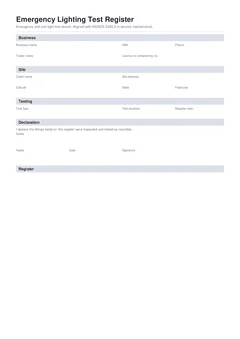
Business and tester details
The register opens with who did the work. Your business name and the tester name are both required before you can finish the record, because the register is only as good as the person who can stand behind it.
The tester on an emergency lighting service is a competent person, usually a licensed electrician or a fire safety technician. The register carries your business name, the tester name, and a licence number so anyone reading it later can see who serviced the system. If you run these jobs regularly, this is the block you do not want to retype on every site. Save the business, tester, and licence details once and prefill them, then check they are current rather than typing them fresh each time.
Site and client details
Next is where the testing was done and who it was done for. The register records the client name and the site address so the record ties to one building.
This sounds trivial until a managing agent looks after a dozen properties and needs to file your register against the right one. A register with the wrong suburb or a half-written address is hard to match to the building it belongs to. Get the client and site address right at the start, because the rest of the record hangs off it, and the finished document is named from these details plus the register date.
How long does the discharge test have to run?
Before you get into the fittings, the register sets out what kind of service this is. You nominate the test type, the test duration in minutes, the standard the service is being carried out against, and the register date.
The test type and duration matter because they frame every result that follows. If this is the six-monthly discharge test, the duration is what the fittings were run down over, and each fitting result is read against that. Recording the standard basis as AS/NZS 2293.2 makes clear which service regime the register is documenting, so there is no confusion about whether this was a quick lamp check or the full discharge service.
The register date is the date of the service. It is the date the next service is measured from, so it needs to be the day you actually did the work, not the day you typed up the paperwork.
The register: every fitting logged
This is the heart of the record. Each emergency and exit fitting on the site gets its own line, and every line needs to be complete before you can download.
For each fitting the register captures:
Identity and location. An ID or reference for the fitting, a short description, and where it sits on the site.
Type and sustained duration. Whether it is an emergency luminaire or an exit sign, and how long it sustained illumination on battery during the discharge test. The sustained duration is the evidence that the fitting held for the required time, so it is a number, not a tick.
Result and test date. Whether the fitting passed or failed, and the date it was tested. A pass says the fitting held to the required duration. A fail says it dropped out early or did not perform.
Next-due date or failed-item action. A passed fitting needs a next-due date so the service cycle keeps running. A failed fitting needs the failure details and the action being taken, so the problem is on the record with a plan against it rather than buried in a list of results.
Do not leave the sustained duration blank because the fitting "obviously" held. A blank makes the line unverifiable, and an unverifiable line is exactly what an auditor picks on. Every applicable field on every fitting needs a value before the register is worth anything.
Declaration and sign-off
The register closes with your sign-off. It carries any notes, the name of the person declaring the service, the date, and a signature. Name, date, and signature are all required before you can download.
The declaration is you standing behind the whole record. It should only go on once every fitting line is complete and correct, because signing first and filling in the results later is how blank durations and missing next-due dates slip through. Notes are the place to flag anything that needs a return visit, a part on order, or a fitting that could not be reached on the day.
Common register mistakes
These are the ones that turn a done service into a return trip or a record that will not stand up.
Recording a pass without the duration. A pass with no sustained-duration figure does not show the discharge test happened. The duration is the evidence, so it has to be on the line.
Leaving failed fittings without an action. A fail with no failure detail and no next step is just a problem with no owner. The register needs the action so the failed unit is being dealt with, not forgotten.
No next-due date on passed fittings. Without a next-due date the six-monthly cycle stops running and the site drifts out of service. Set the next date as you close each fitting.
Writing it up later. Filling the register at a desk from memory is how corridors get missed and durations get guessed. Complete it on site while the fittings and the timings are in front of you.
Most of these come down to the same habit. The register gets written up away from the fittings, hours after the service, and the detail is already gone. The fix is to log each fitting at the fitting.
How Tradie Forms helps
Tradie Forms turns the emergency lighting test register into sections you work through one at a time that follow the order of the service. You set the test type, duration, and standard basis once, then add each fitting with its ID, location, type, sustained duration, result, and dates as you work through the site.
Your business, tester, and licence details are saved and reused, so the contractor and tester fields are not retyped on every job. The form checks for missing fields before you download, which is what catches the passed fitting with no duration or the failed fitting with no action before an auditor does. You preview the entries mapped onto the official PDF layout, then download the finished register to leave on site and hand to the building manager.
Tradie Forms maps your entries onto the layout aligned with AS/NZS 2293.2. The licensed tester still does the actual inspection and discharge test, and still checks the readings and the downloaded PDF before it goes on the record.
Start the emergency lighting test register at the board, or browse more electrical forms for the rest of your job paperwork.
If you arrange these services rather than perform them, see the six-monthly checklist for facility managers and what fire inspectors look for in an emergency lighting log.
Official references
Check AS/NZS 2293.2:2019 at the Standards Australia store for the routine service and maintenance standard, the National Construction Code Part E4 for how emergency lighting and exit signs are required and referenced to AS/NZS 2293.1, WorkSafe Victoria on emergency lighting for the six-monthly test and record-keeping expectations, and the Queensland fire safety inspection and maintenance guidelines for how the service and records are treated. Requirements and building conditions vary, so confirm the current standard and your obligations for the specific building before you certify the service.