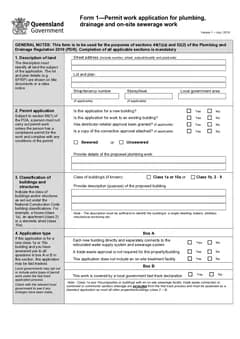
Tradie Forms: prepare a QLD Form 1 permit work application on the official PDF layout, working through land details, proposed work, building class, soil reports, fixtures, owner details and the declaration in one pass.
A Form 1 rarely fails because the plumbing is wrong. It stalls because the land is described loosely, the proposed work could mean anything, or a soil report everyone assumed was attached is not.
The form itself is not hard. The problem is that its answers are scattered across plans, a rates notice, the builder's messages and the owner's memory. Gather them once, while the site and the customer are still in front of you.
Start QLD Form 1, or browse QLD plumbing forms.
What is QLD Form 1 used for?
Form 1 is the permit work application for plumbing, drainage and on-site sewerage work. Business Queensland lists it under the plumbing and drainage forms, and the official PDF says it is used for sections 44(1)(a) and 52(2) of the Plumbing and Drainage Regulation 2019, with completion of all applicable sections mandatory.
In site terms, it is the cover sheet for the work you are asking local government to assess. Business Queensland says permit work needs a permit before it starts, that you must comply with the permit and its conditions, and that the work is inspected against the relevant plumbing laws, the permit terms and the plans that came with the application.
Not every job is permit work. Queensland plumbing and drainage work can also be notifiable, minor or unregulated depending on what is being done. If the job sits on the edge, check the current Queensland guidance, the regulation and the relevant local government process before lodging. A online form completes the PDF layout; it does not decide whether your work is permit work.
Description of land
The form asks for a description of all land the application covers. That usually means the street address, lot and plan, shop or tenancy number, storey or level, and local government area where relevant. The form notes that lot and plan details appear on title documents or a rates notice.
A job nickname is not a land description.
Units, tenancies, mixed-use sites, rural blocks and new subdivisions all need the extra identifiers.
Boundary suburbs, new estates and commercial properties also make the local government area easy to get wrong. The LGA on the form should match the land subject to the application, not the billing address or the builder's office.
Permit application details and proposed work
This section asks whether the application is for a new building or work to an existing building, whether distributor-retailer approval has been granted where applicable, whether a copy of the connection approval is attached where applicable, and whether the site is sewered or unsewered.
Then it asks what you propose to do. This is where most applications get thin. "Plumbing work" could describe any job in Queensland. Descriptions that let council match the form to the plans read more like these:
- New sanitary drainage and water service for class 1a dwelling
- Alter existing sanitary drainage for tenancy amenities upgrade
- On-site sewerage system installation for unsewered rural dwelling
- Water supply connection and fixture installation for commercial tenancy fit-out
The goal is not a long description. It is a description specific enough to identify the location and scope.
Building classification and application type
Form 1 asks for the building class under the National Construction Code, such as class 1a, class 2 or class 10a. If the class is not obvious, confirm it against the building approval documents rather than guessing. The form also asks for a plain description of the proposed building, with examples such as a single dwelling, bakery, distillery or mechanical workshop.
The form then includes fast-track questions for certain new class 1a or 10a buildings. The PDF notes that local governments may opt out of the fast-track process or include extra types of permit work, and that you should check with the relevant local government for changes.
Slow down here. The form asks specific questions about direct and separate connections to reticulated water and sewerage, trade waste approval, on-site treatment facilities and local government fast-track declarations. If the job is unsewered, involves trade waste, combined or community sanitary drainage, or an on-site sewerage facility, read the form notes and check the council process before selecting a pathway.
What attachments does the application need?
Attachments are the most common reason a complete-looking Form 1 stalls. For sanitary drainage work, the form says a copy of the soil classification report must be supplied, and for classes H, E and P an articulation report must be supplied as well. Business Queensland's supporting documents guidance says extra documents may be needed depending on the proposed work and the building class.
Before lodgement, confirm what is actually attached rather than accepting "the builder has that":
- Current plan set, matching the work description
- Soil classification report
- Articulation report where the soil class requires it
- Site and soil evaluation report for on-site sewerage where required
- Connection approval or distributor-retailer evidence where applicable
- Owner authorisation or project approval notes
Fixtures, water supply and wastewater
The fixtures section asks for the number of fixtures to be installed, including sinks, basins, urinals, baths, WCs, showers, laundry tubs, other fixtures and the total. Count from the latest plan set, not from memory or an old quote. If the builder has issued revised drawings, update the form before it is lodged.
The water supply section captures new connections, alterations or disconnections, and whether the purpose is domestic, industrial, commercial or fire. The Form 1 PDF notes that some South East Queensland local governments cannot grant a permit unless the distributor-retailer approval position is satisfied for relevant water infrastructure work.
For unsewered areas, the wastewater disposal section captures treatment plant details, approval numbers, environmentally relevant activity information where applicable, bedrooms or flow details, and whether the site and soil evaluation report is attached. A missing treatment plant approval number can hold up an application even when the plumbing design is sound.
Owner and applicant details
Form 1 has separate owner and applicant blocks. The applicant does not have to be the owner, but the applicant is responsible for ensuring the information is correct and that they are authorised to manage the application on the owner's behalf.
Get the company name, contact person, phone, mobile and email right before the declaration is signed. Saved details help with repeat lodgements, but a licence number or company name carried over from an old job makes a finished PDF look careless. Check them each time.
A clean pre-lodgement check
- Confirm the land description against title documents, a rates notice or the plans
- Confirm the local government area for the land, not the office
- Write a proposed work description that matches the plan set
- Confirm the building class and building description
- Answer the fast-track questions from the form, not from habit
- Confirm soil class, articulation and site and soil evaluation requirements
- Count fixtures from the current drawings
- Complete water supply and wastewater sections where they apply
- Check owner and applicant details, then read the declaration
- Review the finished PDF, then lodge it through the pathway the council accepts
Council processes vary. Some use online portals, some ask for extra documents, and some have local lodgement instructions. Prepare the Form 1 cleanly, then follow the relevant council's process.
Next steps
Start QLD Form 1 before lodgement, or browse QLD plumber forms. Browse the plumbing forms hub for job and safety paperwork that travels with you.
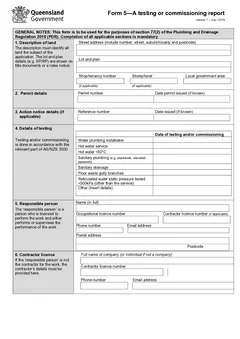
If the approved scope later changes, QLD Form 2 covers amendments and extensions - see the Form 2 guide. Where a specialist statement supports the application, see common Form 12 mistakes. For the stages after the permit, read the Form 5 testing or commissioning guide and the Form 19 final inspection certificate guide. The Form 1, Form 5 and Form 9 handover guide shows how the records pass between people, and the QLD plumbing forms list covers the wider set.
Tradie Forms maps your entries onto the Queensland Form 1 layout and lets you preview it before you download the finished PDF. It does not lodge the application, decide whether your job is permit work, or approve anything. The applicant and the licensed person remain responsible.
Official references
For current requirements, check the Business Queensland plumbing forms page, permit applications for plumbing and drainage work, supporting documents for permit applications, the Queensland Form 1 PDF, and the Plumbing and Drainage Regulation 2019.