Tradie Forms: finish the emergency after-hours certificate at the property so the network crew can reconnect, then lodge the online CoC once you are back. These guides help NT sparkies keep records straight; the same on-site habits apply as we add more Australian trade templates.
It is late, the power is off, and you have just made an installation safe after a fault. The customer wants their supply back on, and Power and Water will not reconnect the property to the grid until they have a certificate of compliance in hand. The problem is that the after-hours connection crew cannot see the online certificate system, so a certificate lodged in the portal does not help them on the night. That is exactly the gap the NT emergency after-hours repairs certificate of compliance fills.
This guide covers when the emergency form is the right one to use, who signs it, what each section asks for, and why you still lodge the online CoC afterwards so your records line up with the Electrical Safety Act 2022.
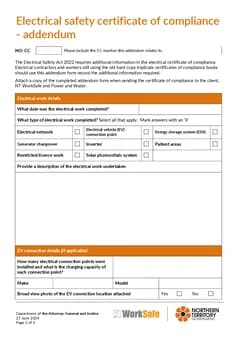
If you are closing out an after-hours job now, open the NT emergency after-hours repairs certificate of compliance. Browse the rest of the NT electrical forms, or if a standard CoC needs more room for detail, the NT electrical CoC addendum runs alongside it. The NT CoC addendum guide explains when the extra page is required for battery, EV, solar and inverter work.
When is the after-hours repairs CoC the right form?
The Electrical Safety Act 2022 and the Electrical Safety Regulations 2024 commenced in the Northern Territory on 1 July 2024. Under that framework an electrical contractor or worker who carries out electrical work completes a certificate of compliance that certifies the work was tested to be safe from electrical risk and complies with the Act and the standards it adopts, including the AS/NZS 3000:2018 Wiring Rules.
Most of the time that certificate goes through the online electrical safety certificate of compliance, or onto a hard copy triplicate CoC book bought from the Territory Business Centre. The emergency after-hours form is the exception. Its scope is limited to electrical workers or contractors who have completed emergency after-hours repairs at a property and need to provide a certificate of compliance to the network provider before they reconnect the property to the grid.
The reason is practical. NT WorkSafe says Power and Water connection crews working after-hours do not have access to the online CoC system, so a certificate sitting in the portal is invisible to the person standing at the pole. The emergency form gives that crew a document they can accept on the spot. If you carry the old triplicate CoC books, they do the same job. If you do not, this form is your after-hours option.
One thing the form makes clear is that it is not the end of your paperwork. It does not satisfy the requirements under section 41(4)(a) and (b) of the Electrical Safety Act 2022. In plain terms, giving the network provider this emergency certificate does not discharge your duty to give a proper CoC to the owner, occupier, and the person the work was for. That is why you resubmit the information through the online CoC once you are off site.
Customer and property details
The first block on the form is the customer. You record the customer name, and where the customer is a business, the primary contact name, plus a phone number and email. Then the property address, which the form defines as where the electrical work was completed. On an emergency job the caller and the site are usually the same, but not always, so keep the address tied to the actual installation you worked on rather than the account holder's postal address.
Getting this right matters more than it looks. When you resubmit through the online CoC later, the customer and property details are what tie the emergency certificate to the permanent record. A mismatch between the address on the night and the address in the portal is the kind of small gap that turns into a query weeks after the job.
Property owner where different from the customer
The next section is for the property owner, completed only if the owner is known and different from the customer. It captures the owner name and email.
This one comes up on rentals and managed properties. The tenant or a managing agent might be the customer who called you out, while the owner is someone else again. Section 41(4) of the Act requires the certificate to reach the owner and occupier as well as the person the work was performed for, so recording the owner here is what lets you close that loop when you lodge the online CoC. If the owner genuinely is the customer, you leave it blank.
Electrical repairs details
Here you record what you actually did. The form asks for the date the electrical repairs were completed and a description of the repairs undertaken.
Write the description for someone reading it cold. An after-hours fault, a made-safe, and a repair can blur together in memory by the time you are lodging the online version, so describe the fault you found and the work you carried out to make the installation safe and compliant. This is the same wording you will want in the online CoC, so a clear description now saves you reconstructing the job later.
Defects or non-compliance you did not repair
Emergency work is about restoring safe supply, not rewiring the house at 2am. The form recognises that with a defects section. It asks a direct yes or no question: were there any defects or non-compliances observed on the existing installation which were not repaired.
If the answer is yes, you provide details, and the form specifically asks you to include the standard and clause number for each non-compliance. That is where AS/NZS 3000:2018 gets cited by clause. Recording an unrepaired defect is not an admission that you left a job half done. It is you documenting the state of an installation you did not have the scope or the daylight to fully rectify, and flagging what the customer needs to have addressed. Leaving this blank when you did see a problem is the field that comes back to bite people, so note what you saw and where it sits in the standard.
The electrical worker declaration
The certification is split into two declarations, and the electrical worker is the first. You record the electrical worker name and licence number, then sign and date a declaration that the information provided is complete and correct, that you carried out all examinations and tests on the electrical installation work detailed on the certificate, and that the results satisfy the requirements of the Electrical Safety Act 2022.
That is the person who put hands on the work certifying the testing. Your licence number needs to be current and correct, because the declaration is a statement that you did the examinations and tests and stand behind the results. If you did not test it, it does not belong under your signature.
The contractor declaration
The second declaration is the contractor, or an authorised person acting on the contractor's behalf. It captures the contractor licence holder name, licence number, phone, and email, followed by a signature and date. The contractor declaration certifies that the information is complete and correct and that the contractor managed the electrical work detailed in the certificate, ensuring it meets the requirements of the Electrical Safety Act 2022.
On a one-person job the worker and the contractor may be the same licensed person completing both declarations. On a larger job the worker who carried out the repair and the contractor who holds the licence and manages the work are different people, and both need to be on the certificate. Interstate electricians should note that not holding an NT licence does not exempt you from issuing a CoC for work done in the Territory, so sort your authority out before you sign anything.
After the reconnection: lodge the online CoC
The emergency form gets the property reconnected. It does not replace the standard certificate. NT WorkSafe says it does not satisfy section 41(4)(a) and (b) of the Act, so you take the same job details and resubmit them through the online electrical safety certificate of compliance at the Territory Services site once you are back at a screen.
Section 41(4) sets the window. The certificate must be given within 20 business days of completing the work to the owner and occupier, to the person the work was performed for, and, where the work relates to the electricity network, to the network operator. Treat the emergency certificate and the online CoC as one job with two steps, not two separate pieces of paper, and use the same customer, property, repair, and defect details across both so the records match.
How Tradie Forms helps
Tradie Forms turns the emergency after-hours certificate into sections you work through one at a time that follow the official form: customer and property, property owner where different, repair date and description, the defects question with room for the standard and clause, and the two declarations for the electrical worker and the contractor.
Your licence and business details are saved and reused, so the worker and contractor fields are not retyped in the dark on every callout. The form flags missing fields before you download, which is what catches the blank defect note or an empty licence number before the network crew does. You preview the entries mapped onto the official PDF layout, then download a clean certificate to hand the connection crew and keep with the job. When you lodge the online CoC afterwards, the same details are already in front of you.
Tradie Forms maps your entries onto the official layout. The licensed electrical worker and contractor still check the work, the test results, and the downloaded PDF before it is issued.
Start the NT emergency after-hours repairs certificate of compliance at the property, or browse more NT electrical forms for the rest of your Territory paperwork.
Official references
Check the NT WorkSafe emergency after-hours repairs form page for the current form, NT WorkSafe certificate of compliance information for the CoC rules, and Territory Services issue an electrical certificate of compliance for the online lodgement. The Electrical Safety Act 2022 sets the certificate duties, and Power and Water electrical safety certificate of compliance covers reconnection. Requirements can change, so confirm the current form and your licence conditions before you certify a job.