You have opened up a job, found something that should not be there, and now you have two things to write: a record that the installation is defective, and a price for fixing it. Plenty of electricians write one document that tries to do both, and it usually does neither well.
The defect notice is a safety record. The quote is a commercial offer. They go to the same person, often on the same day, and they need to stay separate. This guide covers why, and how to write rectification items that work in both documents.
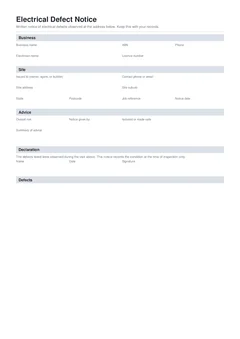
Record the finding in the electrical defect notice. For the field-by-field walkthrough, see the electrical defect notice template guide. Browse more electrical forms for the rest of your paperwork.
Which document are you writing?
The test is what the document is for.
A defect notice exists to record a fact and transfer knowledge. It says: this installation, at this address, on this date, has this problem, and here is why it matters. Its job is done whether or not you ever work on it again. Energy Safe Victoria publishes guidance on electrical installation defects and a sample installation defect letter, which is a useful shape for what this document does.
A quote exists to win work. It says: here is what I will do, here is what it costs, here is how long it takes. It is an offer you want accepted.
Those are different purposes and they carry different weight. A defect notice is stronger for being disinterested. The moment it also contains your price, a sceptical client has a reason to discount it, and a defect they might have acted on becomes a quote they will think about.
Make safe before you write anything
Where there is an immediate danger, the order is not negotiable. Isolate, or otherwise control the hazard, before you start on documentation.
Recording an unsafe condition and leaving it live is worse than not writing it down at all, because you have now documented that you knew. Deal with the hazard, then record what you found and what you did about it, including the isolation itself.
Reporting obligations for unsafe installations differ between states, and SafeWork NSW guidance on electrical inspection and testing is one starting point. Confirm what applies where you work rather than assuming, because the requirement to notify someone can sit alongside your obligation to the client.
Writing a rectification item
This is the part that carries across both documents, and it is where most of them fail.
A rectification item has four parts. What is wrong, in a sentence. Where it is, precisely enough for someone else to find. Why it matters, in language a non-electrician can follow. What the fix involves, at a level of detail that supports a decision.
Compare two versions of the same item.
The second version takes ninety seconds more to write. It is also the version that gets approved.
Do not hide the urgency in technical language
Electricians tend to describe defects accurately and neutrally, which reads to a client as "not urgent".
If something is dangerous, the document should say it is dangerous. Not with scare tactics or exclamation marks, but plainly. "This condition presents a risk of electric shock and should be rectified before the property is re-let" is clear without being theatrical. "Does not comply with AS/NZS 3000" is accurate and communicates nothing about consequence.
The same applies in reverse. If an item is a compliance improvement rather than a hazard, say that too. A client who discovers that everything on your list was described in the same urgent tone, and half of it turned out to be optional, will discount the next list entirely.
Priority, not just a list
A list of nine items with no ordering invites paralysis. Group them.
Three bands is usually enough: things that need attention now, things that should be dealt with in a defined period, and things worth doing when other work is happening. A client who cannot afford the whole list can still act on the top of it, which is a better outcome than deferring all of it.
Putting the same ordering in both the defect notice and the quote keeps them readable together. The client should be able to lay the two side by side and see that item three on one is item three on the other.
When the client is not the owner
A large share of defect notices are issued on properties where the person who called you does not own the building.
A tenant who arranged a repair cannot authorise a switchboard upgrade. A property manager may be able to approve minor work but needs owner sign-off for anything substantial. A builder on site has their own contractual chain back to a client you have never met.
Address the notice to the person who engaged you, and be explicit about who else needs to see it. "This notice should be provided to the property owner" is a sentence worth including, because it removes the ambiguity about whether the message was supposed to travel further.
Where the defect is a genuine hazard and the person in front of you cannot authorise the fix, say so clearly and record that you said it. The gap between a tenant being told and an owner being told is exactly where defects sit unaddressed for years.
Timeframes without guessing
Clients ask how long they have. It is a fair question and the honest answer is usually conditional.
Where an installation is unsafe, the answer is now, and the make-safe work you did on the day is part of that answer. Where the item is a compliance improvement, the sensible framing is around a trigger rather than a date: before the property is re-let, at the next fitout, when the board is next opened for other work.
Avoid inventing a deadline that has no source. A specific timeframe stated with authority, when nothing requires it, weakens the items that genuinely are urgent. If a requirement does set a period, cite where it comes from so the client can see it is not your preference.
Keeping the pair straight in the file
Both documents belong in the job record, along with evidence of what was sent and when.
The pattern that works is one job reference on both, filenames that say what each is, and the delivery record kept with them. If the notice was emailed, the email belongs in the file. If it was handed over on site, a note of that with the date is the next best thing.
Where the client accepts the quote, the completed work record goes in alongside, so the defect and its closure sit together. Where the client declines, that is worth recording too. A documented decline is a much better position than an unanswered notice, for both of you.
What a good pair looks like
The defect notice: dated, addressed, identifies the installation, lists what is wrong and why it matters, states what was made safe on the day, and names the electrician and licence. No prices.
The quote: same job reference, same item ordering, prices each rectification item, states what is included and excluded, notes any supply interruption or access needed.
Two documents, one conversation. The client can accept the quote or not, and either way the safety record stands on its own.
Where the form helps
The electrical defect notice keeps the notice focused on the safety record rather than drifting into pricing. Each defect is entered with its location, description, and the reason it matters, so the items come out in a shape a client can read and you can quote against separately.
Business and licence details are saved and reused, the form flags missing fields before download, and you preview the entries on the notice layout before producing the finished PDF for the client and the job file.
Tradie Forms maps your entries onto that layout. The licensed electrician remains responsible for the findings, any make-safe work, the reporting obligations that apply, and checking the downloaded PDF before it goes to the client.
Related reading: the electrical defect notice template guide, and what insurance assessors scan first in a switchboard report for the adjacent inspection record.
Official references
Check the Standards Australia Wiring Rules for AS/NZS 3000, Energy Safe Victoria on electrical installation defects and its sample installation defect letter for the shape of a defect communication, and SafeWork NSW electrical inspection and testing for inspection and reporting expectations. Defect reporting requirements and licence conditions vary by state, so confirm the obligations that apply to your work before issuing a notice.